
It’s another week here at BCB After Dark: the coolest club for night owls, early risers, new parents and Cubs fans abroad. We’re so glad you decided to stop by. Come on in out of the heat and cool off. We’ve still got a few tables available. The hostess can seat you now. The dress code is casual. Bring your own beverage.
BCB After Dark is the place for you to talk baseball, music, movies, or anything else you need to get off your chest, as long as it is within the rules of the site. The late-nighters are encouraged to get the party started, but everyone else is invited to join in as you wake up the next morning and into the afternoon.
The Cubs were off today.
Last week I asked you about your possible interest in Pirates right-hander Mitch Keller. Thirty-three percent of you would take him if the Pirates didn’t ask for anything other than a minor prospect in return. Another 27 percent of you would take him if he was a package deal with closer David Bednar.
Here’s the part where we talk about music and movies. You’re free to skip that if you want. You won’t hurt my feelings.
So last week I featured a performance of the “Mission: Impossible” theme performed by a French orchestra but written by the great Argentinian composer Lalo Schifrin. Since then, Schifrin passed away. (Free gift link) You can’t really blame me when a 93-year-old man dies, but I suppose in the world of baseball superstition, I mentioned him.
I’ll feature the “Mannix” theme tomorrow, but I actually wanted to show Schifrin himself playing piano tonight. So here he is in 1999 with Jon Faddis on trumpet, Tom Scott and David Sanchez on saxophone, Alex Acuna on percussion and being backed by the BBC Orchestra.
Some of you expressed interest in my thoughts on F1, the new summer blockbuster starring Brad Pitt, Damson Idris, Kerry Condon and Javier Bardem and directed by Joseph Kosinski. I’ll start by sharing a personal anecdote. When I was in college, I had a friend who had written a one-act musical that he asked me to direct. He was a music major and had little experience as a dramatist, so he was very nervous about the whole thing and kept asking me a lot of questions about the book, the sets and how I was planning to stage it. I told him to relax and that my goal as a director was to “Make sure none of that stuff gets in the way of the songs.”
I’m here to tell you that Kosinski does not let anything get in the way of the cars.
F1 has gotten a lot of attention for the Formula One racing scenes and how they spent two years on the circuit getting footage. Stars Pitt and Idris had to go to driving school and do some of the driving of the cars themselves, although they did drive Formula Two cars dressed up to look like Formula One. All this attention to detail delivers. There are plenty of terrific action driving scenes that will make the heart pump faster. The sound of the cars, alongside the Hans Zimmer score and the occasional classic rock song, shake the seats. The cars look undeniably cool. The action is fantastic. Anyone who has any interest in cool cars and auto racing will want to see the film in a theater for that.
The other thing that F1 has going for it is the easy-going movie star appeal of Brad Pitt. I said that Pitt is an old-time movie star in the best sense of the word, and that comes across pretty clearly here. Pitt has always had a bit of Steve McQueen “cool” in him, and in this film he channels that cool into everything his character Sonny Hays does. I can’t say that Sonny’s habit of training his reflexes of bouncing a red rubber ball against a wall is a tribute to McQueen’s baseball in The Great Escape, but I can’t say that it isn’t. It was certainly the first thing that came to my mind. Pitt acts, of course, but more importantly he just oozes movie star. It’s the stuff Hollywood was built on and it’s something Hollywood gets away from too often these days.
Pitt’s Sonny Hays is a former Formula One driver who was called “the best that never was” after a crash ended his career back in the nineties. Since then, he’s been traveling around the world as a driver-for-hire, filling in as a driver when needed and never staying in any one place for long. As a driver, he’s known for pushing both the car and the rules of the race to the limit. Sonny is also a man of action and few words, which is a big plus considering the average dialog of the movie.
Into his life comes his old Formula One teammate Ruben (Bardem), who is in charge of the worst team in Formula One. He needs a miracle—if the team doesn’t win one out of the next nine races, the board of directors will sell the team and everyone will be out of a job. He has a very talented young driver in Joshua Pearce (Idris), but sometimes he seems more interested in his Instagram followers than winning races. Ruben needs both a second driver and a mentor to Pearce.
So what we’ve got is two baseball movies going on here. There’s Bull Durham, where the grizzled old vet chases a dream one last time while he’s expected to mentor a rising star, and then there’s Major League, with a group of misfits have to come together to spite their owner (or in this case, the board) from selling/moving the team. Many reviewers have commented that the “F” in the title stands for “formula,” and yes, the plot of the film is a sports film formula. But there is a reason why dramatists return to these formulas again and again: they work. The plot of F1 is no great work of art, but it doesn’t get in the way of the cars. It’s a simple story and it helps that the cast is so good. Idris isn’t as well-known as Pitt, but he’s pretty good in the Tim Robbins role as the cocky young hot shot who doesn’t think Sonny has much to teach him, until events prove otherwise. Kerry Condon plays Kate McKenna, the “first female Formula One technical director” and, of course, she’s a love interest for Sonny. Her character is underdeveloped, but she does manage to give Kate a little bite and at least she doesn’t swoon at first sight of Brad Pitt. Second sight, maybe.
The dialog, on the other hand, is pretty poor. Unlike Pitt’s other sports movie Moneyball, which has dozens of lines that are still quoted all the time today, there is nothing in F1 that anyone will quote tomorrow. In fact, some of the lines were laugh-out-loud bad. (Example: “Do we have the car?” Answer: “We have the driver.”) It’s a good thing that Sonny communicates more in looks than words, although I will admit that his advice of “Drive fast” wasn’t a bad line. But there were several times I just groaned at the hackneyed dialog.
If you’re a big Formula One fan, I’m sure you’re going to find a lot of nits to pick. There were moments where I thought to myself “That’s not right,” although I’m not enough of an expert to say for sure. Certainly Formula One teams are a lot bigger than the twenty or so people they have at APXGP, the fictional team in the film. You’re also going to get a little tired of the way the film has characters unrealistically over-explain things. The film talks a lot about tires, for example. But you have to admit most of it is necessary. I watched this film with my wife, and she was able to understand what they were talking about even without knowing anything about Formula One. The film has to appeal to people who aren’t there for the racing but rather, like my wife, to look at Brad Pitt with his shirt off. She also praised Damson Idris’ looks. If you’re going to see F1 for hot guys, rest assured that the film goes out of its way to make sure you won’t get lost trying to follow the car stuff. And you will get the hot guys.
As far as a movie about cars and racing goes, the 2019 film Ford v. Ferrari is much better. The characters in that film are better developed and the plot isn’t as formulaic, as it was based on a true story. But Ford v. Ferrari doesn’t have the incredible action sequences of F1. Matt Damon has never achieved that kind of “cool” that Brad Pitt is able to put on screen. (And Christian Bale, while a great actor, gives off more “weirdo” vibes than anything.) But Ford v. Ferrari is a film for car lovers. F1 is more of a film for everyone.
Returning to the start of this piece, perhaps it’s best to think of F1 as a musical, but instead of songs, there are auto races. The plot is fine and the stars shine, but what you are really there for are the car races. In that sense, F1 belts out banger after banger.
One of a few trailers for F1: The Movie.
Welcome back to everyone who skips the music and movies.
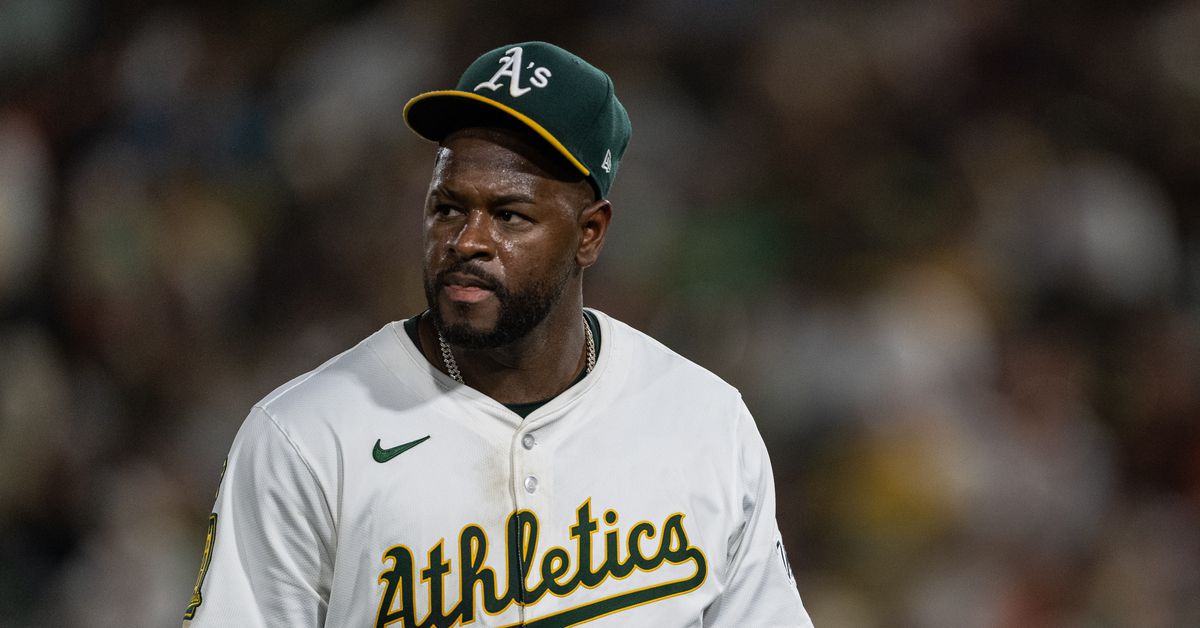
Athletics pitcher Luis Severino is unhappy. Before the season, he signed a three-year, $67 million deal with Sacramento, the biggest deal the franchise has ever handed out. At the time, he knew the team would be playing their games at the minor league Sutter Health Park in Sacto, but he doesn’t seem to have been aware of the reality of what that meant until after he signed the deal.
Severino has a lot of complaints about Sutter Health. (The Athletic sub. req.)
We don’t have that [a major-league stadium] at home right now. It’s not the same. It’s not the same atmosphere. We don’t have a lot of fans. Our clubhouse is in left field. So, when we play day games, we have to just be in the sun. There’s no air conditioning there, too. It’s really tough
Severino notes that when he pitched for the Yankees, he would spend the time between innings cooling off in the clubhouse. He simply can’t do that in Sacramento.
Probably Severino’s biggest complaint about Sutter Health is that it’s a bandbox. It has been the best hitters’ park in the majors this season, even better than Coors Field. And it shows in his home/road splits. At home, Severino has an ERA of 6.79. On the road, it’s 3.23.
To be fair, Severino isn’t the only one complaining about Sutter Health. Zach Wheeler called the mound “terrible” and Carlos Correa said the batter’s box was “the worst I’ve ever stepped in.”
The difference is that Wheeler and Correa don’t play for the A’s. On the one hand, you can say Severino is right. On the other hand, you can say the A’s are paying Severino $67 million to shut up about it. But Severino has always been an outspoken player who speaks his mind, so it’s not unexpected that he would be the one on the A’s to go public with these complaints. When confronted with them, he’s not backing down (The Athletic sub. req.) And to be sure, reporters are saying that other A’s players are saying the same stuff, but don’t want to be quoted. So you could argue that Severino is taking the lead for expressing what many (or most, maybe) other players on the team are feeling.
The A’s front office doesn’t want to hear this stuff. They’re stuck in Sacramento until they move to Las Vegas. Or Portland, as the latest rumor goes. Bob Nightengale reports that the A’s want to trade Severino and that it would be surprising if he’s still on the team in August.
So would you want the Cubs to trade for Luis Severino? On the positive side, he was mostly a pretty good pitcher in his time in New York, both with the Yankees and the Mets. He’s also been a good pitcher away from Sutter Health this season.
There’s one other factor in play here. The A’s would like have to send some money along with Severino. One big reason the A’s “overpaid” (in some estimates) for Severino this past winter wasn’t just that they had to in order to get someone to come to Sacto. The other big reason was that the A’s had to spend money to avoid a grievance that they were just pocketing their revenue sharing money instead of spending it on salaries, as they’re officially required to do.
On the other hand, there are some signs of aging on Severino. He doesn’t strike out nearly as many batters nor miss as many bats as he did with the Yankees. Maybe that’s feeling uncomfortable at the ballpark, but there was also a decline in strikeout rate in this time with the Mets. When he was a two-time All-Star in the Bronx, he was mostly relying on his four-seam fastball, which was 97-98 miles per hour. Now his fastball is down to 95-96—still good, but not nearly elite like it was previously. He’s also stopped throwing it anywhere near as often as he used to. Severino now throws his slider more often than his four-seamer, and he throws a sinker nearly as often. These are just trends continuing from his time in New York.
The one good thing with acquiring Severino is that the A’s are motivated sellers. It will depend on how many other teams are interested in trading for him, but they might let him go for cheap, just to be rid of the headache that he’s become complaining about the stadium. A mid-level prospect might be all that it takes.
So should the Cubs try to trade for Luis Severino?
Thanks to everyone for stopping by tonight. We’re always glad to spend the off-day with friends. Please get home safely. Recycle any cans and bottles. Tip your waitstaff. And join us again tomorrow night for more BCB After Dark.