
After getting nothing from first baseman Matt Mervis over the previous month, the Miami Marlins had finally run out of patience, designating him for assignment on May 30. It was a classic example of “addition by subtraction.” Mervis was acquired by the current Marlins front office and given an outsized role on the team, but they were still willing to concede that it wasn’t working out, and that’s commendable.
This was the Marlins’ opportunity to reward one of their young hitters with a promotion…and they went with Heriberto Hernandez?!
It was a baffling corresponding move. The 25-year-old outfielder was in the midst of a solid season with Triple-A Jacksonville, slashing .220/.319/.454 (108 wRC+) with a lot of hard-hit balls. However, he also had a career-worst 35.0% strikeout rate. Hernandez had a glaring swing-and-miss issue against both right-handed and left-handed pitching.
While I cannot truly speak for everybody, the overwhelming sentiment at the time was that the Marlins were wasting a roster spot on a player who was destined to fail. It took just a few games for Hernandez to begin proving myself and the other skeptics wrong.
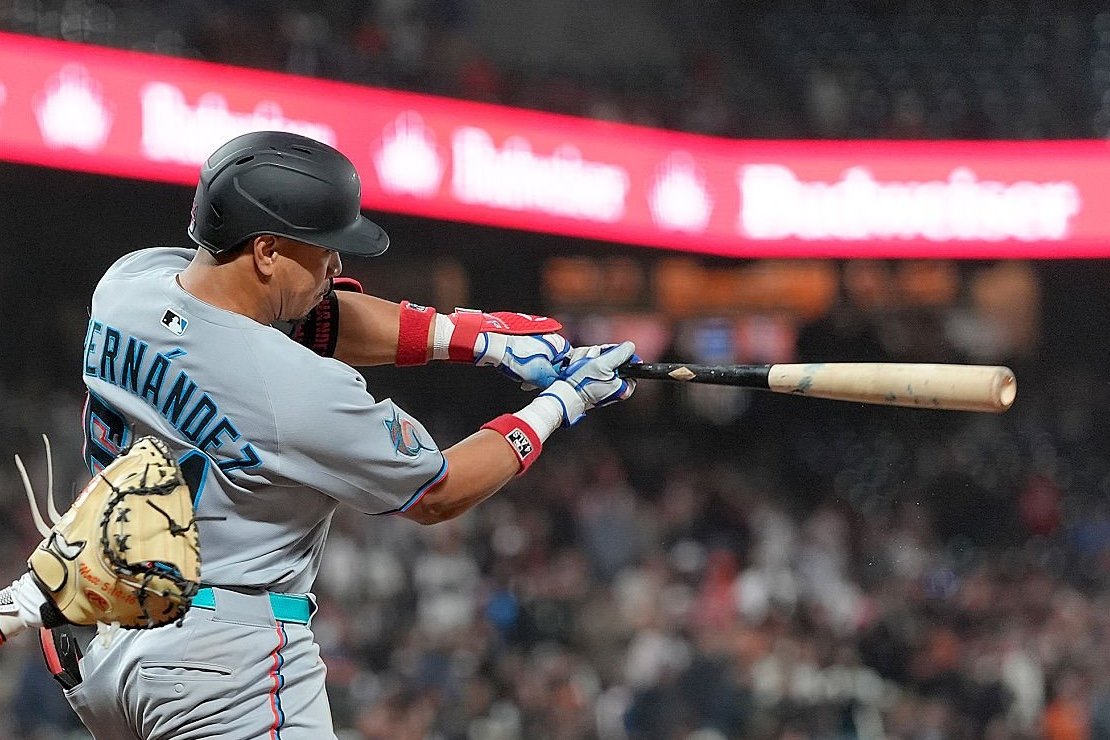
By FanGraphs wins above replacement, Hernandez (0.5 fWAR) has been the third-most valuable Marlins position player since debuting. He only trails Xavier Edwards and Otto Lopez, who have accrued nearly twice as many plate appearances during that span. He enters Thursday with a .340/.377/.480 slash line (138 wRC+). His 26.4 K% is on pace to be the lowest that he has posted at any level of competition since rookie ball! Moreover, his defense in the outfield corners grades out as above average.
Hernandez is coming off his most impactful game as a big leaguer, driving in four total runs against high-quality righty relievers to propel the Marlins to an extra-inning win over the San Francisco Giants.
c3d71aba-b9fd0f7c-a26c56b6-csvm-diamondgcp-asset_1280x720_59_4000K.mp4
Hernandez’s weighted on-base average (.374) and expected weighted on-base average (.375) are practically identical, so it’s not as if he is getting extremely lucky. With few exceptions, though, a player’s career batting average in the minor leagues represents the ceiling for what they’re capable of doing in the majors, and he was only a .260 MiLB hitter. He continues to have an underlying whiffing problem that should result in more strikeouts moving forward. Regardless of the quality of contact, a .457 batting average on balls in play is unsustainable.
Any way you slice it, Hernandez has justified the move to select his contract. The Marlins have other Triple-A outfielders—more conventional “prospects” like Jakob Marsee and Victor Mesa Jr.—making the case to be called up, but they will have to bide their time until trades or injuries create an opening. Hernandez’s job ought to be secure for the foreseeable future.