
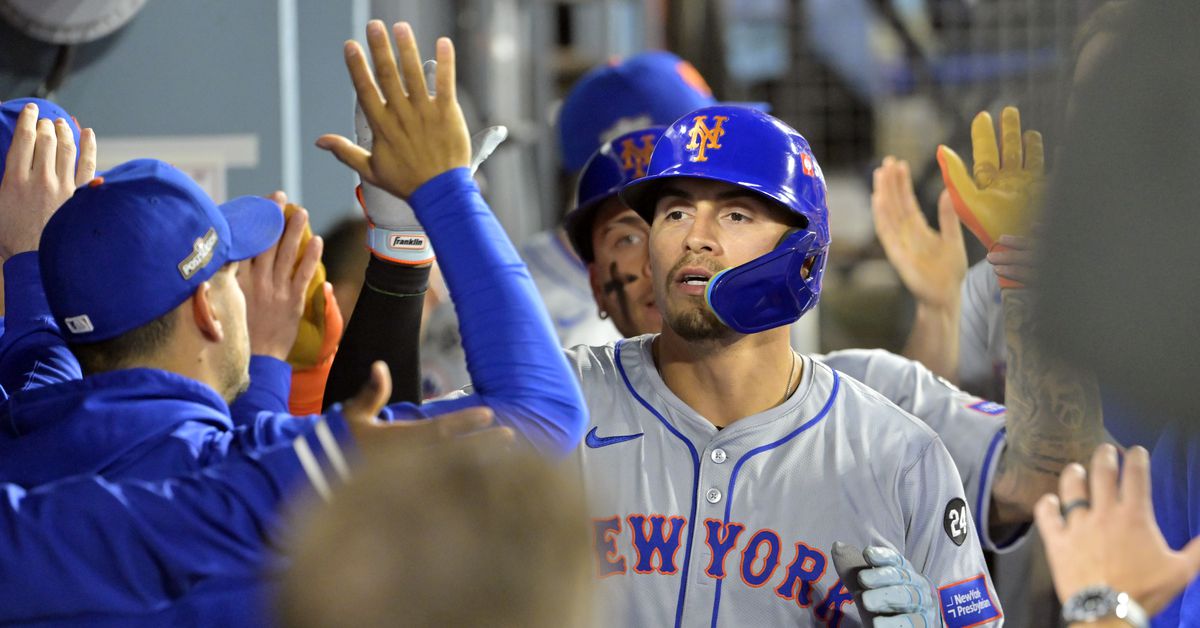
Sometimes players are just who they are. Since 2021, in every season Tyrone Taylor has played in at least 80 games, put up an OPS+ between 91 and 108, and played all three outfield positions. While it would be great to see Taylor take a step forward in his career, if this is who he is, as the Mets’ fourth outfielder, he’s a valuable player.
Taylor came to the Mets from the Brewers in December of 2023, along with Adrian Houser, in exchange for minor leaguer Coleman Crow. In his lone season as a Met, Taylor was worth 2.0 bWAR, while hitting .248/.299/.401, while stealing 11 bases, hitting seven home runs and 22 doubles. He played in the most games of his career, but got sixty fewer plate appearances than his best offensive season in 2022. His .309 BABIP was higher than you’d like, and his .154 ISO lower than career norms by 50 or so points, so the year was a bit of a mixed bag.
With Brandon Nimmo, Jose Siri, and Juan Soto the likely starting outfield for most of the season, and with Ryan Clifford, Jett Williams, and Drew Gilbert all at various degrees of knocking on the door of the majors, Taylor’s job this year is to give all three positions a little depth and to not lose too much when a regular is sitting. If an injury happens early in the year, expect to see Taylor play a lot more. Otherwise, he’s likely a contingency plan more than a regular contributor. Whether as a pinch hitter, a pinch runner, a late-inning defensive replacement, or a day game after a night game starter, Taylor will get plenty of playing time, but probably not too much of it regular.
In fact, on the Opening Day roster, Taylor may be the only viable outfielder on the roster outside of the Nimmo/Siri/Soto trio. Both Jesse Winker and Starling Marte are technically still outfielders, but their defensive performances are likely unplayable for any significant periods of time and, depending how bleak your view is, may be unplayable even in short bursts. With the Mets burning two roster spots on non-fielding hitters, there likely isn’t room on the bench for another outfielder, and so a lot is going to fall on Taylor.
And again, more or less, we know who he is as a player. He’s 31 years old, so while it wouldn’t shock anyone if he had a better season than last, the Mets aren’t asking him to do that. Having Taylor on the roster means that you can keep the DH platoon off the field, keep the kids down on the farm until they’re ready, and keep the regulars rested. If he can bring his power back to his career norms, that would be great. But if not, he’s still a valuable piece who benefits the roster in a variety of ways.