
The calendar has flipped to July, and in the three weeks since our first edition of the MLB trade deadline Urgency Index, we’ve seen a major blockbuster deal, surges from teams that had been fringe contenders and freefalls from teams that had looked legitimate.
The landscape has changed, and it can change yet again between now and July 31.
So this Urgency Index 2.0 is a mix of glaring present needs and projection — some objective and others subjective — of what might change over the next four weeks.
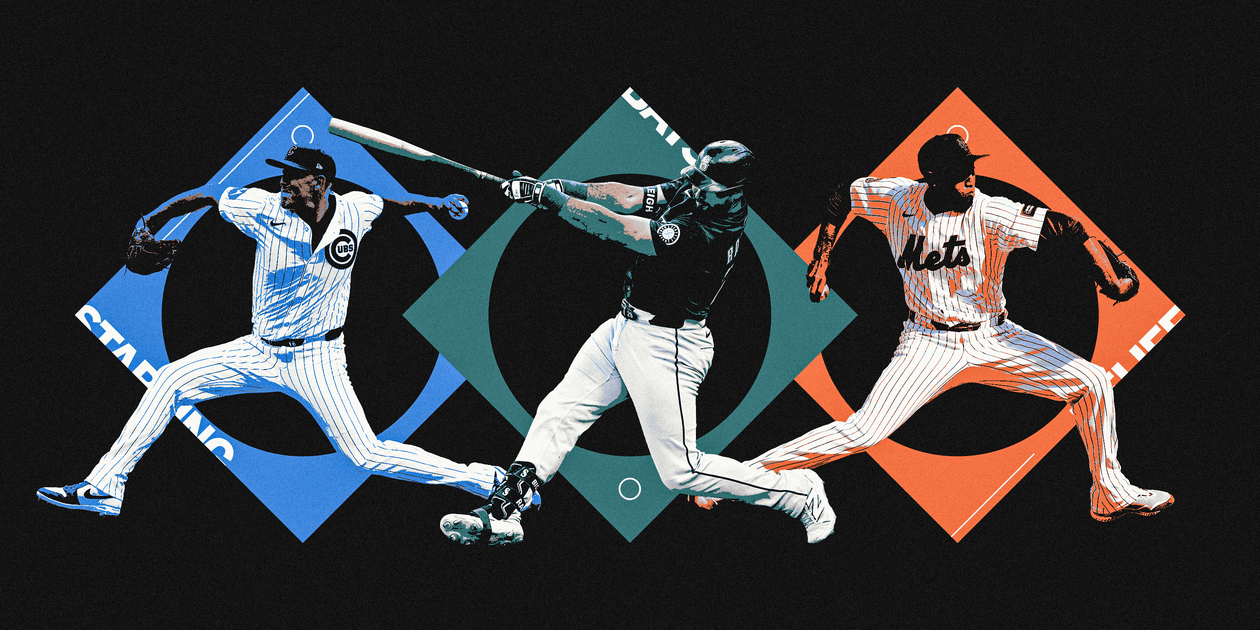
Like last time, it’s Eno Sarris on starters, Tim Britton on bats and Aaron Gleeman on relievers.
Bats
Cal Raleigh is still doing the damn thing, carrying this offense with an OPS more than 250 points better than the next-best regular on this team. He deserves some help. The good and bad news is there are several avenues to procure it. Seattle has already moved on from Rowdy Tellez at first base, and it’s now trying out a platoon of Luke Raley and Donovan Solano there while Dominic Canzone gets a look in the corner outfield. With Jorge Polanco spending most of his time as a DH, both second base and third base could be upgraded as well.
The Mariners can’t expect Raleigh to do this for another three months — though, wow, imagine if he does — and they’re barely holding on to the final wild card spot in a wide-open American League. Adding another bat or two while getting some positive regression in the starting rotation could push Seattle into a more stable playoff position.
It wasn’t that the Brewers didn’t need a bat the last time we did this; it’s that we were generally pessimistic about their chances to make a real playoff push. But now we have egg on our faces: Since we hit publish on that piece, Milwaukee is 11-4 (entering Tuesday night) and is pushing not only for the top wild-card spot but for the division as well.
So yes, now is probably the time to add meaningfully to the left side of the defensive alignment, at shortstop, third base or left field.
Yes, the platoon of Isaac Collins and Jake Bauers has done well in left, and Caleb Durbin has provided decent production in his time at the hot corner. But projection systems don’t love any of those players moving forward, Joey Ortiz just hasn’t worked out offensively this season, and the lineup as a whole includes too many bats that are league-average or below to settle at this many spots. The pitching staff looks absolutely legit; a better offense makes this a team capable not just of getting to October again, but of finally advancing.
Thanks to a deeper NL Central than anyone anticipated, the Padres have dropped out of playoff position in the last week. And that places a spotlight on their position of obvious, glaring need: left field.
San Diego’s offensive numbers in left have gotten better since it started playing Gavin Sheets out there, but that’s left the defense compromised and only helps the lineup so much when Sheets’ bat is replaced at DH by José Iglesias or Trenton Brooks.
Right now eight National League teams are on pace to win 87 games, which means some good teams won’t be playing into October. That puts extra emphasis on the upgrades available for the home stretch.
The day we published our first Urgency Index, the Mets’ playoff odds were a season-best 96.2 percent (according to FanGraphs), and you could argue that the club had no legitimate needs at the time. Well, New York has been popping leaks across the roster in the time since, and few teams with championship aspirations have ever looked as bad in a single series as the Mets did over the weekend in getting outscored by the Pirates, 30-4.
Even so, we’d trust the Mets’ current offense more so than the other four teams appearing on this list. The thing is, we don’t much trust their pitching staff considering the freefall it’s experiencing, and so the offense has to win on its own more often moving forward. And as presently constituted, New York’s lineup simply hasn’t been as deep as expected, due to regression by Mark Vientos at third base and Francisco Alvarez at catcher. Even if the Mets think those two can contribute more in the second half, there’s room to add another infielder and perhaps a center fielder.
Voila! We listed the Giants No. 1 here on June 12, and Buster Posey took note: San Francisco added Rafael Devers within days. How will Posey react to still cracking the top five?
Devers solves the Giants’ biggest issue — first base. (Even if he doesn’t himself play there, Wilmer Flores can shift from DH to first.) And for the moment, San Francisco has a solution for its second-biggest issue, at second base. Casey Schmitt has belatedly fulfilled some of the hype he generated as a prospect in taking over for Tyler Fitzgerald. But there’s not enough track record there to be confident Schmitt will keep hitting quite like this, and projection systems remain bearish on the lineup as a whole when compared with other NL contenders.
Honorable mention:

Toronto Blue Jays,

Cincinnati Reds,

Minnesota Twins,

Atlanta Braves,

Houston Astros
Relief pitcher
June was a rough month for the Mets’ bullpen, which ranked 29th in ERA (5.47) and 29th in Win Probability Added (minus-1.3) despite closer Edwin Díaz doing his job just fine. What’s the point of building a star-studded, $325 million roster if getting leads from the starter to the closer is an adventure? New York needs bullpen help.
In particular, the Mets could use a left-handed setup man to replace the injured A.J. Minter. And it’s possible the front office could view the suddenly shaky bullpen as needing multiple reinforcements, especially given the relatively small cost — both in terms of salaries and prospect capital — of adding relievers at the deadline.
Late-inning relief has been a season-long issue for the Phillies, and the bullpen isn’t trending in a positive direction, ranking 21st in ERA (4.21) and 27th in WPA (minus-0.56) during June. And while the mid-August return of left-hander José Alvarado should help, he’s ineligible to participate in the playoffs as a result of his PED suspension.
Not unlike the Mets, the Phillies have too much star power and too much invested in the $285 million roster to let a shaky bullpen sabotage a potential championship run. Even the best Dave Dombrowski-built teams have often required bullpen help and the Phillies are no different thanks in large part to Jordan Romano’s struggles.
Detroit has a big enough division lead to lessen the immediate urgency, but if the Tigers are going to make a deep playoff run it would make sense to add a veteran high-leverage reliever to a bullpen that’s been in the middle of the pack all season. Bat-missing ability should be the focus for a group that sits 26th in strikeout rate.
Will Vest and Tommy Kahnle have been a strong one-two punch in the late innings, and the Tigers have shown big names and specific roles aren’t necessarily required to piece together a quality bullpen. Still, bringing in at least one veteran setup man would seemingly be a smart play for a team with obvious October aspirations.
Tampa Bay’s bullpen is usually among MLB’s best, but Rays relievers rank 16th in ERA and 24th in WPA this year. There are contenders with worse bullpens, but the Rays are always built to win tight games in the late innings and lack their preferred firepower to do so right now. They might even buy and sell in a bullpen makeover.
Arizona has the worst relief pitching of any contender, but it’s possible things have gotten so bad that the bullpen could keep the Diamondbacks from remaining in the playoff picture. Elbow surgeries have knocked Justin Martinez and A.J. Puk out for the season, and rebuilding on the fly a unit with a 5.27 ERA will be very difficult.
Honorable mention:

New York Yankees,

Los Angeles Dodgers,
Toronto Blue Jays,

Seattle Mariners,

Milwaukee Brewers
Starting pitcher
Getting Shota Imanaga back was a good first step, but it’s not enough. Over the last month, the Cubs rotation has been near the bottom of the league in ERA, as well as bottom third in Wins Above Replacement and strikeout rate. You can’t build a rotation on two starters, and only two starters have kept their ERA under five in the last month.
Projections are no kinder. FanGraphs depth charts have them 24th overall, and if you single out the top three starters, they’re only a slightly more palatable 18th. They need an arm, but they also need that arm to be a playoff starter. This is a team ripe for a big swing at one of the best starting pitchers available. Cubs fans should be rooting against the Rangers.
It’s been a mixed bag in terms of results for the Blue Jays starters this last month. Chris Bassitt and Kevin Gausman have come back to earth with ERAs over five, but José Berríos has continued right on ticking, and Max Scherzer’s return seems to give them a shot at an average rotation going forward. That’s how the projections have it despite bottom-third results over the course of the season as well as the last month.
With Eric Lauer as their fifth starter, and continued health from their top guys, Toronto may be in the position where it’s time for a big swing or none at all. An upgrade over Lauer might be available, but if the incoming pitcher isn’t good enough to start a playoff game or help in the playoff bullpen, will the move be worth the assets?
This might be a surprising entry to the list. Certainly, the Mets rotation has been pretty good so far. By ERA, it has been fourth! But that park smooths out some wrinkles – away from home, the starters have put up the 13th-best pitching line. That fact, as well as significant injuries to Kodai Senga and Tylor Megill, have the Mets projected as the 16th-best rotation going forward.
That’s something that can be upgraded in all sorts of ways. Sean Manaea coming back will be one, but that’s factored in. Perhaps one of the intriguing prospects with great stuff in the high minors – Blake Tidwell, Nolan McLean or Brandon Sproat – will get an opportunity to shine. But, given that the Mets’ top three starters rank 24th in projections going forward, it seems likely that some of that young depth will be converted into a surer thing. Especially as the Mets slide.
Injury has clouded the picture in San Diego, like so much fog coming off the ocean. Michael King still doesn’t have a timeline. Yu Darvish might have one, but it’s not the first time he’s seemingly been on track and then had to back off. Without those two, the need is dire, especially with Dylan Cease underperforming his stuff. If King and Darvish come back, a lesser rental arm that just gets them to the postseason intact might be just enough – they’re down to 14th in the projections.
Could the Cardinals actually buy? That race for the central is surprisingly tight given preseason prognostications. If so, the rotation could use some help. They’re 18th overall as is, with only three pitchers with a sub-four ERA projection, and only Sonny Gray with a sub-3.5 ERA projection. Any buying seems like it will be modest, but there are multiple spots in this rotation that can be improved even with a rental back-end type.
Honorable mention:
,
,

,
,

(Illustration: Demetrius Robinson / The Athletic; Top photos: Jayne Kamin-Oncea, Al Bello, Geoff Stellfox / Getty Images)