

Missing bats ceased to be a problem for Joe Ryan once he found his splitter. When he added a sweeper to the mix, his ability to strike batters out went to another level. He’s never had a hard time throwing strikes, anyway, so once he reached that new echelon in terms of punchouts, he was almost guaranteed a place among the top rank of starters throughout the majors. There was a missing ingredient, though.
Ryan’s fastball is a strike machine, and it can miss bats at the top of the zone, too. That’s the good news. The bad news is that it’s vulnerable to hard contact in the air, when batters do make contact. That’s true of lefties and of righties, and it’s somewhat immutable. It lies in the nature of Ryan’s delivery and his heater’s shape. His fastball is incurably homer-prone.
Therefore, he needs more ways not to throw it all the time. That’s what slowly deepening his arsenal has been about, as he’s undertaken that project over the last few years. Having the splitter and the sweeper and his traditional slider and the occasional curveball or sinker at his disposal keeps hitters from squaring up the four-seamer with quite as much conviction, and makes them cover a larger strike zone. Unfortunately, he’s found that the sweeper, too, gets lifted, and any time that happens, damage can follow. The splitter does induce weak contact on the ground, but it needed a partner—especially once Ryan began mixing in the sinker. Thus, the righty went to work to tweak his slider.
First, as he ratcheted up his usage of the sweeper and made it his main breaking ball, he also firmed up his slider. That makes it materially different in velocity than his sweeper, but still slow enough to be very much distinct from his fastballs.
Joe Ryan – SL
v. LHH
v. RHH
Season
Velo.
H-Mov.
IVB
Velo.
H-Mov.
IVB
2023
82.7
-2.1
2.3
83.5
2.2
3.5
2024
87
2.7
4.6
87.2
2.7
4.3
2025
87.5
-0.7
7.3
87.5
0.6
6.1
Interestingly, just as teammate Chris Paddack has spent this summer adding a true slider to the more cutterish pitch that previously dominated pitches classified that way for him, Ryan is doing the opposite. He already had that slider down at sweeper speed, with good depth relative to his four-seamer. This year, he’s throwing a lot more of what are effectively cutters. The pitch is averaging almost 88 miles per hour, and its vertical movement is much less. It’s not a plunging pitch; it’s also not sweeping. For those things, he goes to the sweeper. At this point, that slider is as much a cutter as it is a true slider.
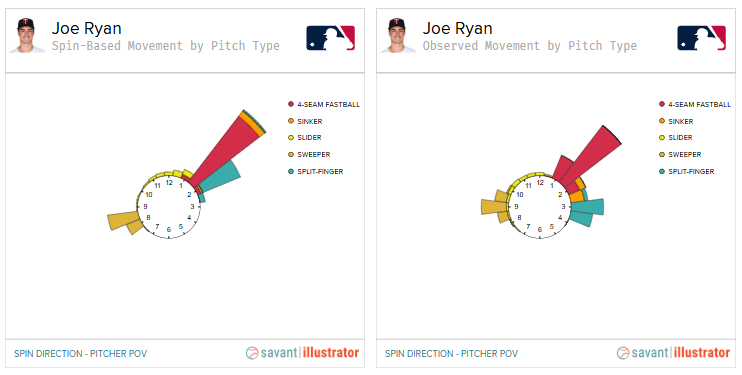
Here’s how his spin profile looked in 2024. On the left is a histogram showing the number of pitches (colored by type) thrown with each spin direction described on the clock face, based on spin right out of the hand. On the right is the same chart, but showing actual movement direction instead of simple spin direction.
Here’s the same image for 2025.
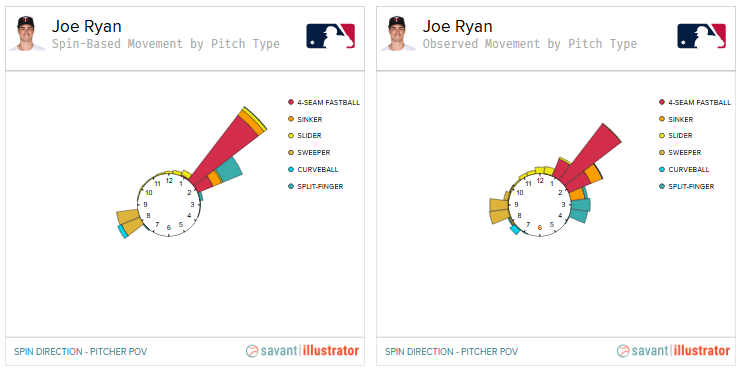
The sliders (in bright yellow) are hard to see, forming a rim across the top of the quasi-clock. If you look at each visual closely, though, you can see that Ryan was using grip effects to create unexpected glove-side movement with the slider in 2024. This year, the ball is staying much more true, thanks to backspin that isn’t distorted by the way Ryan positions the seams as much as it was in the past. That is, in effect, a cutter.
As you can see in the table above, the changes are especially pronounced against lefties. That’s so that Ryan can jam them, without having the ball end up too low, where it would work right into the bat path of many hitters’ swings. Meanwhile, introducing the same change of pitch shape to righties has some advantages, too. This version of the slider can work a bit better off his sinker than the old one could, and he uses the slider to set up the sweeper to righties, too. It’s easier to keep this version of the slider on the plate, which means more strikes and forces opponents to respect the rest of his arsenal more.
Changing the slider has led to more whiffs for Ryan. Batters missed on 20.6% of swings against the slider over the previous two years, but that figure is 26.7% in 2025. More importantly, though, he’s also getting ground balls with it. Over the previous two seasons, opponents averaged a launch angle of 18° against the slider. This year, it’s 1°. Though it technically has less glove-side movement now than it did the last two seasons—in fact, technically, it moves very slightly to his arm side, against lefties—it’s better at crawling along barrels. Though it’s dropping less, it’s playing heavier. The reason is simple: the altered spin profile makes it more deceptive. It looks more like his four-seamer than it has in the past.
Ryan’s arm angle on almost all his stuff has gotten very slightly lower over the last two years. (This isn’t intentional; I asked. He says it’s just a matter of his mix, and mostly, that checks out.) However, his slider stands out as getting lower by considerably more than it has for his other offerings.
.jpeg.0beac71e95b4b2752abeda7b2d9bf28d.jpeg)
Getting lower with the slider, in terms of arm angle, has created more carry on the pitch. That’s unusual, or at least, it would be for another pitch type. With the slider, it makes some sense. Ryan’s grip change here has actually been very subtle. Mostly, he’s getting a little more crossfire with his delivery, and in creating the spin to rip through the ball as he comes around with it, he’s backspinning it more. It’s a very natural, minor adjustment—but it’s had big ramifications.
Ryan’s slider was 5 runs worse than average in 2023. It was 2 runs to the bad last year, even in limited usage. This season, so far, the run value of the pitch is 0. It doesn’t dominate batters, but nor is it a pitch on which he’s getting hurt, or even on which he falls behind in counts and gets into trouble.
A happy tinkerer, Ryan is always adding things to his arsenal. This year, it’s not quite a full-fledged addition, but a renovation. He still has a slider, but it’s not the slider he threw two years ago, or even in 2024. It’s a better pitch, and because of it, he’s a better pitcher.