
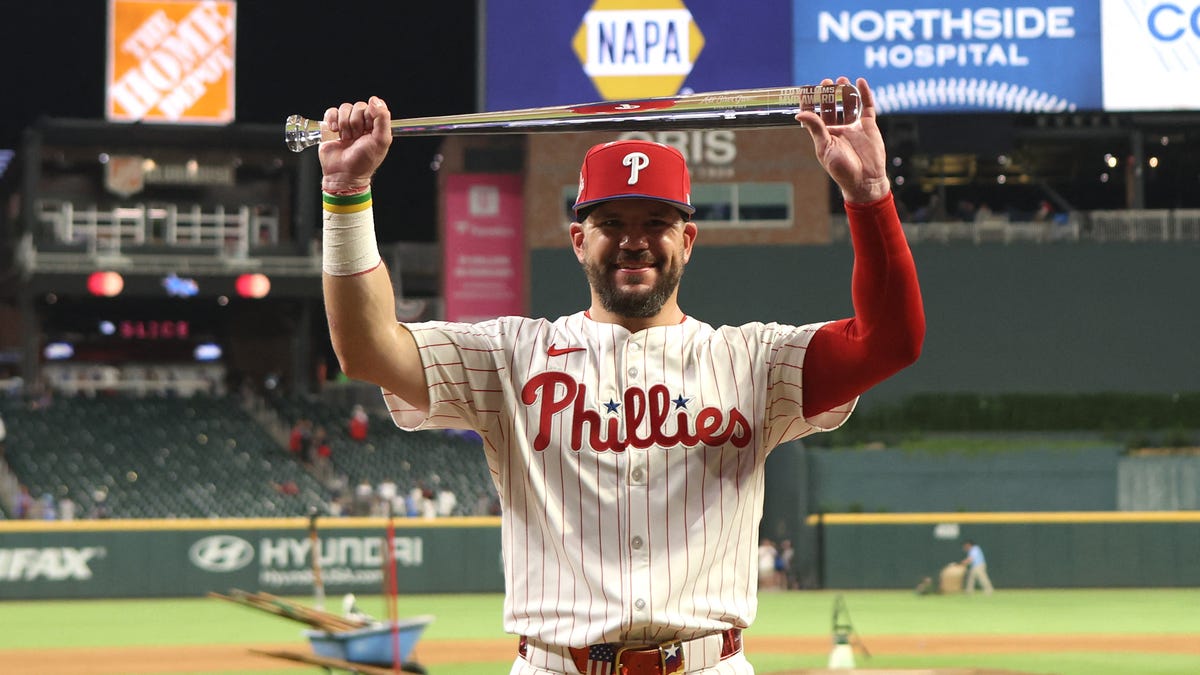
The 2025 MLB All-Star Game and last season’s eight-overtime Georgia Tech-Georgia college football game were both held in the state of Georgia. The two games provide an instructive comparison of baseball’s and college football’s methods for deciding games in overtime. Everyone is talking about the MLB All-Star Game’s tiebreaking home run derby on Tuesday night, with Kyle Schwarber hitting three homers to lift the National League to a win over the American League in Atlanta. The raging debate about a proper overtime format makes this the perfect time to revisit college football’s overtime system.
While the MLB All-Star Game is not a regular-season game, it is still a major made-for-TV event and a showcase of the sport. MLB reasonably wanted a way to decide a winner without having the game go into a 10th, 11th or 12th inning and exhaust the players who need to get back to their teams for the second half of the season on Friday. MLB’s use of the ghost runner (a runner at second base) in extra innings of regular-season games is unsatisfying to many. Some people responded to the All-Star Game conclusion by saying that a home run derby is either better than the ghost runner or, at the very least, not any worse. Baseball fans don’t seem to share a universal view of overtime and how to resolve it.
In college football, opinions are similarly split. Fans and commentators don’t want overtime to go on forever, as in baseball, but they also aren’t unified in how to readjust the overtime format. This is the time to discuss changing college football’s overtime rules.
Comparing the MLB ghost runner to college football overtime
We will talk about the home run derby format in a minute, but first, let’s go to the regular season method of resolving overtime in baseball. The ghost runner at second base in extra innings means that a runner is in scoring position without advancing there or being advanced there. One could say the team did not earn the chance to have a runner in scoring position. This is why the ghost runner is rightly considered a gimmick. A baseball team should have to fully create a run instead of having a run gift-wrapped with the ghost runner format.
College football overtime is not really all that different from the ghost runner. OT possessions start at the 25-yard line, in scoring position. A team did not advance the ball to the 25; it started there. The parallel between the ghost runner and college football starting OT at the 25-yard line is very striking. The more one thinks about it, the more similar the two systems are.
MLB home run derby — great for exhibitions, terrible for regular season
The MLB All-Star Game used to be a cutthroat game that both teams desperately wanted to win. Recall Pete Rose barrelling into Ray Fosse at the end of the 1970 MLB All-Star Game. The National League and American League urgently wanted to beat the other, but as salaries have skyrocketed and the need to preserve one’s health for the regular season has become increasingly important, the All-Star Game has devolved into an exhibition.
The home run derby format is a fun and great way to resolve exhibitions. It is an awful way to decide regular-season games. The obvious but necessary point to make: Home run derbies involve a batting practice pitcher throwing behind a fence (protective barrier). That’s not real baseball. Real baseball involves a pitcher trying to get a hitter out. Batting practice (that’s what a home run derby is) involves a pitcher trying to groove pitches so that a hitter can hit them 500 feet. Either baseball needs to have ties, or it needs to have “real baseball” decide the outcomes of games. Don’t use gimmicks.
This is something college football needs to keep in mind.
Endless OT is bad — on that, everyone should agree
MLB put in the ghost runner so that teams would be much more likely to score in extra innings, which significantly reduces the likelihood of games going 13, 15, 17 innings and taking forever. The need to reduce strain on athletes, particularly pitchers, is appropriate and reasonable. The problem is that MLB needs to find a less gimmicky way of deciding games in extra innings. However, the emphasis on not having “endless overtime” is good and necessary.
College football starting possessions at the 25-yard line — and then going to a 2-point conversion tiebreaker in the third OT inning — is the sport’s own attempt to avoid endless overtime. However, as the Georgia Tech-Georgia game from 2024 showed, eight overtimes with lots of timeouts and — ultimately — a 4.5-hour game is not really a shortened product. Overtime needs to be shortened, but not in a gimmicky way. We are getting closer to a solution here.
College football overtime adjustments
The central and most obvious change college football should make to overtime is to have possessions start at the 50-yard line, not the 25. That way, teams have to advance the ball into scoring position instead of starting in scoring position. This is like an MLB team having to score a run from scratch in extra innings instead of getting the ghost runner at second base. It would be a lot more satisfying to everyone if teams had to advance the ball into scoring position.
Limited possessions
College football overtime currently allows for four possessions — two for each team — in the first two overtime innings, followed by the 2-point conversion tiebreaker. Instead of having more possessions, college football should have fewer possessions. Just have one possession apiece from the 50-yard line. Don’t make this go on forever.
Why? We’ll explain that point next:
Football coaches being conservative
The vast majority of the time, football coaches — pro and college — kick a PAT for a tie and overtime instead of going for two and the win in regulation time. Coaches are basically happy to play for overtime. Keep in mind that if you think it’s too restrictive to limit overtime to one possession for each team, coaches could simply try to avoid overtime altogether and should be encouraged not to play for overtime in the first place. This leads us to the final elements of an adjusted college football overtime format:
Coaches can play for ties but will be punished for it
Having just two possessions in overtime, one for each team, means ties will be very possible. If Team A kicks a field goal, Team B can choose to play for a field goal. If Team A scores a touchdown and kicks a PAT, Team B can kick a PAT as well. Teams (coaches) can choose what they want to do.
However, coaches should be penalized for choosing to play for ties. They need to be given every incentive to coach to win in the limited OT format. This also means that late in regulation, coaches should be incentivized to go for two and the win instead of playing for overtime.
How can college football create this new system of incentives? Here’s how:
Choosing ties could negatively affect conference, playoff seeding
College football can institute a very simple and binding rule: In a simplified two-possession overtime, the team/coach with the second possession has the burden of avoiding a tie. If that team ties, it will lose any and every season-ending tiebreaker for conference placement, playoff priority, everything.
Some people will say, “But why penalize the team that happens to get the ball second in overtime?” The whole point is for coaches and teams to be incentivized to avoid overtime in the first place and not be conservative. This adds another layer to the conversation:
No more coin tosses in overtime
Do away with the overtime coin toss. No team gets to choose the first or second possession.
The road team gets the first possession, period. The home team — having the advantage of being at home — gets the second possession and the burden of having to avoid the tie and a losing tiebreaker. The home team basically has to be better than the road team. A tie should feel like a loss for the home team and should be treated as such. Home-team coaches should not think they can be cautious and conservative.
Overtime wins versus regulation wins
One thing both baseball and college football could consider is valuing regulation wins more than overtime wins. Failure to win a game in regulation could be seen as a defect or limitation. That doesn’t seem ludicrous. Soccer has ties as a matter of course. Not winning a regular-season soccer match means a team gets one point in the standings instead of three.
College football could emphasize the value of regulation wins by including a provision that teams with more regulation wins (and fewer OT wins) get priority in College Football Playoff evaluations.
For baseball, end-of-season ties could similarly be decided by counting regulation wins more than extra-inning wins.
Conclusion
How to conduct overtime — and how to reward/punish teams for playing overtime games — is clearly not a fully resolved matter in major American sports. College football can look at the 2025 MLB All-Star Game as a time to reconsider an overtime format that many people think is outdated and needs reform.
Contact/Follow @College_Wire on X and @College_Wires on Threads. Like our page on Facebook to follow ongoing coverage of college sports news, notes, and opinions.