
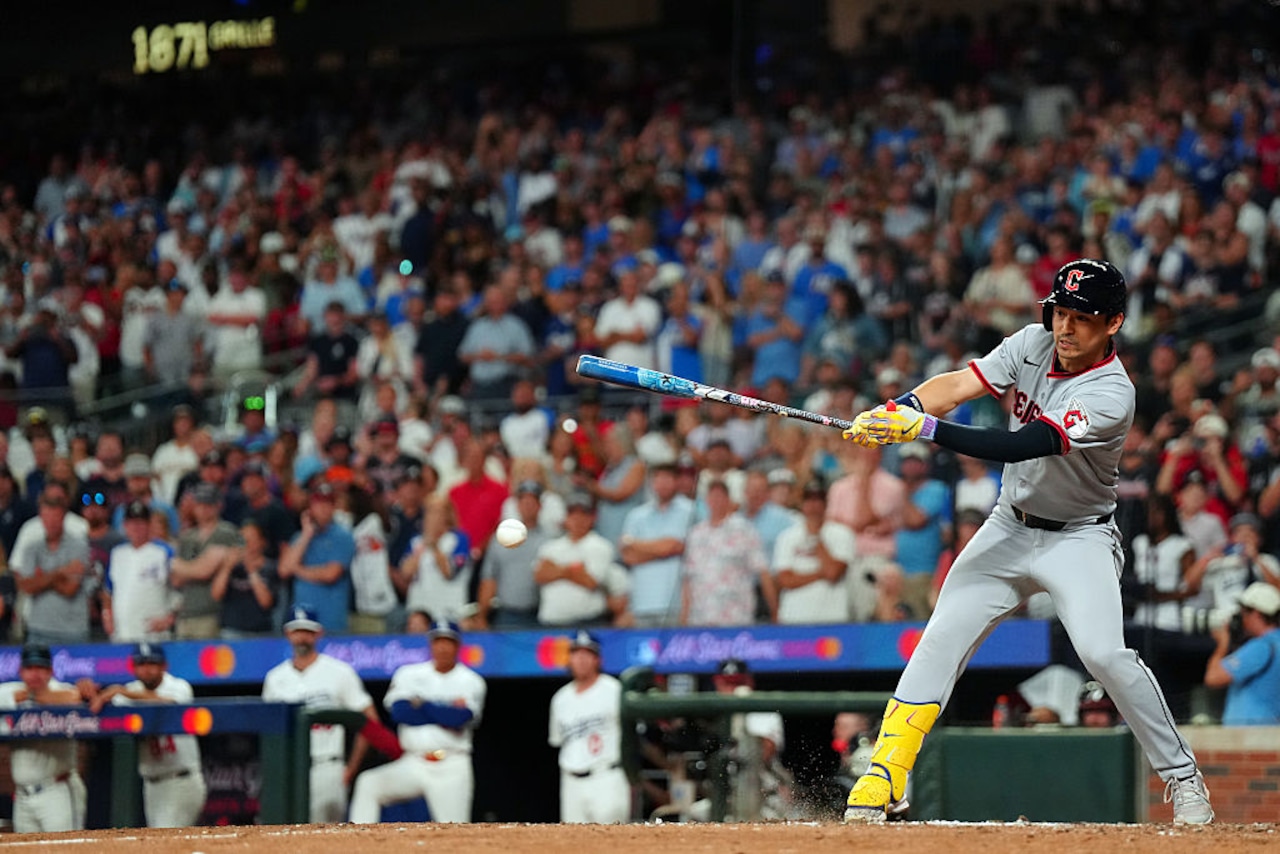
CLEVELAND, Ohio — When the American League needed a hero in Tuesday night’s All-Star Game, Cleveland’s lone representative stepped into the spotlight and delivered in signature ‘Guardsball’ fashion.
Steven Kwan, representing the Guardians as their sole All-Star after José Ramírez withdrew from the event, found himself in a dramatic ninth-inning situation that perfectly showcased the unique skills that have made him one of baseball’s most distinctive talents.
With the American League trailing by a run in the ninth inning, Kwan stepped to the plate against Mets closer Edwin Diaz — one of baseball’s most dominant relievers. What followed was vintage Kwan: patience, contact skills, and speed combining at the perfect moment.
“Down to his last strike, battling Diaz and he comes away with the game-tying RBI on an infield single,” Joe Noga explained on the latest Cleveland Baseball Talk Podcast. “That at-bat sort of encapsulated everything that’s great about Steven Kwan and makes him an All-Star.”
Paul Hoynes agreed, noting how the at-bat represented what Cleveland fans have seen from Kwan throughout the first half of the season: “Just a great moment, really. A good at bat by Kwan, the kind of at-bat we’ve seen throughout the first half. Seven pitches, he kept fouling balls off and finally put one on in play.”
The infield chopper down the third base line wasn’t the most majestic hit of the All-Star Game, but it was quintessential Kwan — putting pressure on the defense with his elite speed while demonstrating exceptional plate discipline by extending the at-bat against one of baseball’s most dominant pitchers.
“Eugenio Suarez was playing way back,” Hoynes said. “I haven’t seen (Kwan) run that fast for a while. He was hauling it down first base,” Hoynes observed.
Not content with simply tying the game, Kwan immediately showcased another dimension of his all-around skill set by stealing second base, putting himself in scoring position and giving the American League a chance to win the game in regulation.
While Kwan didn’t enter the game until the sixth inning defensively and had limited opportunities to impact the contest, he maximized his crucial ninth-inning moment. His game-tying hit followed impressive contributions from other AL Central stalwarts, with the Twins’ Byron Buxton and Royals’ Bobby Witt Jr. hitting back-to-back doubles to start the rally.
“And then the Guardians All-Star comes in and cleans up and drives in the game-tying run,” Noga said, highlighting how the division’s stars collaborated in the dramatic comeback.
Kwan’s performance served as a statement that his first All-Star selection in 2024 was no fluke. As a two-time All-Star at age 27, he’s establishing himself as one of the American League’s premier outfielders with a unique profile that stands out in today’s power-focused game.
“He showed everything in his toolbox, all of the skills that make it known why he’s not just an All-Star once, he’s an All-Star twice,” Noga emphasized. “He’s going to be in the conversation I think for a while there in the outfield in the American League.”
For Guardians fans, seeing their lone representative deliver in the clutch provided a perfect showcase of what makes Kwan special — exceptional bat control, elite speed, and an uncanny ability to put the ball in play when it matters most.
Want to hear more about Kwan’s All-Star heroics, the dramatic Home Run Derby finish, and what the Guardians can expect in the second half? Listen to the full Cleveland Baseball Talk Podcast for Joe and Paul’s complete breakdown of an unforgettable midsummer classic.
Note: Artificial intelligence was used to help generate this story from the Cleveland Baseball Talk Podcast by cleveland.com. Visitors to cleveland.com have asked for more text stories based on website podcast discussions.
Podcast transcript
Joe Noga: Foreign. Welcome back to the Cleveland Baseball Talk Podcast. I’m Joe Noga, joined by Paul Hoynes Hoynsie. The All Star Game last night in Atlanta, I gotta say it started rather slow, but by the end it was edgier seat and you couldn’t, you couldn’t get enough of it. The way that they finished with the, the Home Run Derby to, to decide the winner because the game was tied. A rule that was put in place ahead of last year’s All Star Game, but there was no tie in that game. They, they decided there’s not going to be extra innings. It allowed the managers to sort of empty their tanks, empty the benches and, and the bullpens throughout the game and use every pitcher. It, it wound up really being interesting and, and really engaging and I think, I think Major League Baseball has found something here. What were your impressions in general of the All Star Game last night and the way it wound up?
Paul Hoynes: Yeah, really kind of really an interesting take on the game, Joe. I mean, is this what’s going to happen now in regular season? Are they going to take away the automatic runner, you know, in the 10th inning and then have a swing away, you know, after every regular season game, or is it going to be like the NHL, a shootout after every tie game? I’m not sure, but it got your attention. It was fun to watch. Watch.
Joe Noga: I, I think the idea of having it for an exhibition is a great idea, but, you know, regular season I think still has to be decided on the field by the players. It’s not a free throw shooting competition. It’s not like you said, the NHL deciding things in a shootout. Really? Would you line the NFL up with, you know, a field goal kicking contest to decide the Super Bowl? I, I can’t imagine and I can’t, I can’t ever see a Major League Baseball going that way. But it makes, you know, clearly the Major League Baseball All Star Game is the best of the All Star Games, you know, better than the NBA All Star Game. The NFL doesn’t even have a Pro bowl anymore. NHL, they’re not hitting each other. They’re not really playing for blood. So I really think that of the All Star Games out there that are, that are being played, Major League Baseball has it right. They do just enough sort of differentiation, experimentation sort of things with the rules, and we’ll get into some of those here. But this was the most watchable, the most engaging and having been to, you know, the, the all star game in 2019, just the environment and the atmosphere and the way that everybody sort of treats the game. It’s, it’s the best of them, no.
Paul Hoynes: Doubt about it, Joe. And you know, the level of competition is high because these players are so competitive. You’ve got the best players in the world on both teams and nobody, you know, they will take a break, you know, to celebrate a guy, you know, you know, a retire player, maybe in a Hall of Famer in his last year and you know, give him a moment. But it’s, you know, it’s nine innings of baseball and you don’t want your, you don’t want to, you know, you don’t want to come up short amongst your peers. You want to play the best you can play. And you can see that these guys, they’re serious when, when they’re playing, it was just, you get that environment and you, you have that buzz about a game like this. It’s always fun, it’s always interesting. You get to see the best pitchers in the world. You get to see a lot of them, you know, one inning each. But you know, the, the result tonight last night was really surprising because I’ll be honest with you, Joe, I did not know that rule existed. You know, I was wondering why are these guys going through so many of their pitchers so quickly? They weren’t holding anything in reserve.
Joe Noga: Yeah, usually in the, the old days, the old way, there was one pitcher that was, was told, hey, you’re going to be our guy who doesn’t pitch unless, you know, we go into extras or something like that happens. And there was just enough fan service, I think, in this, in this version of the All Star Game to make it viable and make it something, you know, that we get excited about every year now. And it’s certainly a jewel event and in that the guardian’s lone representative there, because Jose Ramirez, you know, backed out of the appearance there. The lone representative was Stephen Kwan. And he conducted himself with, you know, just, he was, he was everything that we needed him to be and more in, in that game to represent Cleveland, to represent the American League Central, to represent the American League. Getting up there in the ninth inning, down to his last strike, battling Mets closer Edwin Diaz and he comes away with the game tying RBI on an infield single. And, and really that bat, that at bat sort of encapsulated everything that’s great about Stephen Kwan and makes him an All Star. Just, you know your thoughts on that showdown and that moment where Stephen Kwan came through for the American League.
Paul Hoynes: Just a great moment, really. A good at bat by Kwon, the kind of at bat we’ve seen throughout the first half, what, seven, eight, nine pitches. He kept falling balls off and finally put one on in play. A little chopper down the third baseline. Suarez, Suarez was playing way back the third baseman and got the tying run home. He beats it out. I haven’t seen him run that fast for a while. He was, he was hauling it down first base. Then he steals second base and gives, you know, gives him a chance to win it. It doesn’t happen but you know, he goes into extra innings. But just a great, you know, great performance and a great All Star appearance by Quan1 1 he’ll remember for sure.
Joe Noga: Yeah, and he, and he kind of had to wait a little extra there. Brett, I keep calling him Brett Boone. It’s Aaron Boone. Aaron Boone didn’t put him in defensively until the sixth inning. He wanted to give Riley Green, the starter in left field, an extra at bat. Green had str two times he was up, I think he popped out to center his, his third time up. So Kwon really didn’t get into the game until late. I really didn’t have a chance to impact things, you know, in those middle innings where sometimes the, the subs come in and, and they make a big difference there. He did have one catch in the outfield on a, on a nice, you know, running play towards the line. But other than that he really didn’t have a lot of impact in the game. His first at bat was a, a ground out with runners in scoring position that ended an inning, I believe in the seventh. And then, you know, he did make it up when, when the American League Central sort of asserted itself there in the, the ninth inning. Down by two, Byron Buxton and Bobby Witt Jr. Back to back doubles. So the, the Twins and the Royals represented. And then the guardian comes in and cleans up and, and drives in the game tying run after what was an outstanding play down the first baseline by Matt Olson on a hard smash by Jazz Chisholm Jr. I thought that was one of the plays of the game and you know, Olson was going to maybe put to be an MVP with that game saving sort of stop. But that only served to move Wit over to third base and make it easier for him to score on, on Quan’s infield singles. So yeah, I, I, I think Quan did a really nice job. Showed all of the things in his toolbox, all of the skills in his skill set to sort of make it known why he’s not just an All Star once, he’s an all Star twice. He’s going to be in the conversation I think for a while there in the outfield in the American League. So great to see the American League Central perform at a high starter in the American League. Tarek Skubal sort of stumbled early, giving up two runs in the first.
Paul Hoynes: Yeah, Skubal against Paul Skenes. You know, great pitching matchup. An all star type pitching matchup school. Gives up the two run double to Marte in the first inning and really kind of set the tone, the early tone for that game as the National League piled on and what built a six nothing lead.
Joe Noga: Yeah, it made it sort of that pitching matchup while it’s, it’s what you want to see. You want to see Tarek Skubal, you want to see Paul Skenes. But you know, it goes back to Pedro Martinez in 99 striking out the first, what, six, eight batters he faced. It was, you know, it made, made it sort of a snoozer early when the, the NL builds this lead and you’re thinking they’re going to cruise and all that. Then Brent Rooker comes up in the, in what the. The. The fourth inning and the sixth inning, the sixth inning and hits a, hits a three run home run and you sort of show signs of life. The American League puts that rally together and it’s becomes more interesting to watch late. And that’s what you want. You want the seats on the edge of the seats at the end of the game. You know, watching the, the final outs there. What you think of Jacob Mizrowski, the, the brewers pitcher, very hyped. He’s only made five starts in the National League for the, the brewers. And he comes over is a first time all star. Maybe some people thought he didn’t pitch enough innings or have enough appearances to, to warrant that, but heck, Paul Skeen started last year and he had only had a few starts under his belt before that. Mizrowski kind of an exciting character to watch.
Paul Hoynes: Yeah. 102 miles an hour, you know, on a radar gun. He’s, he looks about 15 years old, Joe, doesn’t he? I mean he’s tall and skinny. His arms are. His arms are like pipe cleaners. You know, it’s just this tall skinny guy that, that generates a lot of velo. And you know, I kind of like the move. You know, Major League Baseball, like you said last year with skins, they promote their younger players. They try to get them in the public eye. There’s no better place in the All Star game to do that. And this guy you know, obviously one of the rising up and coming young players. Get him, get him in the big stage, get him under the lights and see how he does.
Joe Noga: It was sort of like when Anthony Ghost, you know, first came out and everybody heard, oh, this guy’s pumping gas. You know, they got to see him. All the, all the players were at the top step of the railing looking and watching Ms. Rosky’s pitches just to see that. That velo and that. That energy. So a lot of fun with that. And, and I think you’re right. Major League Baseball does do a. Has been making a concerted effort to. To sort of get their younger players to events like this and showcase them. And, you know, that goes back to the, the spring breakout games that they do in, during spring training to try and promote the younger players and get, get their faces on the screens and. And have more, more young players, sort of. More young fans sort of connect with them. It’s. It’s something that’s paying off.
Paul Hoynes: Yeah, no doubt about it. They are trying to get a younger, you know, demographic to watch baseball games. You know, it’s a good move, Joe. I mean, and with a guy like that, I mean, you’re going to. If you’re a baseball fan, it doesn’t matter what age you are, you’re going to watch this guy because he can bring it. I mean, that is, you know, he kind of had that deer in the headlights look. Like you said, what am I doing here? Like, you just dropped in, but he was throwing gas, man.
Joe Noga: Yeah. So from the sort of. The other way that the Major League Baseball can go with an event like this is sort of like you mentioned, to honor a longtime All Star, a longtime legend. They did it with Miguel Cabrera. They, you know, bring him on, putting him on the roster, having him, you know, play some sort of role in the game and then, you know, giving him a moment to come off the field. They did that with Clayton Kershaw in this game. Clayton Kershaw walks off that mound. He’s walking right to Cooperstown as soon as he is eligible to do so. You know, have him in that game last night and to have him get taken out and to the applause and all that, definitely a special moment for, For Clayton Kershaw.
Paul Hoynes: Yeah, that was a nice moment. You know, Kershaw keeps coming back, man. I don’t know when this guy’s going to retire. Like, he. Every year he pitches a half a year, you think he’s going to retire, then he comes back for a half year. So who Knows this guy could still be pitching five years from now. But certainly a nice moment. It kind of reminded me of the moment they did with Cal Ripken along I think was in Seattle when you know, he, he was, I think he was elected to the third base to start basement. When and when he came out, a rod moved over to, you know, the third so Cal could, was introduced at shortstop. It was cool, cool moment like that.
Joe Noga: And baseball and that’s, that’s one of the things that baseball can afford to do as opposed to like football. You can’t bring a 45 year old guy out onto a football field and sort of on he’s going to get, he’s going to get murdered. I mean that’s just the way it is. But in, in baseball you can kind of have Clayton Kershaw throw a couple of pitches and then, and then walk off to some applause and tip his cap. Kind of an awesome moment there. We’ve got to talk about the way that the, the game ended basically because of Stephen Kwan’s heroics in the 9th. It activated the first swing off the first Home Run Derby to decide an All Star Game. And this is something that worked, man. I think after the success of the Home Run Derby in its traditional sense on Monday night and all the eyeballs that get on that, you know, bring an element of that. This was something that, you know, Justin Turner suggested this a long time ago and instead of using the Ghost Runner to, to decide games and extra innings, he, he said, hey, why not do a mini Home Run Derby? And this one sort of caught on the rosters for the swing off were sort of decided ahead of time. We found that out that they had to pick their guys beforehand and guys like Cal Raleigh and Aaron Judge weren’t around, weren’t on that list because Aaron Boone knew, you know, Raleigh was going to be out of the game by then. And Judge, once you’ve been to eight All Star games, by the eighth one, you’re, you’re generally bouncing out of there as soon as you’re out of the game.
Paul Hoynes: Yeah. So the rosters were a little surprising. Joe, you know the National League, what Kyle Storrs, Stowers led off Schwab, you know, Kyle Schwaber of course, and then the Polar Bear, Pete Alonso that had some star power. They went and in the American League went with Brent Rooker, Randy Arose arena and Aranda from Tampa Bay. So interesting choice of the three guys. But there was drama, you know, from start to finish with it.
Joe Noga: Yeah. And you know, Rooker hits Two at the start. And you’re thinking he’s put, he’s put the American League way ahead in that situation because it’s not like the timed event on Monday where you can get off as many swings in a, in a minute or whatever. It’s just you get three swings. If you pop one out, if you miss the barrel, you’re not hitting a home run. And we saw that for a couple of these guys. That makes what Kyle Schwaber did in the second round sort of amazing is that every ball that he swung at, he barreled and launched. And these were no doubt home runs.
Paul Hoynes: Yeah, that first one, Joe, you know, you, you forget how, how talented these guys are and how quick they are. And that first home run that Schwaber hit. Now the guys throwing a BP fastball obviously, but his hands were so quick hit to dead central, you know, like 428ft, you know, that you’re generating that. All of that, you know, you’re, that’s pure power, you know. And he was locked in after that. I thought was.
Joe Noga: Was Kyle Schwaber the perfect hitter to have in that situation in terms of just what he can do, what his skill set is to get them three home runs on three swings?
Paul Hoynes: Yeah, I think so. You know, we saw him last year when he was batting leadoff for the Phillies. I mean, that’s what he was up there to do. You know, he’s up there to hit home runs. And you know, obviously last night he was. That was his same role. And man, he. That was the last one. He goes down on a knee and that. That turned out to be the game winner. Alonzo doesn’t even have to bat.
Joe Noga: Yeah, I was that. That was the only negative, the only drawback. I sort of looked around the room and I said, this is going to end on a Pete Alonzo walk off. And, and it really didn’t because like you said, Jonathan Arondic, he was. There’s so much pressure on him to hit at least one of those home runs and he wasn’t able to. And you can’t blame him for that. I mean, what, what Schwaber did was herculean. So really that it turned out to be exciting, even though we didn’t get the drama of sort of that walk off moment. But still, you know, I think Major League Baseball has found something. I don’t think this is something they want to maybe extend to regular season or playoff games. I just can’t see games be real, games that matter being decided this way.
Paul Hoynes: Yeah, Rhonda almost tied it up too, Joe, with that, almost that line. Dry off the, the brick, the top of the brick. The brick, you know, top of the right field fence there, the right field wall was just missed by a foot or two. But yeah, yeah, I think this is, this is perfect for the All Star Game and exhibition, but you don’t want to do this in, in the regular season. Joe, what did you think about the automatic balls and strikes use used throughout the game?
Joe Noga: Well, yeah, that was going to be my, that was going to be one of my, my sort of wrap ups here. You know, the, the piece de resistance for the, the night was, was watching hitters and catchers and even pitchers challenging balls in the strike zone. And we saw this in spring training and it worked. And Hoynsey, personally, I think it can’t get to the big leagues to regular season and playoff games. I think it can’t get here fast enough. I think they need it. It’s, it’s going to help. And fans are going to be a lot more engaged with it as well. The technology is there, it’s, it’s accurate, it works. And now the young players who have been using it in the minors are starting to come up to the major, so they’re going to be used to it. They’re going to, you know, it’s going to be seamless and smooth. I don’t think it’s going to delay games very much. We saw it in action last night and I think we need to see more of it.
Paul Hoynes: Yeah, Joe, and you’re an advocate of officials, so what do you think this does to an umpire?
Joe Noga: I mean, you’ve still got the umpire acting in his role and doing the things that he needs to do. It. It doesn’t take the human element away. It actually enhances the human element because it gets it right. So, yeah, I, I think the umpires are going to adjust to it. I think it’s going to weed out some of the umpires who have real difficulty with the, with calling balls and strikes and, and the guys who are good, it’s going to, you know, they’re not going to get challenged as much. But if, you know, you’ve got a guy behind the plate who struggles with the, with the zone, I think that’s, you know, it’s almost like some umpires should come with extra challenges in a game. You know, if you’ve got an Angel Hernandez game, you know, no one’s ever going to have an Angel Hernandez game again, thank goodness. But if you have an Angel Hernandez game Behind the plate, you should get three extra challenges in that game because you know he’s going to miss that many more calls. I personally think two challenges per game like they were doing in spring training, is not going to be enough during the regular season. I think we would, we should see that expanded or see additional challenges given later in games from when the most important calls are taking place.
Paul Hoynes: Yeah. And then more strategy becomes involved. And when you use those challenges, what part of the game do you use them at? At what critical moment do you use them? So it brings a whole nother kind of layer of, kind of, I don’t know, intrigue to a game that, you know is really built on entry or.
Joe Noga: Or even who’s allowed to use them. I mean, your manager has to be able to say, you know, Steven Kwan, you’ve got the best eye at the plate in the league. If you say it’s a ball, then it’s a ball. I’m going to trust that you can challenge anytime you want to at any point. You know, Gabriel Arias, I might say, hey, Gabriel Arias, you can’t challenge in the first six innings of a game. But if it’s a critical at bat with runners on base and we need to score late in the game, then I might send him to the plate saying, okay, if it’s close and we’ve got a challenge, go ahead and, and use one.
Paul Hoynes: Yeah, yeah, definitely it’s going to be. And I would think, Joe, for sure this is coming in 2026. I would, you know, I would really, I would be surprised if it wasn’t.
Joe Noga: Yeah, it would, it would be shocking to me if it’s not a part of the game in 2026. It’s already in the minors and it’s already being used the, the ABS Challenge system. Definitely another reason why we tuned into the game last night and everybody was watching. One final thought. I was blown away by the Hank Aaron tribute that they did in Atlanta with the use of the projection on the screen, on the, on the field with the holograms and everything and the, the, the pyrotechnics and the laser show. That was as impressive a, you know, mid game break for, to honor somebody who absolutely everybody is in awe of or was in awe of in Hank Aaron. I think that moment was a resounding success for Major League Baseball.
Paul Hoynes: I felt I was right there, Joe. I mean, when he hit.715, I mean, that, that was cool. That was. I don’t know how they did it, but you felt like you were at the game you know, you felt like you were, you were sitting there in the stands and just a, just a really cool moment. Great idea. You know, I hope Hammer and Hank somewhere was smiling after that and we.
Joe Noga: I would, I would not be opposed to seeing more tributes. Like, baseball has so many, you know, moments like that that live on. And we’ve seen those videos and we’ve seen the images, you know, played over and over again to recreate things. The only one I don’t want to see is Willie Mays catch in the 1954 World Series recreated. Please don’t put that on a projector, you know, on the, on the field during an All Star game. That, that just re. Traumatizes an entire generation of Indians and Guardians fans alike. So let’s not do that one, but find another sort of tradition like. And you know what? The other thing that Major League Baseball is good at doing is promoting. I saw enough commercials for the Bristol Showdown game coming up at the racetrack that they’re playing that game. I believe it’s Atlanta. And, and who else? I was the angel. I.
Paul Hoynes: Who.
Joe Noga: Whoever it was, it. It’s it. I saw enough commercials for that to make me want to tune into that game. So great job by, by baseball all around. One more piece of news I want to get to before we get out of here. Shane Bieber back on the mound pitching in a game situation for the first time since May 3rd. The little setback with his elbow seems to be doing just fine. Bieber goes two innings, strike, allows a hit and a walk as the Arizona Complex League Guardians defeat the Dodgers in, in Goodyear Park. 12 nothing. So Bieber looks like he’s back on course and could be coming this way pitching a game in Ohio at some point. Maybe next week.
Paul Hoynes: Yeah, I would think so, Joe. I mean, what he pitches Tuesday, Wednesday, Thursday, Friday, Saturday, maybe Sunday or Monday. He’s doing another, another game, I would think if he comes through this one. All right, so he’s hopefully on his way and he stays on course this year, this time. Joe doesn’t have any setbacks and is ready to rejoin the, the big league rotation sometime in late August, perhaps.
Joe Noga: Yeah, you’ve got to figure at least three or four more outings, three or four more starts to get that pitch count built up to the point where he’s. Where they’re comfortable using him in a big league game. But all good signs and hopefully he reports nothing. Nothing out of the ordinary. And his recovery on the following day as he continues to progress there. I think Travis Bazzana and George Valera both hit doubles in that game. Valera hitting an RBI double off of Blake Snell who was rehabbing for the Dodgers as well. So a lot of good stuff happening out of the Arizona Complex League right now. Good. Good to hear Travis Bazan is back in game action.
Paul Hoynes: Yeah, Bazzana, you know, of course has been sidelined with the oblique injury of, Geez, Joe, what, six to eight weeks. So he’s still he’s just coming back now. Valera hopefully can stay healthy. Joe, this is a guy that can hit but has just had terrible luck, you know, with injuries over the last two or three years.
Joe Noga: Yeah, that’s certainly the case. We’d love to see Valera as an option at some point. All right, Hoynsie, that’s going to wrap up today’s edition of the Cleveland Baseball Talk podcast. We’ll be back to talk to you again another time.
If you purchase a product or register for an account through a link on our site, we may receive compensation. By using this site, you consent to our User Agreement and agree that your clicks, interactions, and personal information may be collected, recorded, and/or stored by us and social media and other third-party partners in accordance with our Privacy Policy.