
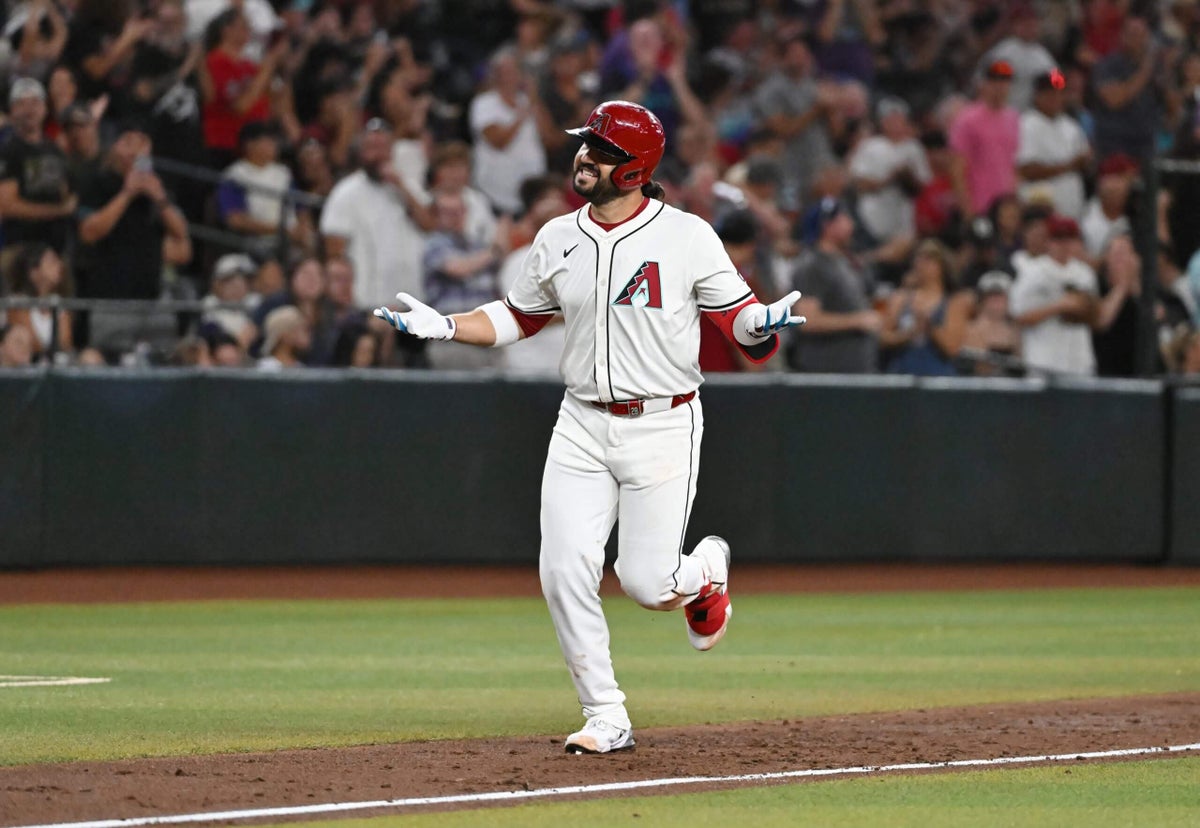
A weekend sweep of the St. Louis Cardinals was encouraging. But no matter where the Arizona Diamondbacks are in the standings on July 31, they will need to trade at least some of their veterans on expiring contracts. Otherwise, 2026 might end up a lost season.
The Diamondbacks already will be without three key pitchers for at least the first half of ’26 as ace right-hander Corbin Burnes and relievers Justin Martinez and A.J. Puk recover from major elbow surgeries. And if they lose their top four potential free agents – third baseman Eugenio Suárez, first baseman Josh Naylor and right-handers Zac Gallen and Merrill Kelly – they essentially could be down seven core players.
Suárez, Naylor, Gallen and Kelly all carry enough value to warrant one-year qualifying offers in the $22 million range. But all four might reject the offers, leaving the Diamondbacks with nothing more than draft picks in return.
The qualifying-offer calculus will figure into general manager Mike Hazen’s decision-making at the deadline. To move any of the four, he would need to clear the value of the draft pick, which would be between the first round and Competitive Balance Round A as long as the player signs for at least $50 million in free agency.
The Diamondbacks benefited from one of those picks in the recent draft, taking Louisville right-hander Patrick Forbes with the 29th selection after losing first baseman Christian Walker to the Houston Astros on a three-year, $60 million free-agent deal.
Kelly, who turns 37 in October, might be the only one of the DBacks’ big four who commands a deal of less than $50 million. The pick for him then would be after Competitive Balance Round B, at or around No. 75. With each extra choice, the Diamondbacks’ bonus pool also would increase.
While the picks would be fine, they would not help the Diamondbacks next season. Kelly and Suárez, in particular, feel strongly about their ties to Arizona, and could re-sign. But at the very least, the possibility of all four potential free agents receiving a guarantee in excess of the qualifying-offer amount would be very real.
Suárez, 34, leads the National League with 35 home runs and 85 RBIs, and is on a 57-homer, 138-RBI pace. Naylor, 28, is young enough and productive enough to command a strong multi-year deal. Gallen, who turns 30 on Aug. 3, will still be in demand, even with his inconsistencies this season. And Kelly, whose first two contracts with the DBacks were club-friendly, finally might want to pursue a bigger payday.
Entering Sunday, when he held the Cardinals to two runs in six innings, Kelly’s average fastball velocity of 92.1 mph was in the bottom 20 percent of the league. Still, he showed no signs of aging, remaining one of the more consistent starters in the game. His 3.42 ERA since 2022 ranked 19th in the majors.
The Diamondbacks, after outscoring the Cardinals 22-7, are back to .500 and 4 1/2 games behind in the NL wild-card race, with three teams ahead of them. And while they entered Sunday ranked fourth in the majors in runs per game, the rotation wasn’t performing as well as its reputation and their bullpen was bottom five in the majors.
If the DBacks stay within striking distance, the logical course for Hazen would be to trade at least some of his potential free agents while simultaneously acquiring bullpen help. It is unlikely he would move both Gallen and Kelly, for it would leave him scrambling to fill out a rotation the rest of the season. But top prospect Jordan Lawlar could replace Suárez at third, and Pavin Smith, once he returns from a right oblique strain, could step in for Naylor at first.
The challenge for Hazen – and any head of baseball operations seeking controllable starting pitching – would be finding major-league ready options. Teams are reluctant to move even their better Triple-A starters, viewing them as one injury away from the major-league rotation. Hazen could collect prospects to improve his talent base for offseason maneuvering, but would face the same problem trying to acquire pitching then.
In any case, standing pat does not seem to be an option. The Diamondbacks, who expect to activate relievers Shelby Miller, Jalen Beeks and Ryan Thompson from the injured list in the next several weeks, could envision themselves being this year’s Detroit Tigers. The Tigers sold at last year’s deadline, then relied on Tarik Skubal and pitching chaos to secure an improbable postseason berth. The Diamondbacks would rely on their dynamic offense to make the same kind of charge. With expanded playoffs, teams can dream.
For the Diamondbacks, though, it can’t just be about 2025. It’s about 2026, too.
Miller on the move?
A year ago, Athletics closer Mason Miller was untouchable. To this point, the A’s messaging this season – we’re not talking about him – is pretty much the same. But according to sources briefed on the team’s plans, that stance is subject to change.
The way the A’s see it, only a few teams are bold enough to propose an offer for Miller worthy of consideration. General manager David Forst might engage those teams as the deadline nears. But for now, he appears willing to let them grow more desperate.
Which teams might tempt the A’s? The Philadelphia Phillies, who reached agreement Sunday with free-agent reliever David Robertson, probably would be No. 1 on the list. The Los Angeles Dodgers, with free agents Tanner Scott and Kirby Yates performing below expectations, almost certainly would be in the mix. So would the New York Yankees, who face the losses of Devin Williams and Luke Weaver to free agency.
The San Diego Padres just sent three relievers to the All-Star Game, but general manager A.J. Preller can never be ruled out on top talent. Nor, for that matter, can Seattle Mariners president of baseball operations Jerry Dipoto.
Still, the A’s asking price for Miller would figure to be exorbitant. Miller, 26, is earning $765,000 this season, just $5,000 above the league minimum, then is under club control for four additional seasons through salary arbitration. His expected 2.84 ERA is well below his actual 4.04 mark, thanks in part to a 40.1 percent strikeout rate that was in the top 1 percent of the league.
Sears, Springs, Severino all in play
At a time when the supply of controllable starting pitching is decidedly scarce, the Athletics are listening not just on right-hander Luis Severino but also lefties JP Sears and Jeffrey Springs.
Before the Cleveland Guardians knocked him around Sunday, Springs, 32, had a 2.94 ERA since June 1 and 3.93 mark overall. He is earning $10.5 million this season and guaranteed another $10.5 million next season. His deal also includes a $15 million club option for 2027.
Sears, 29, might not crack a contender’s playoff rotation, but some teams might consider him a viable back-end starter for the rest of the regular season. His 84 starts since 2023 are tied for fifth in the majors. And his ERA at Sutter Health Park this season (5.61) is nearly a run higher than it is on the road (4.78).
For the A’s, the idea of trading Sears would be to turn back the service clock by acquiring pitchers whose timelines line up better with their young position players. Sears is under control through arbitration for three more seasons, and eligible for free agency after 2028.
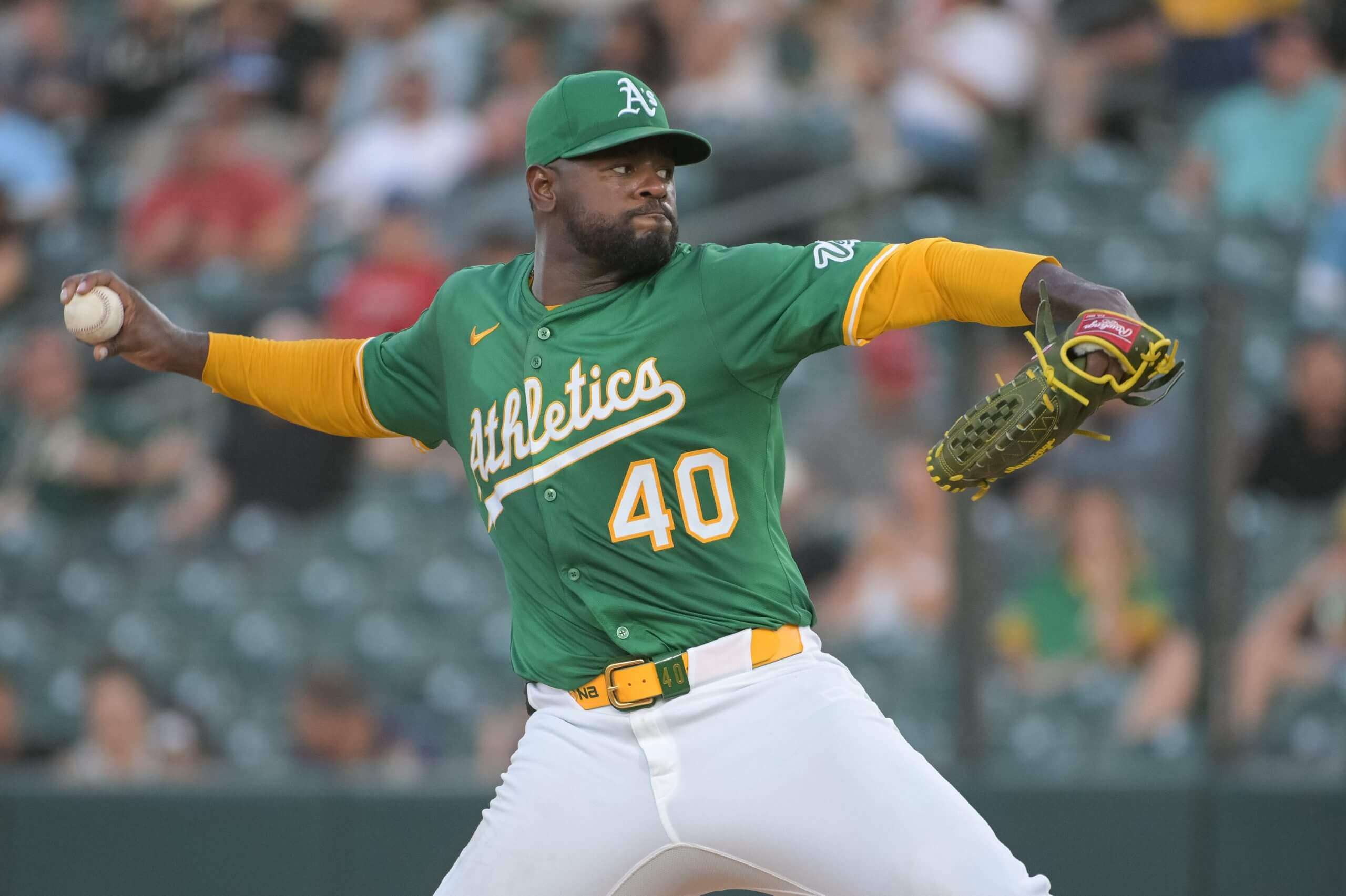
Luis Severino, who signed a club record $67 million deal in the offseason, has been honest about his feelings on the A’s temporary home in West Sacramento, saying playing at Sutter Health Park ‘feels like a spring training game.’ (Ed Szczepanski / Imagn Images)
Then there is Severino, 31, the most vocal objector to Sutter Health Park. His underlying metrics will scare off some clubs, as will his $25 million salary in 2026 and $22 million player option for ’27. If a team acquires him, it surely will point to his 3.10 road ERA, compared to his 6.68 home ERA, as justification for the move.
Nats’ DeBartolo aiming to keep young players
Mike DeBartolo, the Nationals’ interim GM, told reporters Saturday that he is not looking to trade any of the team’s better young players – left fielder James Wood and left-hander MacKenzie Gore, both of whom were first-time All-Stars, as well as shortstop CJ Abrams and outfielder Dylan Crews.
Gore, with two additional years of club control remaining, is at the same level of service Juan Soto was when the Nationals sent him to the San Diego Padres at the 2022 deadline. But the Nationals are in a different place now than they were then. A more uncertain place, even though by now they should be coming out of their rebuild.
The firings of president of baseball operations Mike Rizzo and manager Davey Martinez on July 6 left the Nationals in need not just of a new, permanent top executive, but also an organizational direction. Ownership must decide whom to hire, what the future payrolls will be and how in general it wants to proceed.
DeBartolo obviously will need to listen if teams call on Gore. But barring a mammoth offer, trading the lefty with so much unsettled would be ill-advised. As one rival executive put it, if the Nationals were going to entrust DeBartolo with such a move, they might as well make him permanent GM. The Nationals don’t seem ready to do that just yet.
Aside from closer Kyle Finnegan, who had back-to-back nightmarish outings before rebounding Saturday, the Nats’ most attractive trade chip might be right-hander Michael Soroka. Rival clubs view Soroka’s 5.10 ERA as misleading. Entering Sunday, his 3.22 expected ERA was in the top 25 percent of the league, and his strikeout and walk rates were in the top 30 percent.
Rutschman’s future in Baltimore in question?
The Orioles’ selections of two players listed as catchers with their first two draft picks did not reflect a lack of confidence in Adley Rutschman, according to a source briefed on the club’s thinking.
Still, Rutschman’s long-term future in Baltimore is not as certain as it once appeared. He is under club control for only two more seasons. The Orioles’ interest in signing him to an extension might be waning. Their top prospect, Samuel Basallo, also is a catcher.
The draft, at least, was a separate matter. While some picks get to the majors quicker than in the past, most still take years to develop. So, teams generally focus on the best available players rather than target specific needs.
The Orioles’ top pick, Ike Irish at No. 19, is not purely a catcher. He played 41 games in right field and four in left at Auburn this season, and caught in only 12. The Orioles love his bat. They’ll figure out his position later.
The team’s second choice, Caden Bodine at No. 30, is strictly a catcher, but the Orioles simply saw him as good value. The Athletic’s Keith Law, in his final mock draft, projected Bodine going to the Tampa Bay Rays at No. 14. MLB.com had him going to the Diamondbacks at No. 18.
Rutschman, the No. 1 overall pick in 2019, is on the injured list with a strained left oblique. Since last year’s All-Star break, he is batting only .218 with a .642 OPS. His expected numbers this season indicate he is partly a victim of poor luck. But his extended struggles might create an opening for others.
Basallo, who turns 21 on Aug. 13, entered Sunday batting .264 with 19 homers in 253 plate appearances and a .975 OPS at Triple A.
JT: Original source of swing-off
As his wife Kourtney pointed out on X, the Chicago Cubs’ Justin Turner seemed to be the first to propose a swing-off to decide extra-inning games.
Look what we have here @redturn2 🤣 pic.twitter.com/N72mH3TCVr
— Kourtney Turner (@court_with_a_K) July 16, 2025
Turner, in making his suggestion for the shortened 2020 season, proposed deciding games that were tied after 10 innings with a home-run derby. Each team would pick its three best hitters. The hitters would get five outs. Most home runs wins.
The players and owners adopted the concept for the All-Star Game in the 2022 collective-bargaining agreement, making only a minor tweak from Turner’s original plan (each hitter gets three swings, rather than the five outs proposal). The swing-off at this year’s All-Star Game was a hit, and Turner believes the idea would make sense for the regular season as well.
His argument is not without merit. Turner said a swing-off after the 10th or 11th inning would prevent relievers with options from throwing 40 to 50 pitches in extras. Teams then could keep such pitchers on the roster, preserving their service time, rather than send them out for a fresh arm. Another twist: Setup men and closers might pitch more often in the ninth and/or 10th innings as teams tried to either avoid or force the swing-off, depending upon their circumstances.
He flushed it, all right
Speaking of the swing-off, here’s another story to add to the legend of the Philadelphia Phillies’ Kyle Schwarber:
The Hall of Fame requested the bat Schwarber used to hit three home runs on three pitches in the All-Star Game swing-off. The bat was new; Schwarber had broken his previous wood on a 99-mph Aroldis Chapman sinker in the ninth inning.
When an official from the Hall checked over the bat, he told Schwarber it looked surprisingly unmarked. To which Schwarber replied, “No ball marks when you flush it.”
Golfers and hitters use the term “flush” to describe smacking a ball squarely. That, of course, is what Schwarber did in the swing-off.
Since 2019, the only players with more home runs than Schwarber (244) are Aaron Judge (268) and Pete Alonso (247). His career total is up to 316, and he’s still only 32.
And finally…
Brady Counsell, a shortstop from the University of Kansas and the son of Cubs manager Craig Counsell, was the Diamondbacks’ 10th-round pick in last week’s draft.
Brady, 22, agreed to a $50,000 bonus, or 10 times more than Craig got when the Rockies selected him in the 11th round in 1992.
Craig’s father, John, a former minor-league outfielder in the Twins’ organization, also got more than Craig – $12,000 in 1964, the year before the league enacted the draft to cut down on bidding wars for amateur talent.
(Top photo of Eugenio Suárez: Norm Hall / Getty Images)