
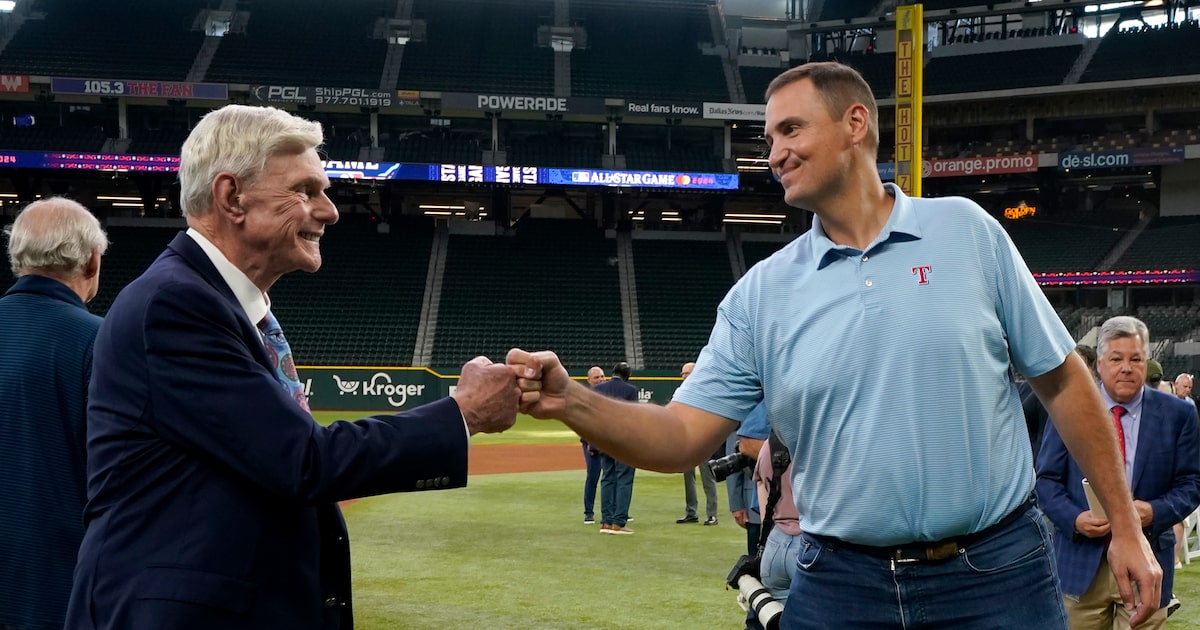
ARLINGTON — It’s never a bad idea to follow the money. In baseball, during the trade deadline season, it may be a requirement.
Texas Rangers president of baseball operations Chris Young said Monday at Globe Life Field that it’s “to be determined” how the club will navigate the potential financial implications of any transactions if they do decide to buy at the July 31 trade deadline.
“We’ll see where we are,” Rangers president of baseball operations Chris Young said Monday at Globe Life Field. “I commend our ownership on consistently giving us payrolls and financial support that a lot of teams don’t have. I’m very grateful for the way we’ve been able to construct our roster the last couple of years.”
The Rangers were one of six teams that exceeded the tax threshold in each of the last two seasons with estimated final payrolls of more than $242 million in 2023 and more than $268 million in 2024 according to Baseball Prospectus.
Rangers
They paid a 20% charge on each dollar spent beyond the threshold two years ago and a 30% charge last season. A 50% tax on all overages — which the New York Yankees, New York Mets, Los Angeles Dodgers and Philadelphia Phillies paid last season as violators in three consecutive seasons — awaits the Rangers this season if they surpass the $241 million threshold.
That brings us to this season. The Rangers, per Baseball Prospectus, are projected to finish with a $235 million payroll that encompasses the 40-man roster, bonuses, the pre-arbitration pool and more. Certain events — like the lack of bonuses that right-hander Tyler Mahle will now qualify for because of his shoulder injury and the trade of right-hander Dane Dunning — have saved them a marginal amount of money over the course of this season. They keyword there, though, is marginal.
It leaves the Rangers with a figure in the ballpark of $5 million in space between where they currently stand and a bigger year-end bill. They’re effectively left with three paths to follow:
Exceed it again and pay the price: They did so two years ago and it yielded their first championship. They did so last year with the bulk of a World Series-winning core still intact and a title to defend. This year’s team — which, despite their recent run of swell play, has spent the bulk of the season under .500 and more resemblant of a franchise that should have its eyes on the future over the present — may not have earned the benefit of the doubt to spend. The Rangers would have had to certify themselves as legitimate frontline contenders to justify the hefty year-end bill that’d come with big-money additions. They haven’t done that, and it makes it hard to envision a scenario in which Texas does go beyond the tax threshold for this team. Pursue contracts that fit within their means: Consider this the most probable outcome if the Rangers do add by the deadline. The Rangers, who are expected to be in the market for a relief pitcher, can acquire a contract that sits in the $1-2 million range without pressing their tax threshold luck or needing to move off of any preexisting contracts they already have on the books. Sensible options — like Pittsburgh’s David Bednar (roughly $2 million due for the rest of this season) or Washington’s Kyle Finnegan (roughly $2 million due for the rest of the season) — exist on the market. Baltimore’s Felix Bautista and his $500,000 contract once made sense, but, a recent trip to the injured list with shoulder discomfort likely disqualified him. The premium arms that may be available such as Minnesota’s Jhoan Duran and Cleveland’s Emmanuel Clase, who both have less than $2 million left to earn this season, would require a heftier prospect package than either Bednar or Finnegan. The Rangers will need to decide how much they’re willing to mortgage to support this year’s club. Give money to get money: This one’s a tad more complicated and may not make sense given where the team stands. If the Rangers do want to pursue higher-priced contracts without exceeding the tax threshold, they could look to swap similarly sized deals. The options, though, are rather thin. Mahle (due more than $6 million the rest of this season) was a logical trade chip at one point but is now void because an injury that will keep him out until the middle of August at the earliest. Right-hander Jon Gray, who’ll make a tad more less than $5 million the rest of this year, may have more value to the Rangers as a flexible swing man that can both start and relieve than he does in trades. Could right fielder Adolis García (around $4 million remaining) or catcher Jonah Heim (under $2 million remaining) make sense on the block? Theoretically, sure, though the Rangers would need to determine whether they’d be better off with or without them if they want to make a second-half push.  Evan Help Us: A trade deadline special and will the Rangers ever be healthy?
Plus, could Texas pursue Pete Alonso? Do they need to address catcher?
 Former Ranger Rick Helling on speaking out during the steroid era and how he’d pitch today
Helling was a guest on DMN’s new SportsDay Rangers podcast and spoke about his time with Texas and much more.
Find more Rangers coverage from The Dallas Morning News here.
Click or tap here to sign up for our Rangers newsletter.