
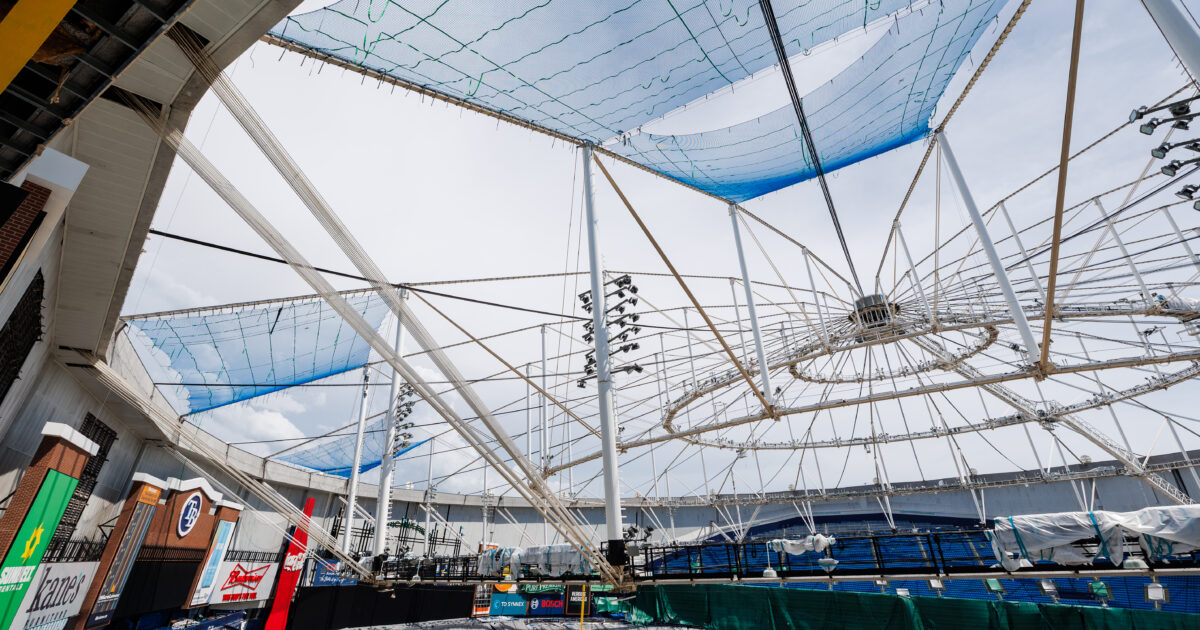
St. Petersburg will receive $400,000 annually and can redevelop part of the Tropicana Field site under a new licensing agreement with the Tampa Bay Rays.
City council members also unanimously approved allocating an additional $5.26 million to repair the storm-damaged stadium Thursday. The estimated $55 million project is on pace to conclude in April 2026, before the start of a new Major League Baseball season.
However, memorializing an arduously negotiated $6.5 billion plan to redevelop the Historic Gas Plant District and a new ballpark was the meeting’s watershed moment. While Mayor Ken Welch called the team’s decision to exit the deal “terribly disappointing,” officials will “refocus on our primary objective – the progress of our city.”
“The most important element of this is that the development rights of this area, previously held by the Rays since 1995, are now in the hands of the city,” Welch said in a prepared statement. “This puts us in the strongest position to assure that the future development of the Historic Gas Plant District meets the needs of St. Petersburg and honors the promises of equitable development.”
The licensing agreement encompasses four parcels: Two are for parking, one is for storage and one contains a team marquee facing I-275. Starting Aug. 1, the Rays will pay the city $400,000 annually for three years until their lease at the Trop expires after the 2028 season.
A roughly 2.3-acre parcel at the intersection of 1st Avenue and 16th Street South, the fourth, will cost the team just $12. The city can terminate that agreement following the 2026 season and still receive the exponentially larger payments.
City Administrator Rob Gerdes said retaining control of all four parcels would cause operational issues for the Rays. He also noted that there is “significant interest in potentially moving forward much faster” on redeveloping the fourth. “Therefore, we want to be able to get out of this agreement at our discretion.”
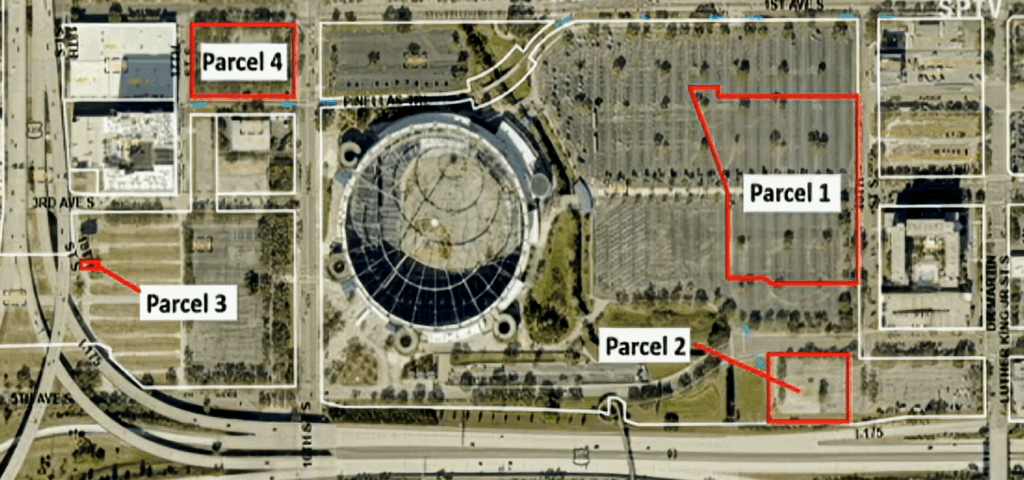
An overhead map highlighting parcels the city will lease to the Rays and redevelop (No. 4). Image: City documents.
Welch said the initial focus is on affordable housing for seniors, the city’s commitment to the Woodson African American Museum of Florida and advancing a workforce development ecosystem. “We are also working on a feasibility study for a right-sized convention center on a portion of the Historic Gas Plant property.”
The Rays are responsible for maintenance, utilities, fees and taxes associated with the parcels. City Attorney Jackie Kovilaritch said the deal is “just as positive” for St. Petersburg as “any other licensing agreement.”
Gerdes said administrators presented an initial payment structure based on potential revenues from the properties. The Rays countered with a “much, much lower offer.”
“We ended up meeting somewhere in the middle where we’re comfortable,” Gerdes continued. “With the $400,000 a year, that’s $1.2 million.”
He reiterated that administrators expect the Federal Emergency Management Agency (FEMA) to reimburse the city for most of the Trop’s repair costs. “But there’s a portion that we won’t get reimbursed for, and this will help us offset some of that cost.”
Councilmember Brandi Gabbard thanked Gerdes for his work on the redevelopment and now termination negotiations, a “hard mountain to climb.” She “never had a worry or a doubt that we would end up here today.”
Councilmember Richie Floyd, who opposed the development deal, called the saga’s conclusion a gift. He noted the city now has “a lot more finances to move forward with the things we need.”
With the latest allocation, officials have now dedicated over $40 million to repairing the Trop. Beth Herendeen, the city’s special projects manager, stressed that the current stadium use agreement remains intact and will transfer to a new ownership group.
“The city is still responsible for fixing the stadium, and whoever owns the team … is obligated to use the stadium until 2028,” Herendeen said.
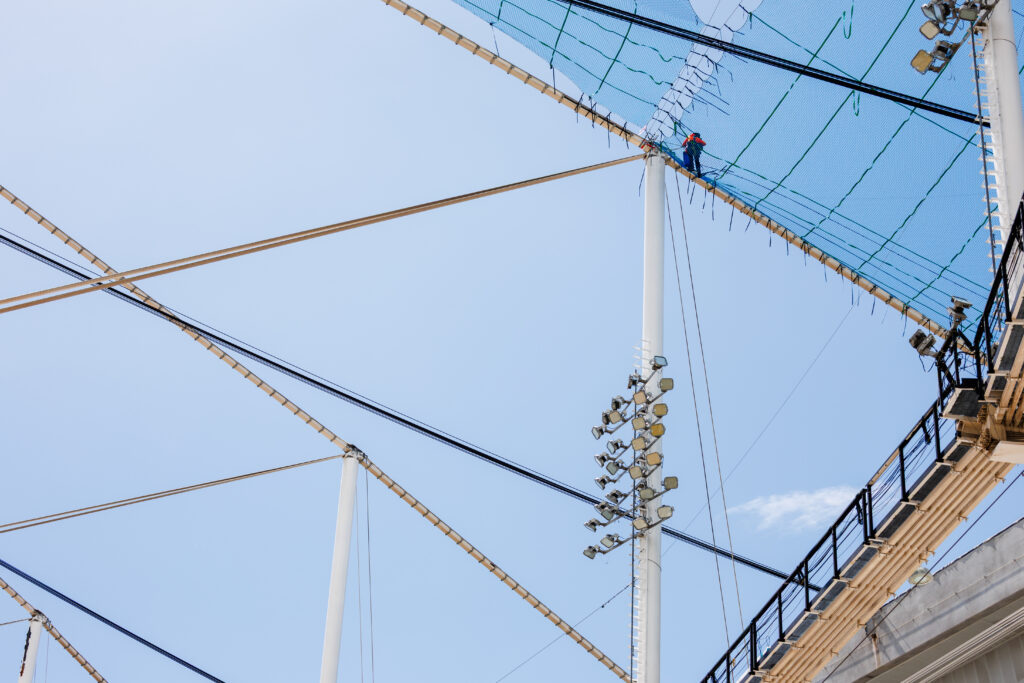
A worker stands atop mesh netting needed to replace Tropicana Field’s roof. Photo: City of St. Petersburg.
City architect Raul Quintana said the $5.26 million contract would fund the installation of about 100 sports lighting fixtures and catwalk electrical systems. Council members must still approve funding for architectural finishes, flooring, audio and video equipment, and mechanical, electrical and plumbing components.
The city committed $23.78 million to replacing the stadium’s roof in April. Access netting needed to begin the job arrived July 14, and Trop should have a top in December.
Contractors will then begin “major interior work” and, finally, turf installation. “We are on the target schedule we said we would be, barring any major weather issues or concerns,” Quintana said.
Councilmember Mike Harting credited the administration for their progress on a “Herculean task in a very short period.” He noted there is “no path to follow” for a unique project that relies on manufacturers across multiple continents.
“I’m pretty sure that it gives a lot of people heartburn that we have to pay this and not know what the future brings to Tropicana Field,” said Councilmember Lisset Hanewicz. “If there was a way out, trust me, I would have been screaming about it.”