
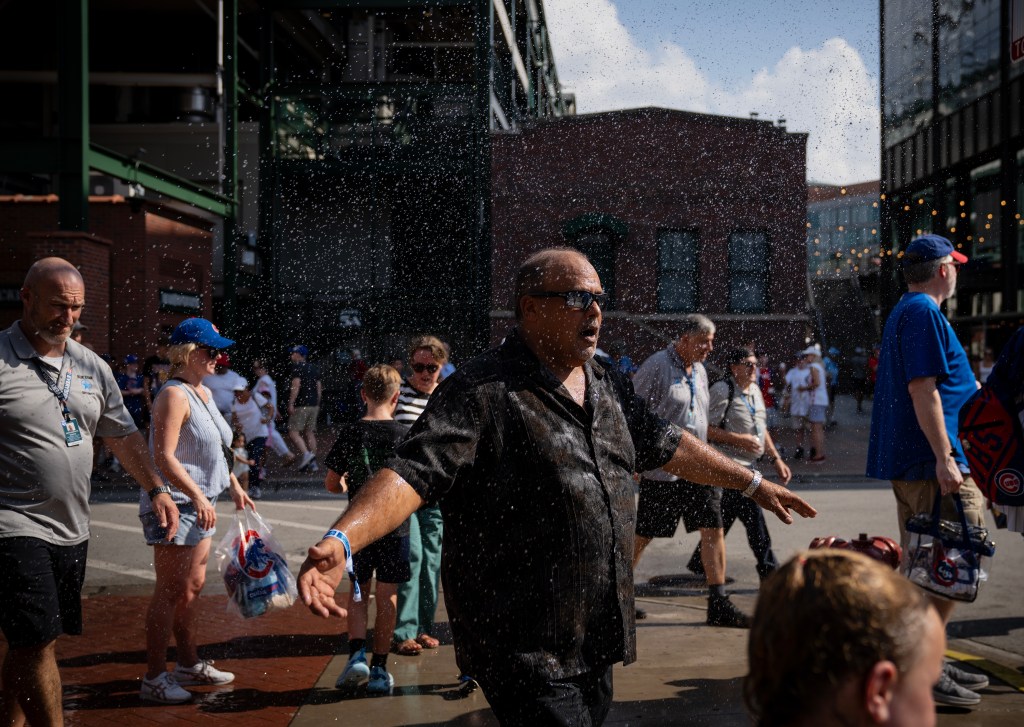
The Kansas City Royals were hot Wednesday at Wrigley Field, scoring an 8-4 road win.
So were the Cubs. And the umpires. And the fans. Everyone felt the heat in Wrigleyville.
Fans swarmed to the Addison Red Line station after the game, waiting as the humid 90-degree heat beat down on them. Riders in their sweat-stained Pete Crow-Armstrong jerseys squeezed onto the train, turning each car into a sauna room.
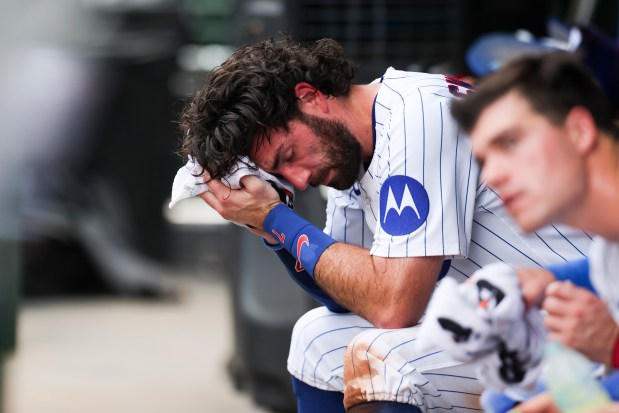 Chicago Cubs shortstop Dansby Swanson wipes his face with a towel during the fifth inning against the Kansas City Royals at Wrigley Field, July 23, 2025. (Eileen T. Meslar/Chicago Tribune)
“If you wear a fur coat, you’ll die,” said Cubs fan Lee Kesselman, 73, while waiting in front of Gate 1.
Extreme summer heat during baseball season is not only making games uncomfortably hot and sweaty for fans in the stands — it’s also posing a danger to the health of players and changing the physics of the sport.
Since 1970, human-made climate change has driven up average summer temperatures in Chicago by 2 degrees, according to the climate science nonprofit Climate Central. That lines up with an average increase of 2.8 degrees across 26 Major League Baseball home cities in the United States — except Los Angeles. The home of the Angels and Dodgers has had no measurable change in baseball season temperatures since 1970.
Across the Midwest, with a 3.6-degree increase each, Cleveland, Detroit, Milwaukee and St. Louis are some of the top 10 MLB cities that have undergone the most warming.
In a June 21 Cubs game against the Mariners at Wrigley Field, during this summer’s first heat wave, the temperature at first pitch was 94 degrees. After five innings, plate umpire Chad Whitson had to leave due to dehydration. Seattle reliever Trent Thornton then lost his balance on the mound in the eighth inning with one out and was helped off the field by medical staff. A Wrigley Field staff worker also dealt with heat-related issues, according to a Cubs spokesperson.
“It was a heat blast, that’s for sure,” said Cubs reliever Brad Keller, who earned the 10-7 win. “Running in, I didn’t want to throw my warmup pitches because I wanted to conserve all of the energy that I (could). But it was hot for everybody. I’m from Georgia, and I’ve felt the heat before.”
The players are combating the heat, but the baseballs may be embracing it.
 A security worker is transported off the field after being overcome by the heat and humidity after a 10-7 Cubs win over the Mariners at Wrigley Field on June 21, 2025. (John J. Kim/Chicago Tribune)
Researchers have found that warmer, less dense air lets batted baseballs fly farther — leading to a slight but measurable increase in home runs.
A 2023 study of 100,000 MLB games led by Christopher Callahan, an Earth system scientist and postdoctoral researcher at Stanford University, found more than 500 home runs between 2010 and 2019 could be attributed to global warming.
That’s an average of 58 additional home runs each year, accounting for 1% of all home runs during that period. Experts say that the use of performance-enhancing drugs like steroids, as well as better analytics and player training, all likely contribute to the increase, too.
“I think it’s fair to say that increases in temperature that result in lower density — and therefore in balls flying farther — is not the predominant factor that increased home runs over the last several decades,” Callahan said. “It’s definitely not a nonexistent relationship. And that number could get bigger in the future. If temperatures continue rising, that contribution will get larger and larger.”
Future warming — even if emissions of heat-trapping greenhouse gases are reduced — could triple that effect over the next 25 years. In scenarios where pollution is not curbed, the impact could be greater with home runs seeing a 9% yearly increase by the end of the century.
As heavy rains, heat waves become more common, fans could see more baseball games postponed
Experts suggest switching to more night games or building more ballpark domes to reduce the impacts of hotter summer days on players, staff and spectators, as well as on the baseballs.
But tradition and logistics might complicate a speedy adaptation in places like Chicago, where the Cubs play more day games than night games and both the Sox and Cubs ballparks are open-air and vulnerable to the outdoor heat.
Players feel the heat
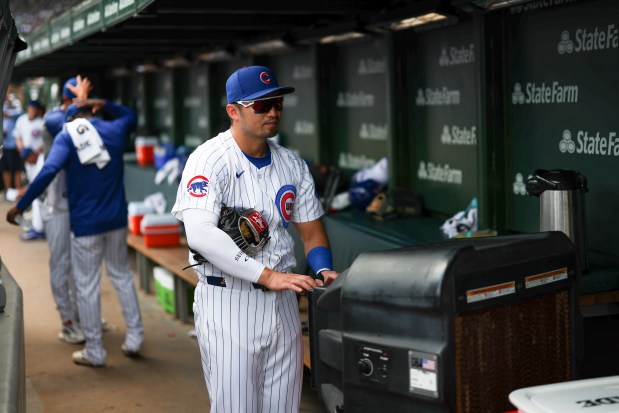 Cubs outfielder Seiya Suzuki cools himself in the dugout before the game against the Kansas City Royals at Wrigley Field, July 23, 2025. (Eileen T. Meslar/Chicago Tribune)
Every 10 seconds in the dugout, a yell rings: “Hydrate!”
And, White Sox manager Will Venable says, staff run around with water bottles for White Sox players. It’s one of the ways the team stays on top of the heat.
“Our performance group is on top of it with the stuff they have access to and give our players pregame (and) throughout the game,” said Venable after an 8-3 win against the Tampa Bay Rays in Tampa, Florida, during a road series this week.
The Monday game was held in the open-air George M. Steinbrenner Field, where the Rays are temporarily playing while Tropicana Field undergoes repairs to its roof sustained during Hurricane Milton last year. The temperature at first pitch was 89 degrees. According to Climate Central, Tampa has experienced a 3.3-degree temperature increase during baseball season over the last 55 years.
Playing in unsafe heat can cause immense stress to the body. Heat exhaustion and heat stroke raise the body temperature, which can damage organs in serious cases. Heat is the leading cause of weather-related deaths, and athletes are some of the people most vulnerable to heat.
“Environmental heat, or heat stress, is probably one of the leading issues — at least in the sporting community — we have to contend with just because of the potential risks … on the human body,” said William Adams, a sports medicine doctor and adjunct associate professor at the University of North Carolina-Greensboro. “Particularly during exercise, when your body is generating body heat.”
Only 15% of the energy that the human body breaks down gets used. The rest is given off in the form of body heat, Adams said.
“Now, the issue is, if it’s hot outside, if there’s a heat wave, and the air temperature is hotter than skin temperature, then it actually works in the opposite direction — where your body is gaining heat from the environment,” he said.
 A fan wipes his face before the Cubs host the Royals at Wrigley Field, July 23, 2025. (Eileen T. Meslar/Chicago Tribune)
Humid air, already saturated with water, also makes it harder for humans to sweat efficiently, which is one of the main ways the body regulates temperature. In the Midwest specifically, climate change is making summers more humid overall, even as seasonal high temperatures have rarely broken records in recent years. Dry conditions might drive up temperatures more dramatically, while moist air keeps them a bit lower but makes the heat feel worse to humans.
“If it’s hot, and hot and humid, and you’re exercising in hot environments, your body’s producing body heat. It needs to get rid of body heat,” Adams said. “But the environment can either slow the rate at which the heat is dissipated, or it can actually add additional heat strain onto the body.”
The four main types of heat-related illness that athletes can suffer from include heat stroke — the most severe and which can be deadly — and heat exhaustion, when the heart cannot keep up with the intensity of the exercise, followed by conditions that can cause performance issues, such as heat syncope or fainting episodes, as well as muscle cramps.
Some factors that can make athletes particularly susceptible to heat include dehydration, a lack of acclimatization, low physical fitness, sleep deprivation or wearing protective equipment.
“I don’t think we’re at a point where we can confidently say at all that we can 100% prevent heat illness from occurring,” Adams said. “It’s going to occur, but we can do things to minimize the risk.”
MLB has monitored the landscape of summer games, with Commissioner Rob Manfred echoing player concerns. In a news conference before the All-Star Game, he said he was “obviously aware and concerned” about player safety and has been in discussions where a “vast majority” of games can be played at night.
“We always aim to be flexible with our schedule,” an MLB spokesperson said. “We are always open to rescheduling games if weather conditions are deemed unsafe for on-field personnel, and we take the comfort of fans into account. We consult with the MLB Players Association during the process, as well as the Clubs involved, our medical experts, and independent weather experts.”
It has long been a Cubs tradition to play in natural sunlight, and the team’s ballpark still hosts the most afternoon games in the league. Wrigley Field was the last stadium to install lights for night games in 1988, some 40 years after every other team. Fans can even purchase shirts with the iconic Wrigley Field clock set to 1:20 p.m.
 Jonah and Lucy Puentes from California play in the fountains at Gallagher Way during the heat advisory at Wrigley Field, July 23, 2025. (E. Jason Wambsgans/Chicago Tribune)
Today, a city ordinance allows up to 43 regular-season Cubs night home games to be scheduled. A maximum of 35 nights may be scheduled before the season, while the remaining eight are utilized for rescheduling purposes. Up to four night events — defined as amusement outside of an MLB game — can be scheduled, counting towards the eight backup nights.
These scheduling rules subject the Cubs to more daytime heat than other teams. But Wrigley Field has found some ways to address this, with air-conditioned suites and player clubhouses, water fountains for fans and even the occasional running hanging hose on Gallagher Way.
“You know before you come that it’s going to be hot,” said Kesselman, the Cubs fan, after the Wednesday game. “This never would have stopped me from coming to a baseball game.”
According to the MLB spokesperson, “In preparation for warm temperatures, our minimum gameday medical standards that each home Club require a Cooling Room near the field for players, staff and umpires if the wet-bulb temperature exceeds 80 degrees Fahrenheit.”
This wet-bulb measure combines air temperature and humidity to determine how effectively the body can sweat and cool off.
Heat waves are hotter and cooling costs are rising in cities such as Chicago, studies show
Ballparks with roofs reduce exposure to ambient weather and extreme heat. Seven teams — the Brewers, Diamondbacks, Astros, Rangers, Marlins, Blue Jays and Mariners — all have retractable roofs in their ballparks. The Rays are the only MLB team with a fixed dome roof. Tropicana Field features a slanted design that minimizes cooling costs by decreasing the ballpark’s volume.
Home teams determine their roof status for regular-season games, while MLB decides for the postseason. The regular season guidelines vary by team and location; for instance, the Astros’ Minute Maid Park will close their roof if temperatures fall below 65 degrees or rise over 77 degrees, while the Brewers’ American Family Field has set 63 degrees as the “sweet spot” when determining roof status.
Could installing roofs in open-air stadiums like Wrigley and Rate Fields solve the heat problem?
“I think the night games choice is a lot more feasible than the domes, just from an infrastructure perspective,” said Callahan, who studied the impacts of heat on baseballs and home runs.
Adams said teams should have the discretion to postpone day games to the night when it’s too hot. But even a solution like that, which is more practical and flexible than building domes or retractable roofs in existing stadiums, can face logistical obstacles.
“Then you have to go into the factors, as far as what that looks like from a TV perspective, a revenue perspective,” he said.
Flying far
As temperatures have warmed since 1970, more swings have found the stands. The Cubs have had 22 seasons with over 150 home runs since 2000, compared with just nine between 1970 and 1999 — that’s an increase from .82 home runs per game to 1.13 per game. For the South Side team, the White Sox have had 20 seasons with over 150 home runs, compared with eight between 1970 and 1999 — that’s an increase from .99 per game to 1.15 per game.
Besides improvements in analytics, strategy and training, simple physics, according to Callahan’s 2023 study, could also offer an explanation: As hot air expands, meaning its molecules are farther apart, balls going through that air encounter less resistance, so they can fly longer distances.
A small air temperature increase — just 1.8 degrees Fahrenheit — at open-air ballparks during game days can lead to an almost 2% increase in home runs each game, according to the researchers.
“The difference in the batted balls between a 50-degree day and a 90-degree day is really significant,” Callahan said.
Controlling for all other factors and variables, Callahan and his co-authors found that 1% of the increase in home runs since the 1970s could be attributed to rising temperatures from climate change.
The study also associated each degree of global warming with some 95 extra home runs per baseball season. Even limiting global warming to 2.7 degrees Fahrenheit — a threshold established in the Paris Agreement that, if met, would avoid the most severe effects of climate change — instead of 3.6 degrees would avoid an additional 1,865 home runs.
“My initial reaction was, ‘Whoa. This is something I know something about. Let me do this my own way,’” recalled Alan Nathan, professor emeritus of physics at the University of Illinois at Urbana-Champaign. His work primarily focuses on baseball, and in 2017, he chaired an MLB committee that investigated the sharp increase in home runs across teams starting in 2015.
In its report, the committee pointed to changes in the aerodynamic properties of baseballs — specifically, reduced drag or resistance — as the main reason for home run increases, but was unable to pinpoint exactly what ball characteristics were to blame for it. Still, the committee offered some suggestions that have been implemented, such as storing baseballs in a controlled environment, specifically an air-conditioned and enclosed room with climate sensors that measure temperature and humidity.
Another recommendation included a standardization of mud application to baseballs, since surface texture can affect drag, and that MLB reevaluate its parameters on baseball size, weight and bounciness.
While Nathan had some reservations about the technique used in the Callahan study, his calculations, using two different methods, yielded the same result. Another scientist who participated in the committee, Jim Albert of Bowling Green State University, also did his own analysis, getting the same result.
“It seems to be pretty well-established,” Nathan said, “that the 1-degree Fahrenheit (increase) is worth about 1% more home runs.”
The impact of air temperatures remains the same on home runs regardless of humidity levels, as these have only a minor effect on air density, according to the study.
Humidity reduces air density: Even though it makes the air feel thick, it actually replaces dry air molecules with water vapor, which has a lower weight per molecule. So, if anything, humid days could also lead to less resistance to batted balls and more home runs.
“But, ultimately, that’s a small effect,” Callahan said. “If you look at, basically, days that are humid versus less humid, the effect of that on air density is pretty small. Whereas if you look at days that are hot versus cold, the effect of that on the density there is very strong.”
Ways to adapt to the small yet measurable impact of heat on home runs, much like addressing health concerns and heat-related illness, include increasing the number of night games and building domes or roofs over ballparks.
Callahan’s research found that a season made up entirely of night games would reduce the effect of warming by an average of 15%. Additionally, domed parks experience only about half of the home run increases that nondomed parks do.
The study offers other recommendations, like different pitching strategies or changes in bat composition, that might help the sport adapt to this heat.
Adaptation, however, might not prove sufficient without mitigation measures that address the root causes of extreme summer temperatures, such as heat-trapping greenhouse gas emissions.
“If you actually think about the effects of climate change on baseball, the home run effect is one, but the actual thing that we need to worry about is the safety of players and fans at baseball stadiums,” Callahan said.
Nathan agreed.
“We’re going to have far more problems to worry about than just how far a baseball travels,” he said.
Chicago Tribune’s Meghan Montemurro and LaMond Pope contributed.