
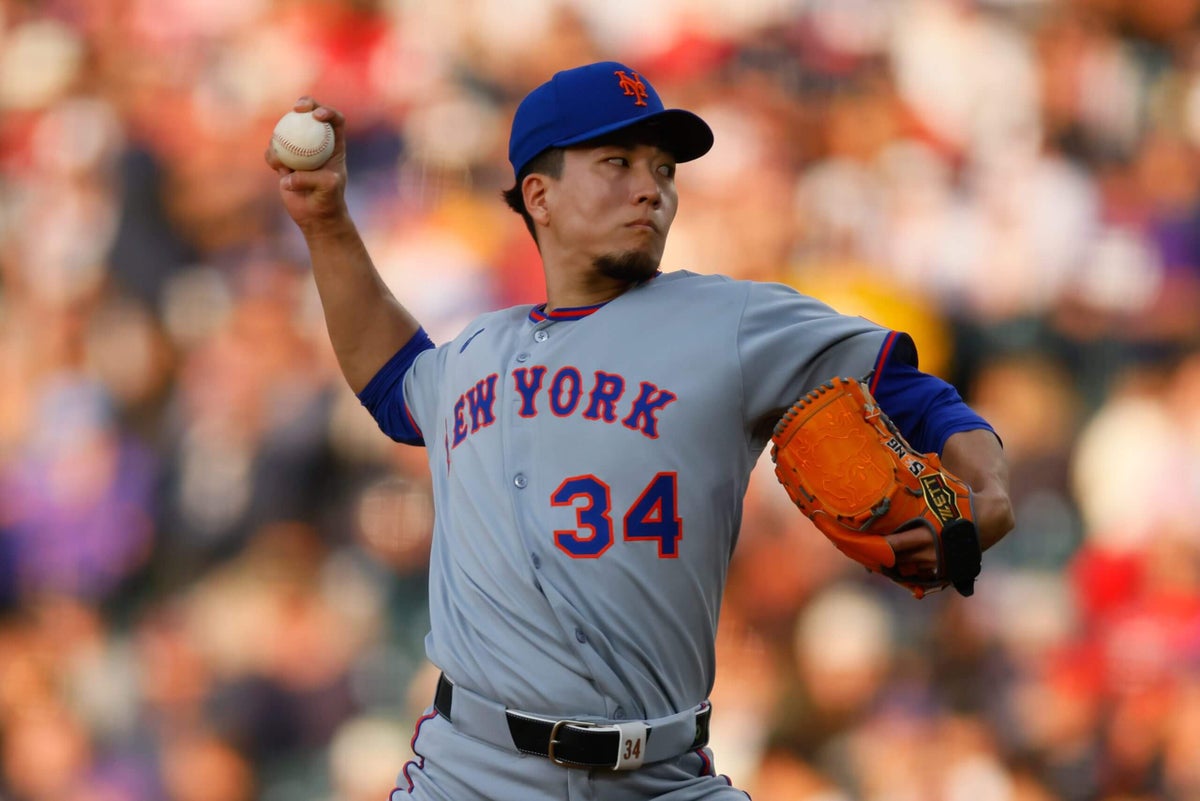
This franchise pairing has a few different historical connotations. It’s New York City’s National League legacy, or a 10-hour double-marathon, or a Barry Bonds playoff freeze-up, even the bicoastal battle for Wilmer Flores’ loyalties. This weekend’s three-game series between the New York Mets and San Francisco Giants has power for the present moment, too. Both teams are in the NL playoff shuffle, and each side has big names set up as probable starters.
How to watch New York Mets at San Francisco GiantsViewing guide
Time (ET)TVStreamProbables
10:15 p.m., Fri.
MLB.TV (national)
WPIX (NYM) and
NBCS BA / KNTV (SF)
Clay Holmes
Logan Webb
9:05 p.m., Sat.
MLB.TV (national)
SNY (NYM) and
NBCS BA / KNTV (SF)
David Peterson
Robbie Ray
7:10 p.m., Sun.
ESPN
Kodai Senga
TBD
“Sunday Night Baseball” is also available on ESPN+. KNTV can be watched over-the-air with broadcast antenna.
The visitors park their kayaks at McCovey Cove with four consecutive wins, including a home sweep of the Angels. That was sorely needed, as the Mets’ incandescent April was washed away by a rather uninspiring two-month stretch (27-27 in May and June). Before the All-Star break, they lost winnable series to under-.500 opponents like the Braves, Orioles and (gasp) Pirates. The Phillies are formidable, but New York is still atop the NL East as it starts an abridged West Coast road trip — Giants this weekend, then the Padres from July 28-30 — kept afloat by its steely overachievers on the mound.
The Mets lead the National League in team ERA. That’s in spite of losing Griffin Canning to a season-ending Achilles rupture and shelving Tylor Megill (elbow) on the 60-day IL. Perhaps David Stearns’ front office will try to add a starter at the trade deadline, but this series’ trio exemplifies what the team has been getting from the top of its rotation. RHP Clay Holmes (8–5, 3.48 ERA) is the weakest of the weekend probables, but he’s still in the 93 percentile for ground-ball outs and 91 for fastball run value. Southpaw David Peterson (6–4, 2.90 ERA) is coming off his maiden All-Star appearance, and he’s allowed one run or fewer in his last three starts. The finale’s starter, right-hander Kodai Senga (7-3), carries a filthy 1.79 ERA into “Sunday Night Baseball.”
San Francisco is down to third place in its division, the competitive NL West with its top-line Dodgers and Padres. Yet the Giants are still in striking distance of the wild card, hosting Friday’s action at 54-49 and winners of two straight games. They tagged the Braves for nine runs on both Tuesday and Wednesday, a cathartic end to a six-game losing streak. Rafael Devers played first base (yes, really!) in Tuesday’s 9-0 thumping, going 2-for-5 with an RBI and three total bases. The midseason acquisition followed that up with two homers on Wednesday:
Like the Mets, these Giants have tremendous heat cooking atop their rotation. Friday’s home starter is Logan Webb (9-7), an All-Star for the second consecutive year and the NL’s leader in innings pitched for the third straight season. Webb has allowed 10 runs in his last 11.1 innings, but the righty is still at a clean 3.08 ERA, and he’s third in the NL with 140 strikeouts. Saturday features Robbie Ray (9–4, 2.92 ERA), a fellow second-time All-Star and high-leverage strikeout machine. Ray’s FIP (fielding independent pitching) is at 3.76; he posted a 3.69 mark in his 2021 Cy Young season.
Pitching is our headliner here, but both lineups have mainstay sluggers with long-range pop. In 22 career games at Oracle Park, Juan Soto has a slash line of .325/.436/.614. On the other side, Willy Adames has a .305 batting average and six home runs in the last 28 days.
Most home runs wearing both jerseys:
Willie Mays, 660 (646 SF, 14 NYM)
Darryl Strawberry, 256 (252 NYM, 4 SF)
Jeff Kent, 242 (175 SF, 67 NYM)
Dave Kingman, 231 (154 NYM, 77 SF)
Michael Conforto, 167 (132 NYM, 35 SF)
Current playoff odds for each team
Betting/odds, ticketing and streaming links in this article are provided by partners of The Athletic. Restrictions may apply. The Athletic maintains full editorial independence. Partners have no control over or input into the reporting or editing process and do not review stories before publication.
(Photo of Kodai Senga: Justin Edmonds / Getty Images)