
![Saitama Seibu Lions player Nevin [Photo: provided by the team]](https://www.rawchili.com/mlb/wp-content/uploads/2025/07/aeQXJeF2ADnncEu6gNu9JcQWTFFQuA2PAHssVVJ6.webp.webp)
Established himself as the No. 4 in his first year in Japan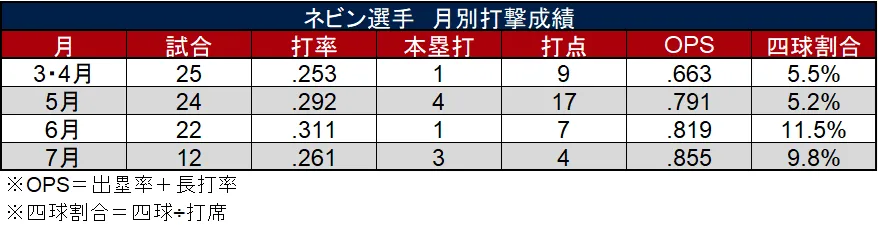 Nevin’s batting performance by month ©Data Stadium
Saitama Seibu is trying to bounce back from last year’s league finish. New addition Nevin stands out in the batting lineup. He had a batting average of .351 in the exhibition games and was in the starting starting line-up at first base and third first baseman. Although he struggled a bit in the first month, he won the Taiki Life Insurance Monthly MVP Award in May and has continued to lead the team as the fourth batter ever since. In this article, we’ll use data to look at Nevin’s process of adapting to Japanese baseball.
The key to success is batting eye Nevin’s ball zone swing rate by strike count ©Data Stadium
As for changes since May, let’s first take a look at the percentage Walk in all at-bats. In March and April, it was only 5.5%, but since May it has risen to 8.5%, above the league average (7.2%). The reason behind this improvement is thought to be his batting eye, which allows him to spot balls that are balls. His ball zone swing rate was 31.1% in March and April, but since May it has fallen by about 7 points to 24.1%. Data broken down by strike count shows that his swing rate before being forced into a tight spot has dropped significantly, making it easier for hitter to spot balls that are balls and bring the count into their favor.
Improve your swing accuracy regardless of the type of ball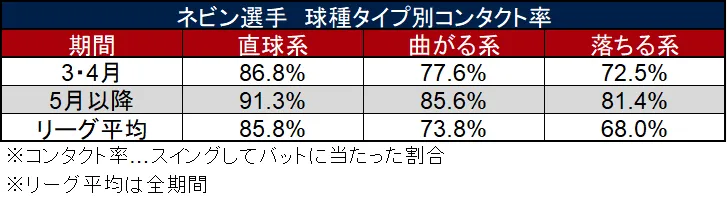 Nevin Contact rate by pitch type ©Data Stadium
In addition to no longer touching ball pitches, he has also improved his mating ability when he swings at them. Looking at the contact rate by pitch type, the numbers in March and April were still around the league average, but from May onward, the straight ball type improved by about 5 points and breaking ball by a little less than 10 points. With count ahead of the ball, the opponent pitcher is forced to throw into the strike zone, making it easier for hitter to catch.
What is the effect of the new bat that has attracted so much attention?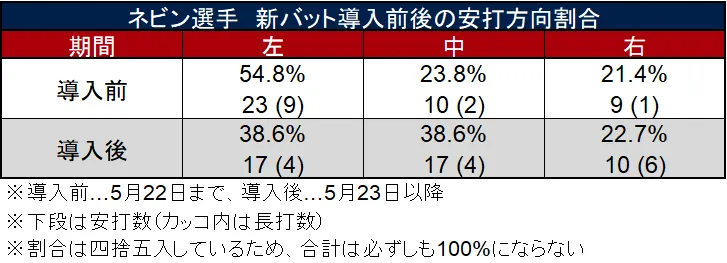 Nevin: hit direction ratio before and after the introduction of the new bat ©Data Stadium
From here, we will dig into the data after contact. One thing we want to focus on is the torpedo bat, which has been a hot topic this season. This new bat, which has a thicker core and a thinner tip than conventional bats, was approved for use in regular season in April, and Nevin has been using it since the game against Chiba Lotte on May 23rd.
When comparing the direction of hit before and after the introduction, we can see that while with the old bat, there were many hits that were pulled to the left, with the new bat, there were more hits to center fielder field. Also, it is notable that while there was only one long hit to the right before the introduction, there were six after the introduction.
Although the number of ground balls has increased, the balls themselves have become stronger. The percentage of ball characteristics hit before and after Nevin’s new bat ©Data Stadium
 Nevin’s batting average by ball type before and after the introduction of the new bat ©Data Stadium
Next, let’s look at the characteristics of the batted balls. After the introduction of the new bat, the percentage of fly balls and line drive decreased, and the percentage of ground balls and fly balls became equal. Ground balls are generally less likely to become hits than flies, so an increase in ground balls is often interpreted as a negative for hitter. However, Nevin’s batting average for ground balls increased from .150 to .237, suggesting that he is hitting more fast balls that go through the gaps between fielder. Opinions on the new bat vary from player to player, but for Nevin it appears to be a valuable ally.
Nevin is a dedicated player not only in batting but also in defense, and is highly regarded by manager Fumiya Nishiguchi as “a model player for everyone.” He signed a new two-year contract in June starting next season, and is already becoming the face of the team. We’d like to keep an eye on the performance of number 26 player in the second half of the season as the team advances to the postseason for the first time in three years.
*All figures in the text and tables are as of July 14, 2025.
Text and Data Stadium