
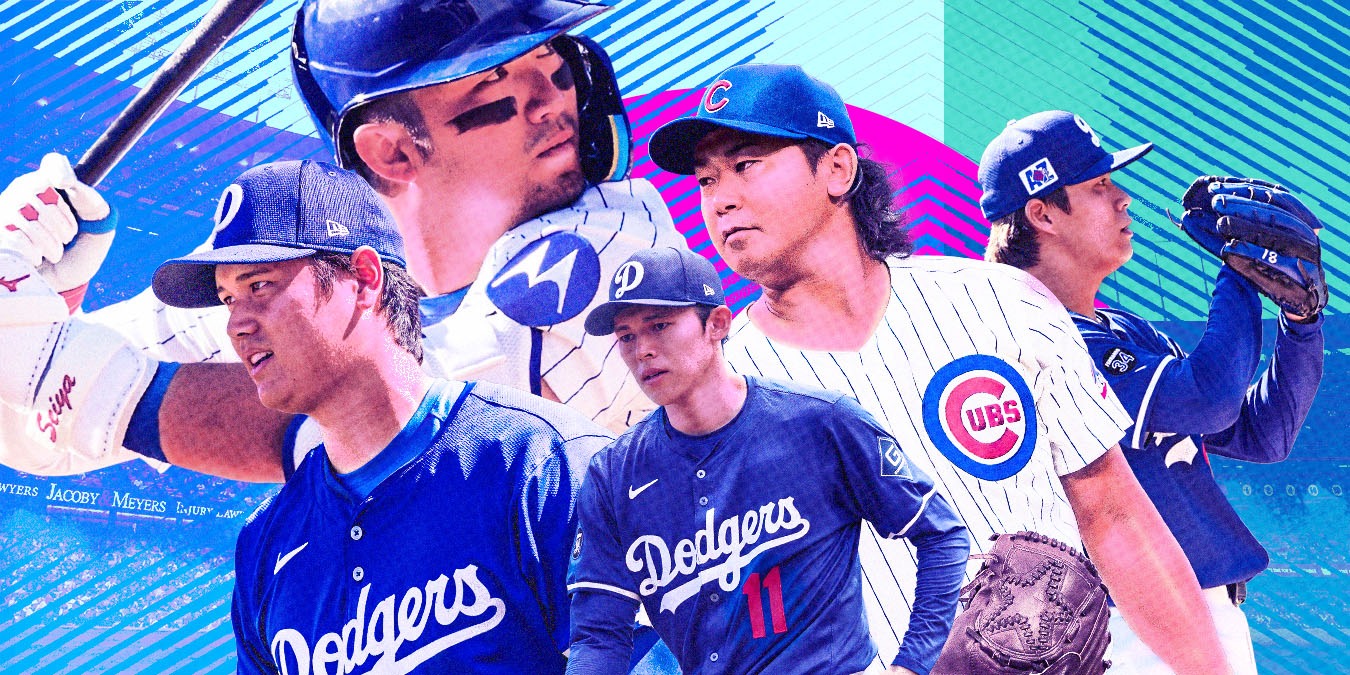
The number of Japanese
players coming overseas to play in MLB has grown
steadily over the last three decades. We’re looking at seasonal WAR
numbers to see how high Shohei Ohtani and Co. must reach to make
2025 the best ever for players from the baseball-obsessed
nation.
The long, rich history of Major League Baseball players and
teams showcasing their skills in Japan dates back to the days when
Babe Ruth and his contemporaries went barnstorming through the
baseball-loving country in the 1930s.
The two-game Tokyo Series between the Los Angeles Dodgers and
Chicago Cubs on Tuesday and Wednesday feels different, however.
It’s not just that the
2025 MLB season is officially starting in Japan, of course.
This is the sixth time that’s happened. And it’s not just that the
Dodgers are opening their season after winning the 2024 World
Series.
There are two elements that make this Tokyo Series especially
special. The first thing: Five Japanese-born players will be
competing in the two games (not including 10-year major leaguer and
current Dodgers manager Dave Roberts, whose father was a U.S.
Marine stationed there when he was born). The Dodgers have global
superstar Shohei Ohtani, along with pitchers Yoshinobu Yamamoto and
Roki Sasaki, while the Cubs counter with starter Shota Imanaga and
outfielder Seiya Suzuki.
Japanese baseball fans are ready to welcome those stars
home.
“You could not have it any better,”
MLB Network analyst Dan Plesac, who pitched in 18 major league
seasons, told Opta Analyst. “You have a guy in Ohtani who has
captured that entire country, and then you’ve got a clash of
Yamamoto and Imanaga, and then you add Suzuki and Sasaki to the
mix?”
Plesac stopped and laughed.
“This is like the greatest smorgasbord of Japanese players,” he
said, “guys who can make a real influence in Major League Baseball
like the game’s never seen.”
And that, folks, is the second thing that makes this series
especially special.
The 2025 MLB season could be – honestly, probably will be – the
most productive season ever for Japanese MLB players. In addition
to the five in the Tokyo Series, Yu Darvish (San Diego Padres),
Kodai Senga (New York Mets), Yusei Kikuchi (Los Angeles Angels),
Kenta Maeda (Detroit Tigers), Masataka Yoshida (Boston Red Sox) and
Yuki Matsui (Padres) are back in 2025.
Pitchers Tomoyuki Sugano (Baltimore Orioles) and Shinnosuke
Ogasawara (Washington Nationals) are prepared to make their MLB
debuts this season, while Koyo Aoyagi (Philadelphia Phillies) and
Shintaro Fujinami (Seattle Mariners) are likely to start in the
minors but will certainly have an opportunity at some point.
Graphic by Matt
Sisneros.
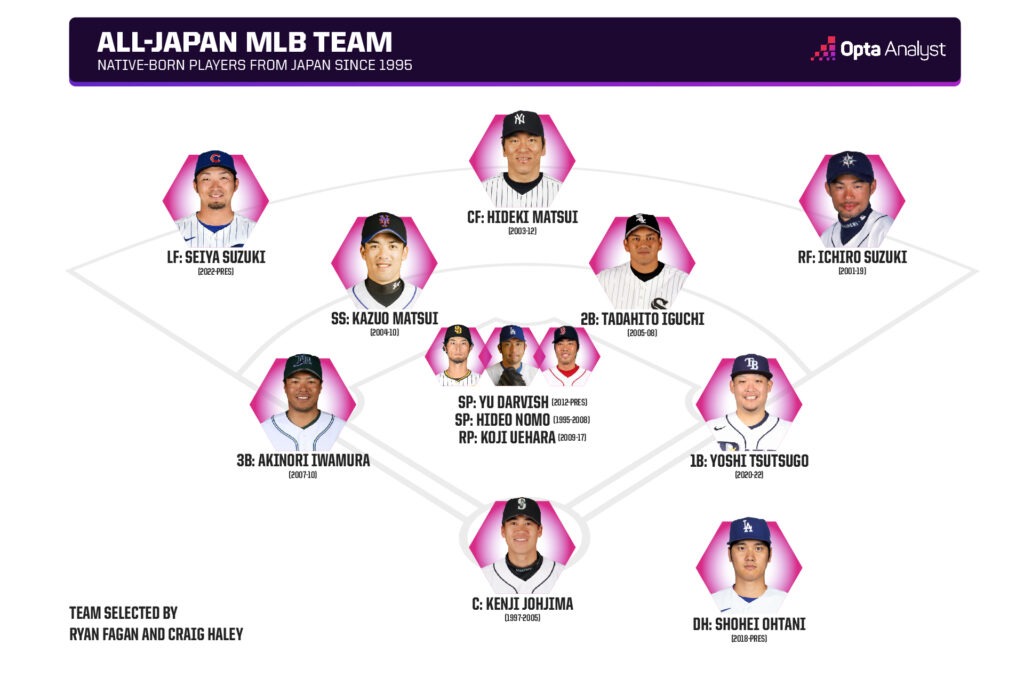
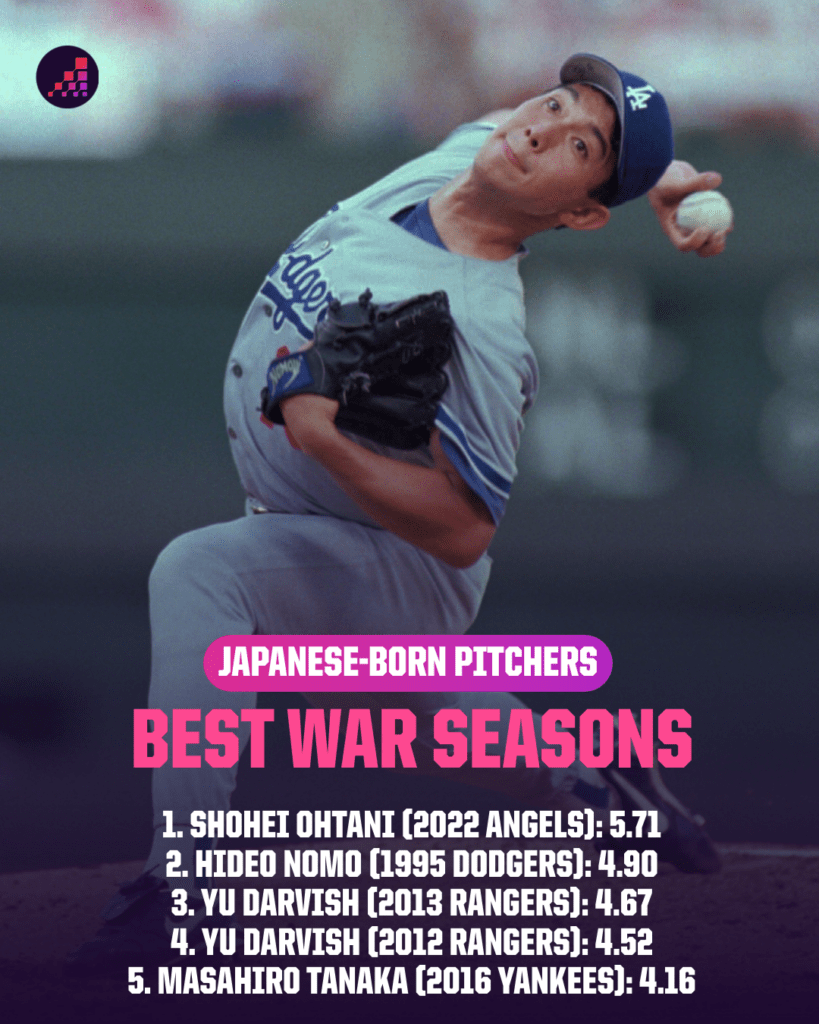
No doubt, baseball has come a long way since Hideo Nomo dazzled
with the Dodgers in 1995; he was only the second Japanese player in
the majors, and the first since Masanori Murakami in 1964-65.
Using the Stats Perform formula for WAR – including numbers
drawn from unique data collections such as historical pitch and
play-by-play data – let’s take a look at the best seasons in terms
of cumulative on-field production by players from Japan.
1. 2024
WAR: 25.51 (14.97
position, 10.55 pitching)
Need to Know: This was Ohtani’s still
mind-boggling 50/50 season, along with WAR numbers around 3.0 from
Imanaga, Kikuchi, Suzuki and Yamamoto. And this is where it starts
to become clear that 2025, with every significant contributor to
this number back in a major league uniform again, is set up to take
the No. 1 spot.
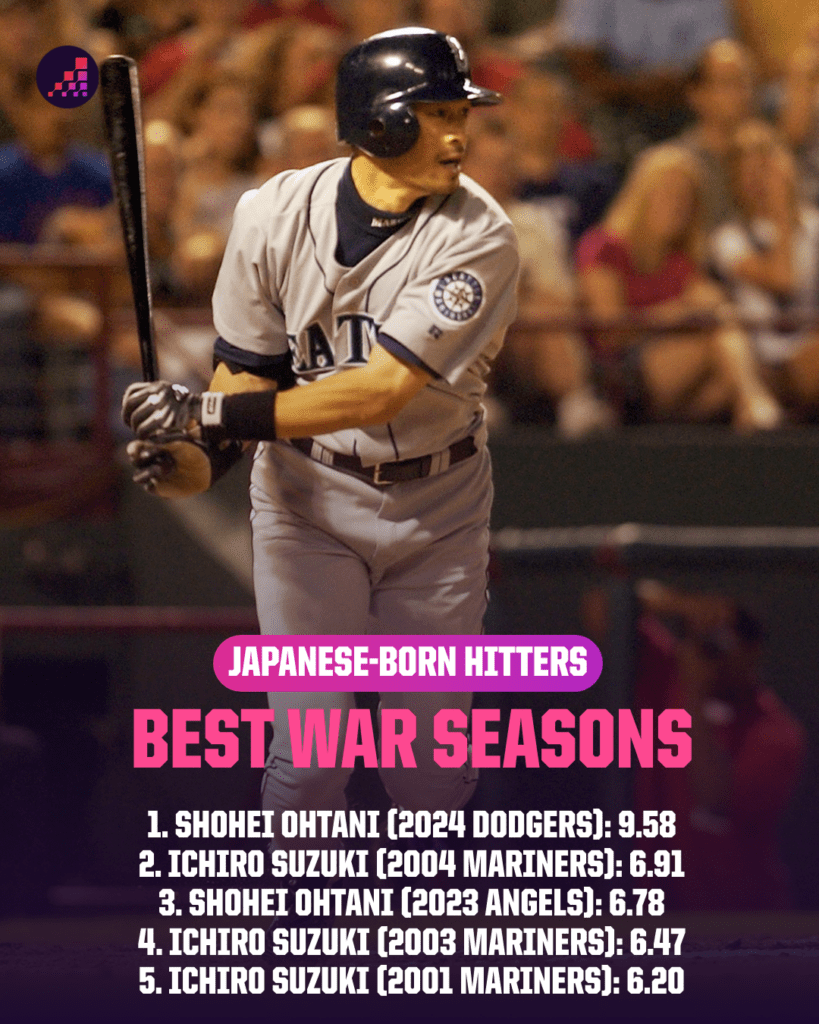
Sure, it’ll be tough for Ohtani to repeat his 9.58 WAR as a
designated hitter, but he’s expected to pitch again at some point
this season, so an overall WAR number of 10 seems reasonable.
Ichiro Suzuki,
2004. (AP)
Health will be a huge factor. Yamamoto only made 18 starts last
year, Darvish only 16 and Senga just one. If that trio makes
60-plus starts instead of just 35, that’ll be a big boost. Plus,
the phenom Sasaki gets added to the mix from Nippon Professional
Baseball.
At the plate, Suzuki’s overall numbers have been solid, but he’s
shown the potential for a monstrous season. In the second half of
2024, for example, he posted a .300/.402/.487 slash line. If he
does that for a full year – he’s always hit well at Wrigley Field –
he could double his WAR.
2. 2007
WAR: 21.51 (16.39
position, 5.12 pitching)
Need to Know: This ranking is all about depth.
Ichiro Suzuki checked in with the top WAR at just 3.85, but Kaz
Matsui, Daisuke Matsuzaka, Aki Iwamura, Hideki Matsui, Tadahito
Iguchi, Takashi Saito, Kenji Johjima, Hideki Okajima and So Taguchi
all produced a WAR of 1.0 or better.
3. 2023
WAR: 20.16 (8.36
position, 11.79 pitching)
Need to Know: This was probably Ohtani’s finest
double-dip season. He led American League batters in home runs,
on-base percentage and total bases, and posted the second-best
pitching season of his four with 10+ starts in innings pitched,
wins, ERA and WHIP.
Humor me for a moment and read that last sentence again. Let’s
all agree never to take Ohtani for granted, no matter how many
mind-boggling things he does. Cool?
Hideo Nomo,
1995. (AP)
As for 2023, Darvish, Senga, Kikuchi and Maeda all had solid
seasons on the mound, too, but it wasn’t the best year ever for
pitchers from Japan. That was…
4. 2013
WAR: 19.17 (4.24
position, 14.92 pitching)
Need to Know: In Darvish’s second year in the
majors, he led the AL in strikeouts and hits per 9.0 innings while
finishing second in the AL Cy Young voting. Hisashi Iwakuma
finished right behind him in third place with a 2.66 ERA in 33
starts, and Koji Uehara was seventh in the voting with one of the
best relief seasons in recent memory: 1.09 ERA/1.61 FIP, with 33
hits and nine walks allowed in 74.1 innings for the Red Sox. Hiroki
Kuroda, whose seven-year MLB career is wildly overlooked among
Japanese standouts, had a 3.31 ERA in 32 starts for the New York
Yankees.
5-12. 2005, 2003, 2014, 2006,
2004, 2009, 2008, 2016
WAR: From 17.82 in
2005 down to 16.79 in 2016
Need to Know: Yep, these were all bunched
pretty tightly together. Ichiro, who later this year will be the
first Japanese player to enter the National Baseball Hall of Fame,
had a couple 6+ WAR seasons in here (2003-04), and Hideki Matsui
had big seasons in 2004-05.
Research support
provided by Jesse Abrahams of Stats Perform.
You can follow our
social accounts over on X, Threads, Bluesky and Facebook.