
Here’s a look back at what happened in the Chicago area on May 12, according to the Tribune’s archives.
Is an important event missing from this date? Email us.
Weather records (from the National Weather Service, Chicago)
High temperature: 92 degrees (1956)
Low temperature: 31 degrees (1981)
Precipitation: 2.67 inches (1935)
Snowfall: None
The projector at the Adler Planetarium with Paul Langa, from left, Curt Richter, Prof. Phil Fox and Ernest A. Grunsfeld, circa 1930. (Chicago Tribune historical photo)
Chicago Herald and Examiner
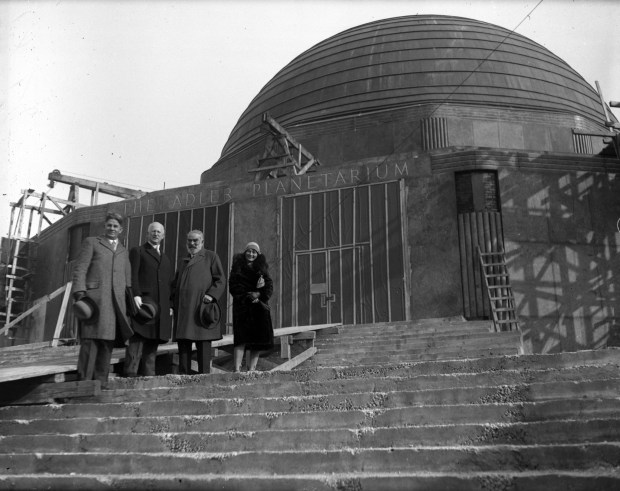
Professor Philip Fox, an astronomer, from left, Max Adler, the donor, Dr. Oskar von Miller and Frau Lula von Miller (also Frau von Bomhardt) in front of the Adler Planetarium, circa December1929. Original caption says: “Dreams come true –Sixteen years ago Dr. Oskar von Miller of Munich ordered, and ten years ago saw built, the world’s first planetarium. Here he is inspecting the latest and biggest, the Adler planetarium near the Field Museum.”
Chicago Herald and Examiner
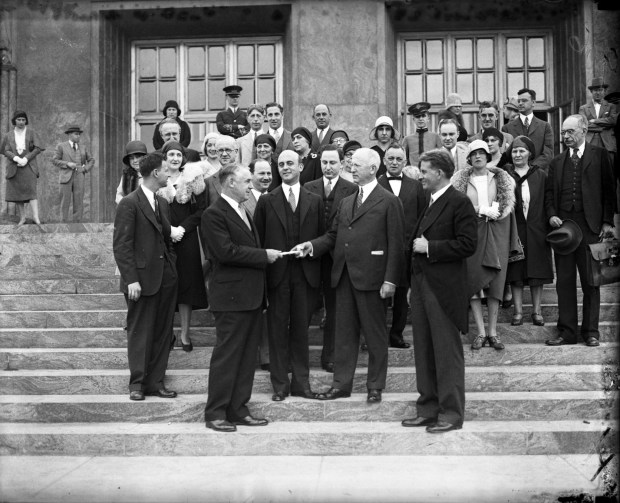
Phillip Grover, from left, George F. Wormser, Max Adler and Col. Philip Fox were present for the dedication of the planetarium on May 11, 1930.
Chicago Herald and Examiner
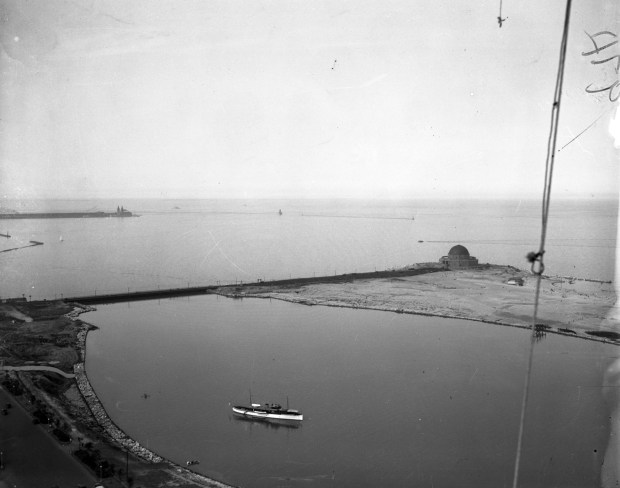
An aerial view of the Adler Planetarium at Lake Michigan just after it opened, circa June 1930.
Chicago Tribune historical photo
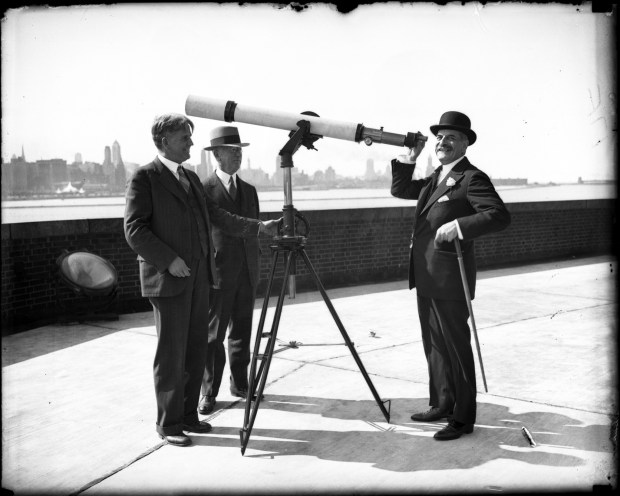
Professor Philip Fox, from left, Max Adler and Felix Warburg pose next to a telescope outside the Adler Planetarium, circa 1932.
Chicago Herald and Examiner
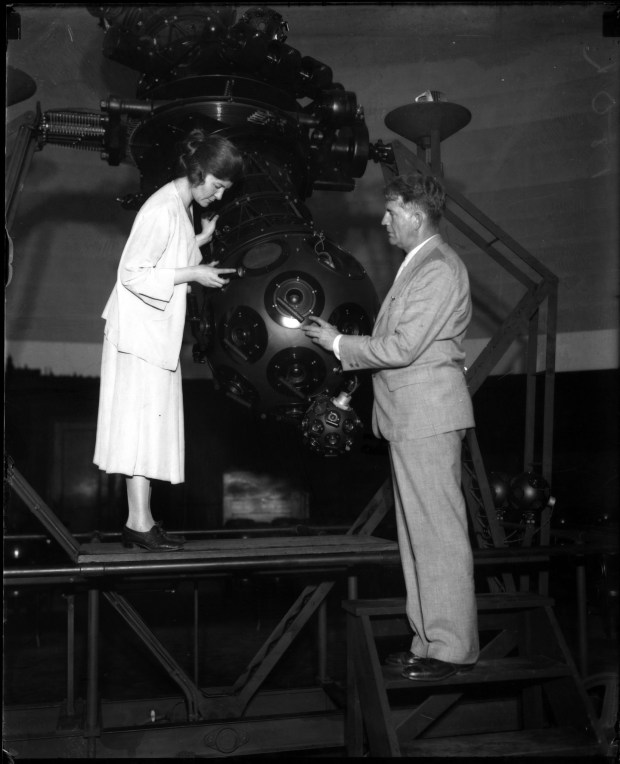
Professor Philip Fox, director of the Adler Planetarium, right, and Maude Bennot, assistant director, circa 1931.
Chicago Tribune historical photo
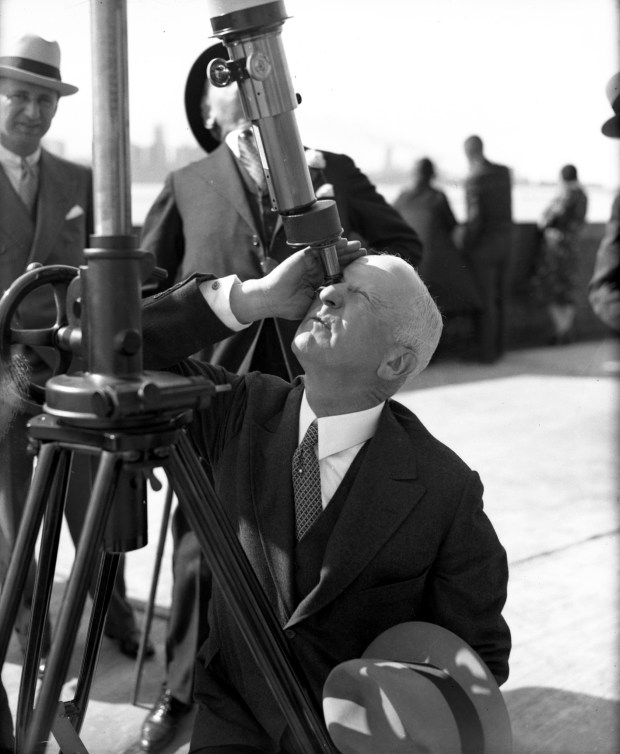
Chicago businessman Max Adler, who funded the Adler Planetarium, circa 1932.
Chicago Herald and Examiner
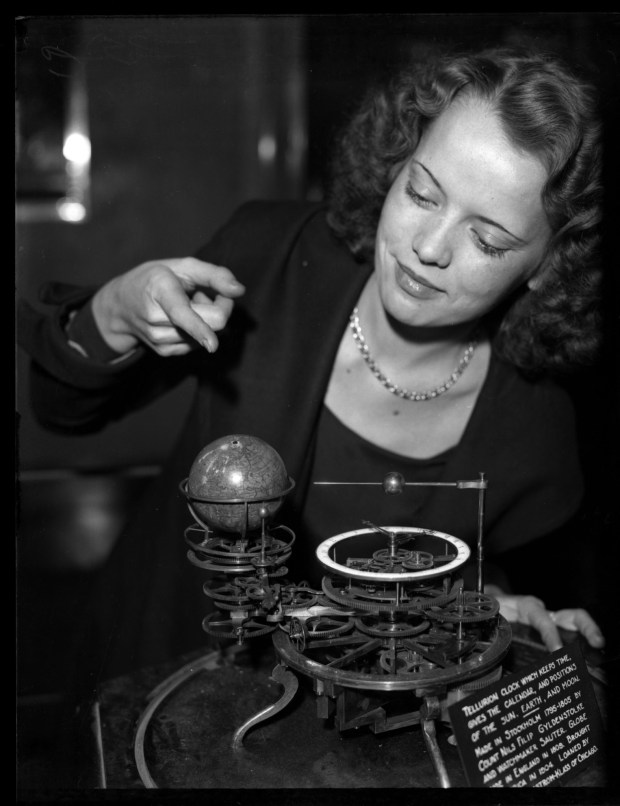
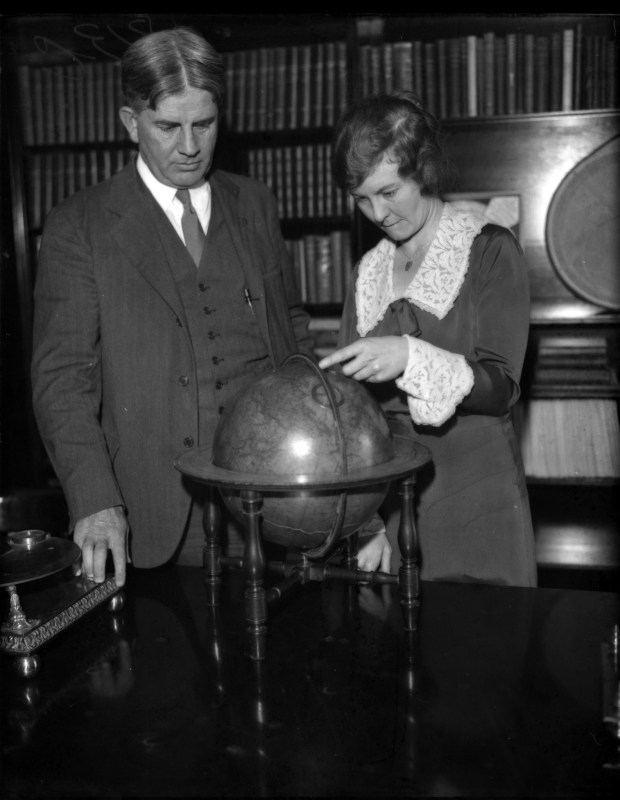
Nell Rettke points to the Tellurion clock, an old-time astronomical instrument on display at the Adler Planetarium in Chicago in 1931. The clock shows the day, night and seasons as they relate to the rotation of the Earth on its axis with the sun.
Chicago Tribune historical photo
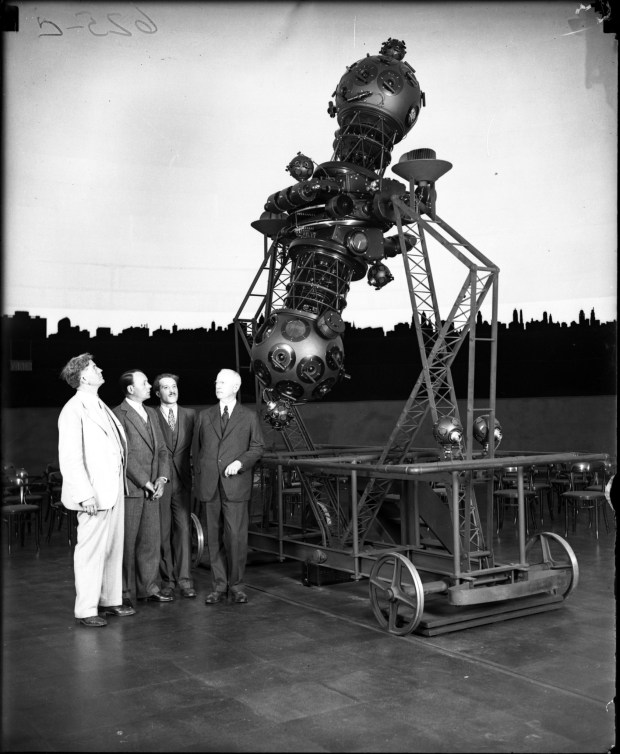
Professor Philip Fox, from left, who was in charge of the Adler Planetarium when it opened, Joseph H. Beauttas, builder, Ernest A. Grunsfeld, architect, and donor Max Adler stand next to the Zeiss projector at the Adler Planetarium in 1930 before opening day.
Chicago Herald and Examiner
Adler Planetarium Director Philip Fox, left, and Assistant Director Maude Bennot, circa 1931. Bennot would take over as director of the planetarium from 1937 to 1945, a rarity for a woman at that time.
Bill Sturm / Chicago Tribune
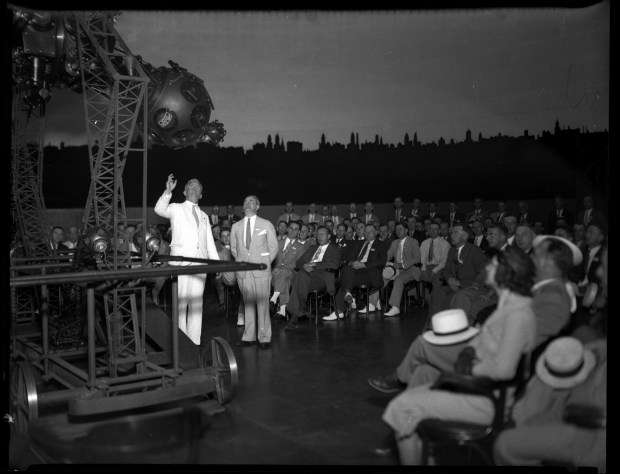
Professor Philip Fox lectures on the eclipse of the moon at Adler Planetarium in 1935. Fox has a crater named after him on the dark side of the moon.
Charles Keller/Chicago Tribune
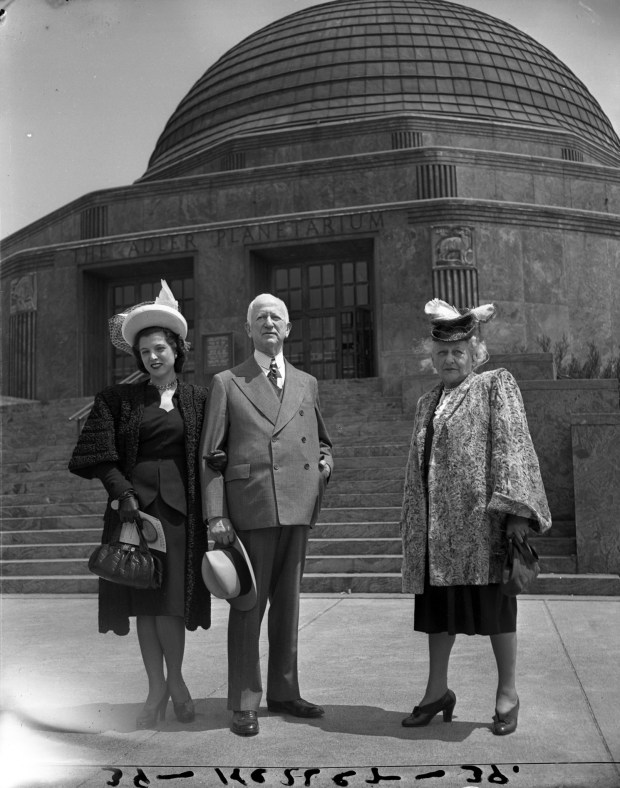
Mrs. Cyrus M. Adler, from left, and Mr. and Mrs. Max Adler make their annual visit to the Adler Planetarium in 1946.
Chicago Herald and Examiner
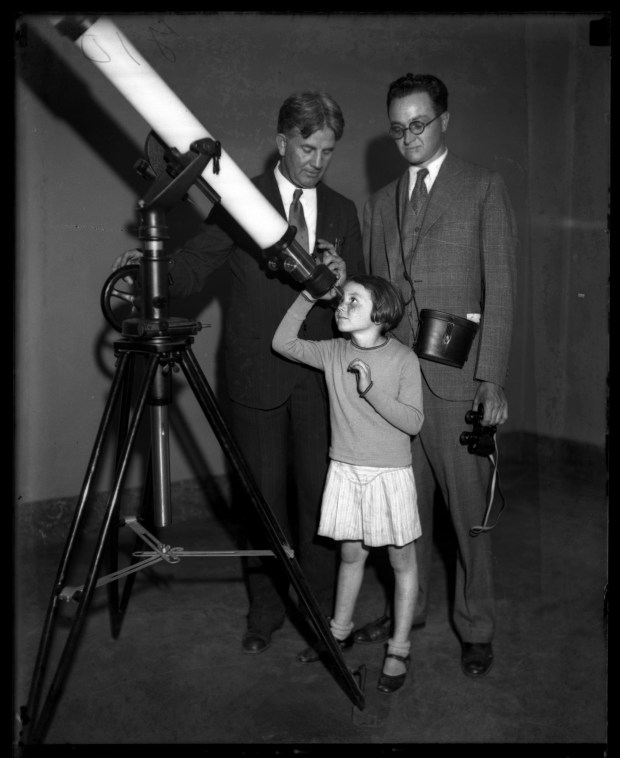
C. A. Dragstedt, of Northwestern University, and Jane Dragstedt are the one millionth visitors to the Adler Planetarium in 1931. With them is professor Philip Fox, left, the director of the planetarium. Dragstedt was given a pair of binoculars as his prize.

Ray Rising / Chicago Tribune
Hazel Gagne, of Iroquois Falls, Ontario, and Sal Amaru, of Brooklyn, New York, sit and stare at a model of the moon on Aug. 1, 1946, at the Adler Planetarium in Chicago.
Ray Rising / Chicago Tribune
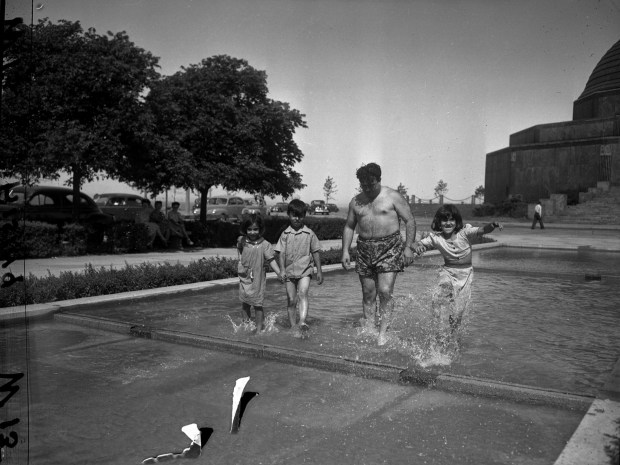
Helen, 6, Robert, 8, and Julia Chavez, 10, wade in the pool near the Adler Planetarium with Carmen Dello on Aug. 1, 1946.
Bob Rea / Chicago Herald American
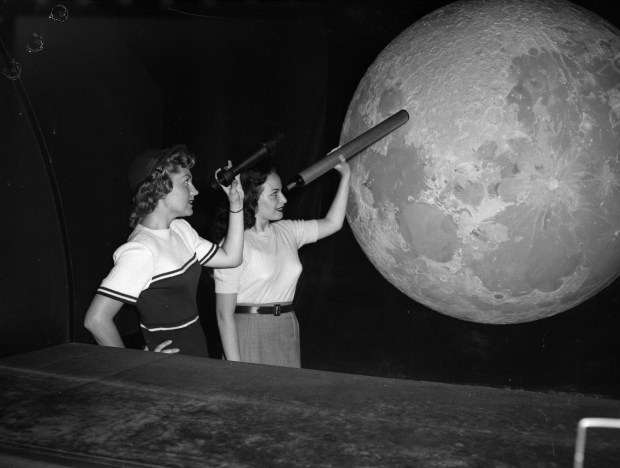
Florine Seres and Nancy Wright, NBC television stars, look at the moon at the Adler Planetarium on Sept. 22, 1950.
Wagner / Chicago Tribune
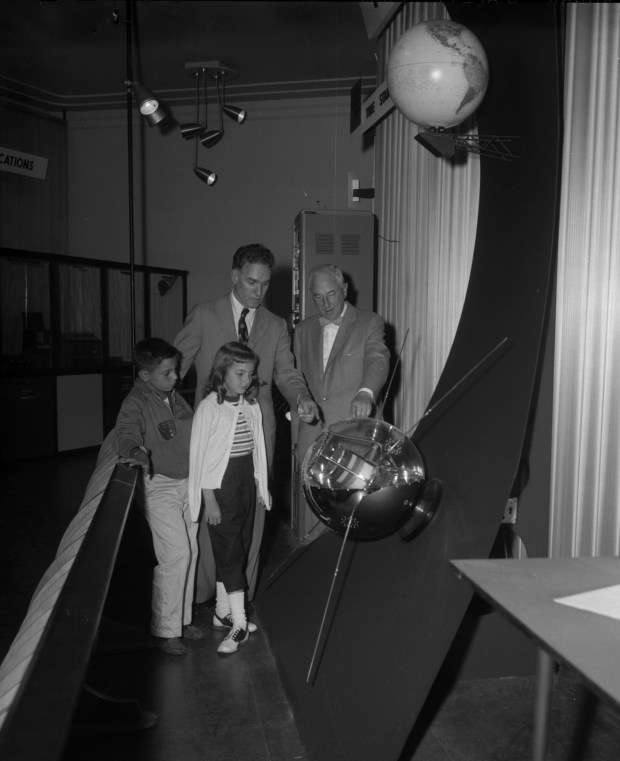
Nickey Nichols, 9, and Valarie Springer, 9, both of Oak Park, look over an exhibit with Adler Planetarium director Albert Shatzel and Robert S. Adler on June 4, 1958.
Arnold Tolchin / Chicago Tribune
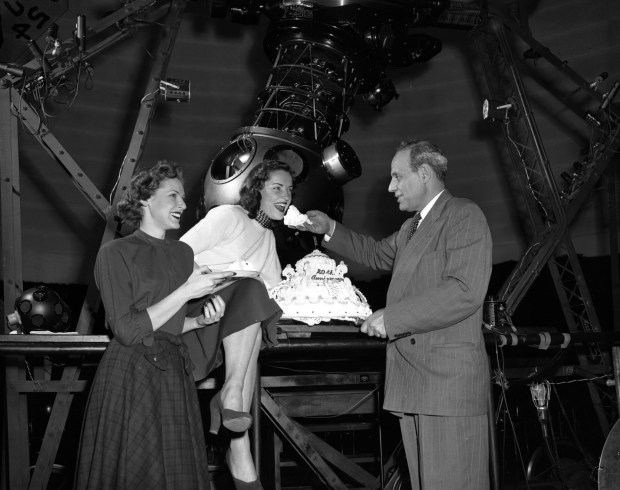
Abbott dancers Ellen Wehr and Donna Bruen get a piece of 20th anniversary cake from the director of the Adler Planetarium, Wagner Schlesinger, on May 9, 1950.
Reichstein / Chicago Tribune
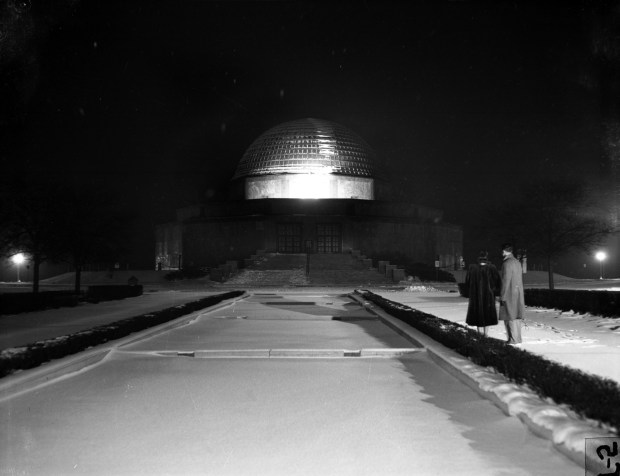
A Christmas star lights up the Adler Planetarium at night on Dec. 12, 1947, in Chicago.
Bill Allison / Chicago Tribune
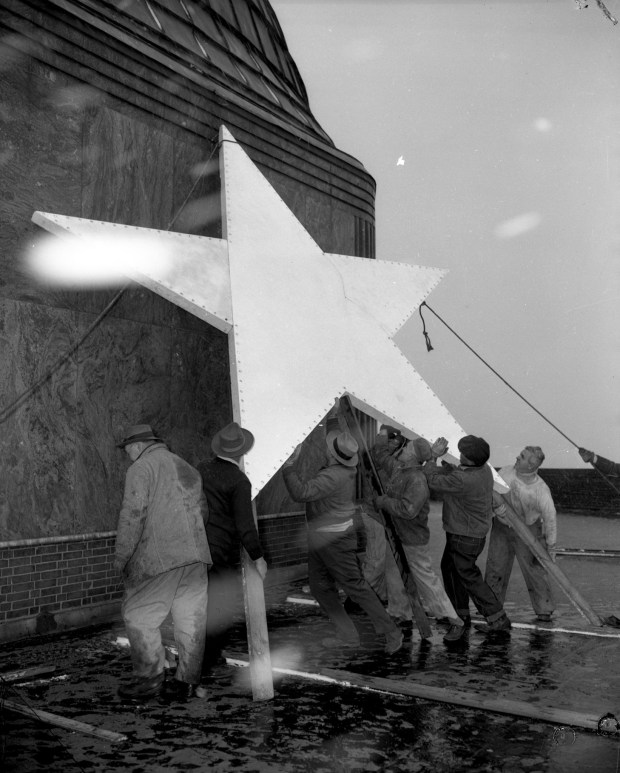
Chicago Park District workers place a star on the front of the Adler Planetarium for Christmas on Dec. 12, 1952.
Joe Migon / Chicago Tribune
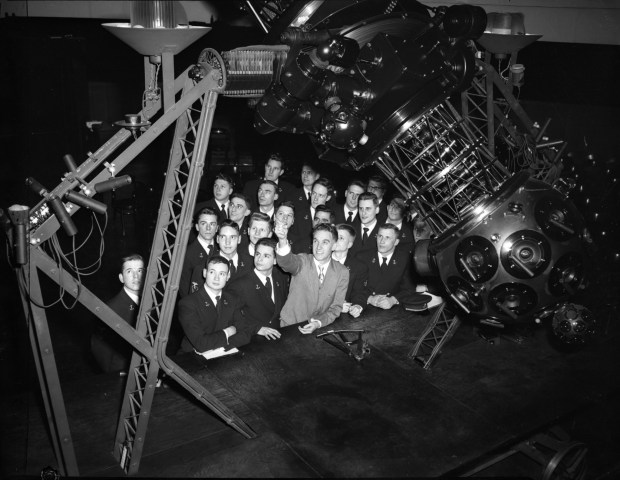
Albert W. Shatzel, assistant director of the Adler Planetarium, talks to Naval ROTC cadets from the Illinois Technical Institute on March 5, 1953.
Ed Wagner Sr. / Chicago Tribune
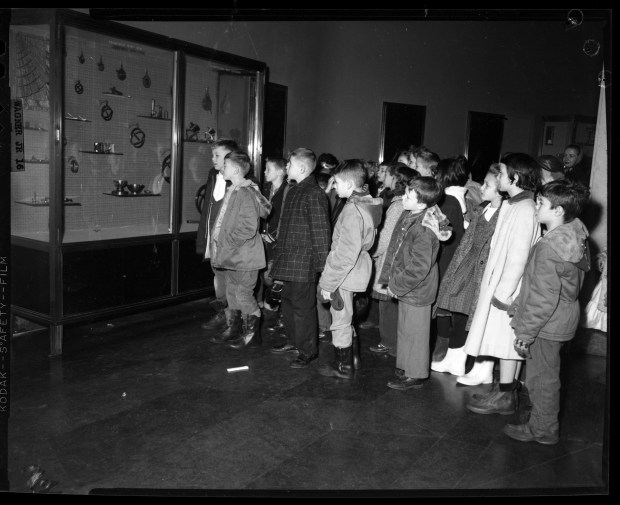
Fourth grade students from Tinley Park Central School look over sundials and nocturnals at the Adler Planetarium on Dec. 16, 1958.
Joe Mastruzzo / Chicago Tribune
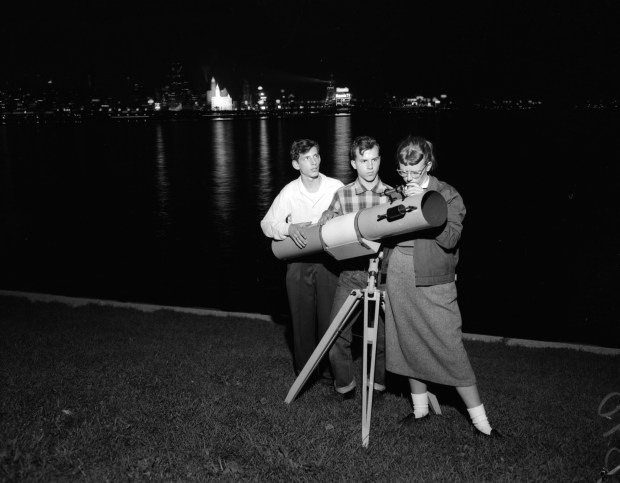
James Caplan, 14, Fred Davis, 16, and Mary Lou Carlson, 15, all members of the Chicago Junior Astronomical Society, observe movements of the planet Mars in 1956.

Chicago Tribune historical photo
Henry Eloridge, of South Coventry, Connecticut, was the seven millionth visitor to the Adler Planetarium on July 6, 1953. Eloridge was with his wife, Lillian. Greeting Eloridge is Wagner Schlesinger, the Planetarium director, who presented him with a clock construction kit.
Jack Mulcahy / Chicago Tribune
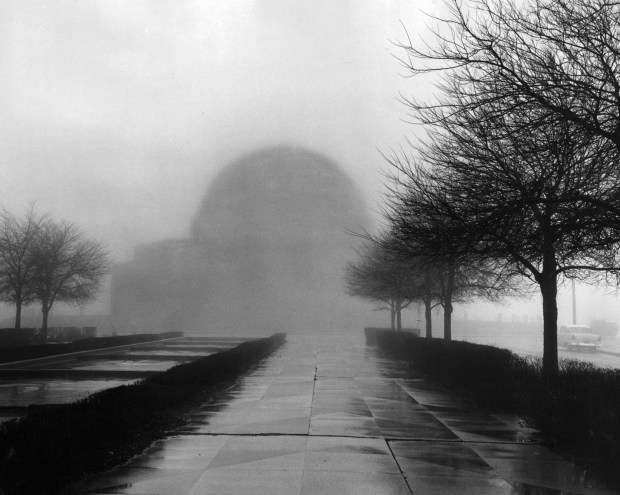
The Adler Planetarium in a wraithlike outline on April 5, 1957, as fog closes in on the city, forcing motorists to turn on headlights.
Show Caption
1 of 25
The projector at the Adler Planetarium with Paul Langa, from left, Curt Richter, Prof. Phil Fox and Ernest A. Grunsfeld, circa 1930. (Chicago Tribune historical photo)
1930: The Adler Planetarium, the first of its kind in the Western Hemisphere, opened on the lakefront. It was followed 18 days later by the John G. Shedd Aquarium.
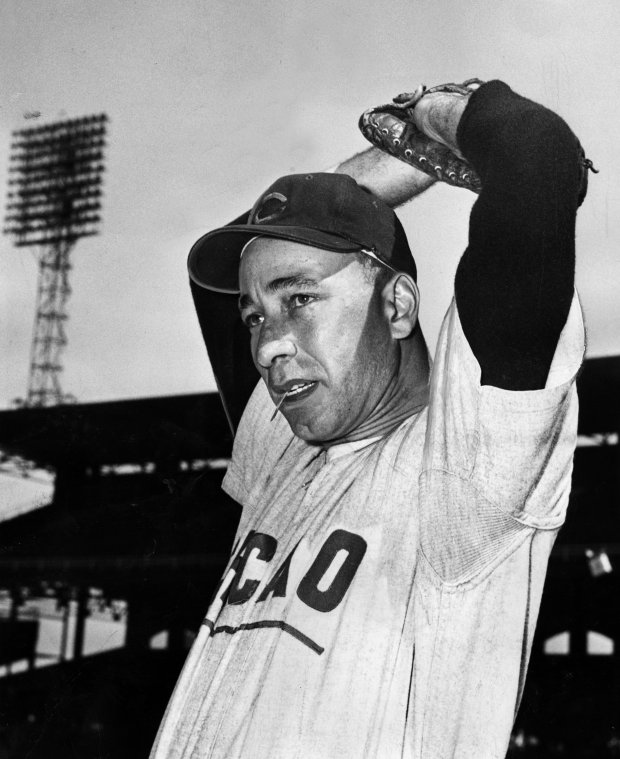 Sam “Toothpick” Jones pitched for the Cubs in 1955 and 1956. In 1955, he led the National League in strikeouts and became the first Black pitcher to toss a no-hitter in the majors. (Chicago Tribune archive)
1955: Sam “Toothpick” Jones, so nicknamed because he chewed on a ‘pick as he pitched, became the first Black pitcher to throw a big-league no-hitter, beating the Pittsburgh Pirates in a drama-packed ninth inning at Wrigley Field.
Jones, also called “Sad Sam,” walked the first three Pirates he faced in the ninth. Then he struck out the side. The three victims were Dick Groat, Roberto Clemente and Frank Thomas. He was later given a golden toothpick by TV announcer Harry Creighton.
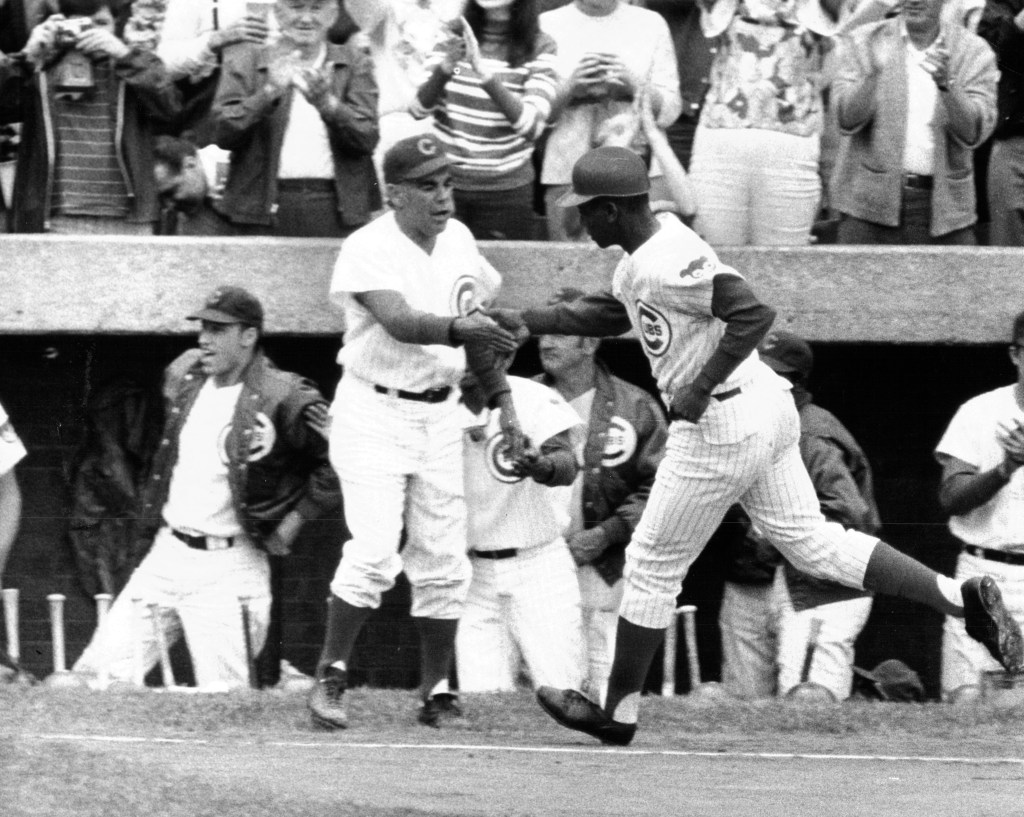
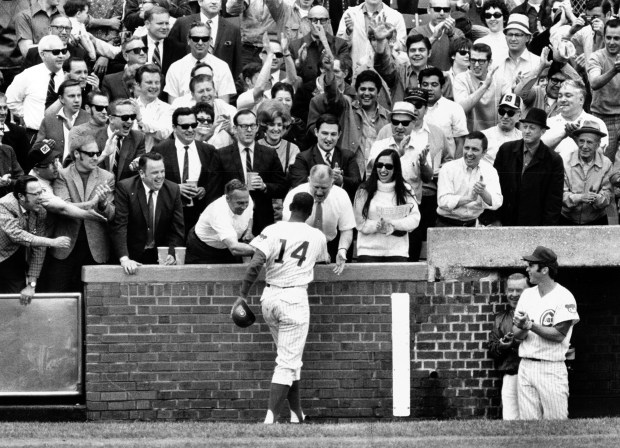 Fans greet Ernie Banks after he hit the 500th home run of his career on May 12, 1970, against the Atlanta Braves at Wrigley Field. (Phil Mascione/Chicago Tribune)
1970: “Mr. Cub” Ernie Banks hit his 500th major league home run, a solo shot off Atlanta’s Pat Jarvis at Wrigley Field. At the time, he was just the ninth player to reach the 500 mark. The milestone home run also increased his career RBI total to 1,600.
2021: Northwestern Athletic Director Mike Polisky stepped down amid criticism of his May 3 hiring. Nearly 400 Northwestern students, faculty and community members marched from campus to university President Morton Schapiro’s home to protest the hiring of Polisky. Polisky, who was NU’s deputy athletic director, was one of four named defendants in a sexual harassment lawsuit filed by a Northwestern cheerleader. The cheerleader dropped the lawsuit last year.
Want more vintage Chicago?
Subscribe to the free Vintage Chicago Tribune newsletter, join our Chicagoland history Facebook group, stay current with Today in Chicago History and follow us on Instagram for more from Chicago’s past.
Have an idea for Vintage Chicago Tribune? Share it with Kori Rumore and Marianne Mather at krumore@chicagotribune.com and mmather@chicagotribune.com