
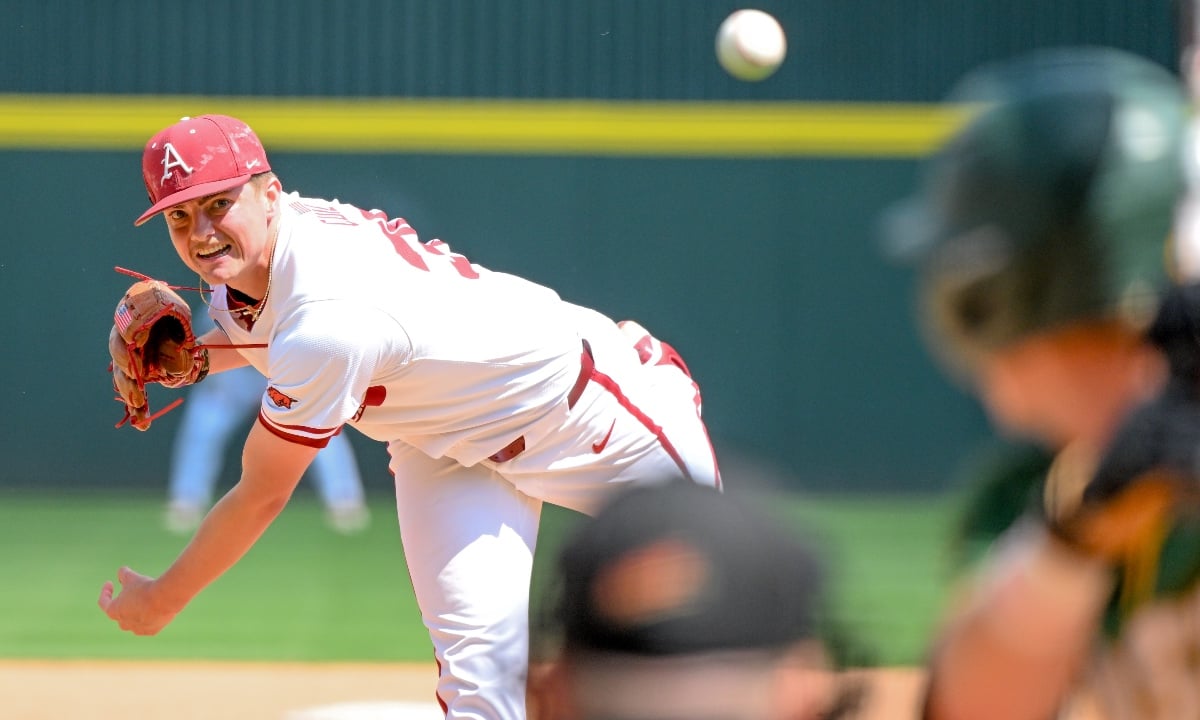
 photo credit: Craven Whitlow
Arkansas baseball fans hoping for some good news finally got their wish Monday when Parker Coil announced he was returning to school for his senior season.
The left-hander was selected by the Milwaukee Brewers in the 16th round of the MLB Draft earlier this month, but has opted not to sign and will instead pitch for the Razorbacks in 2026.
“We were in contact with Parker a lot during this process,” Arkansas baseball coach Dave Van Horn said Wednesday morning. “He felt like there were some things here he hadn’t accomplished yet that he wanted to do. Obviously, then he had to turn down some money, which he did.”
It’s unclear exactly how much Milwaukee offered, but it’s very likely Coil turned down a six-figure signing bonus to stay in college — and in doing so, is taking quite the risk at the benefit of Arkansas.
What Parker Coil is Risking
The Brewers signed five of their final 10 draft picks close to Monday’s 4 p.m. CT deadline and each of them received signing bonuses larger than what’s common for their respective rounds. Van Horn indicated that’s what they had hoped to do with Parker Coil, but his star reliever didn’t want to wait that long.
Based on the figures in Baseball America’s database, Milwaukee could have offered Coil about $165,000 with no penalty, but also had the option to far exceed that if it was willing to pay a tax on the overage. Simply put, it could have met his financial desires.
Of course, it’s also entirely possible that the Edmond, Okla., native decided he wanted to return to school regardless and bet on himself — especially after missing so much of his junior year with a back injury and then slipping into the 16th round.
The risk in such a decision is that college seniors without remaining eligibility have no leverage in contract negotiations and are often drafted as money-savers. This year’s draft featured 34 such picks in Rounds 6-10 who received $50,000 or less despite the slot values ranging from $187,300 to $386,700.
Even Razorbacks who enjoyed very successful senior years, like Jared Wegner in 2023 (.313 w/ 16 HR) and Ben McLaughlin in 2024 (.302 w/ 9 HR), got only $75,000 each after being taken in the top 10 rounds. Logan Maxwell didn’t even get drafted after hitting a team-high .356 with 13 homers and neither did Dylan Carter, who posted a 2.18 ERA in 33 innings.
That’s why most juniors turn pro if they get drafted. Only five of 302 (1.7%) such players selected this year did not sign, according to MLB.com’s draft tracker.
With the House settlement erasing the 11.7-scholarship limit, though, Coil is likely to get much more – if not all – of his school paid for this year. That’d allow him to just pocket any NIL or revenue sharing payments. It may not be enough to entirely close the gap with what he left on the table, but it at least gets him closer.
What it Means for Arkansas Baseball
Regardless of the personal financial ramifications of his decision, Parker Coil choosing to come back to school is a significant development for the 2026 Arkansas baseball team.
Worst-case scenario, the senior will provide veteran leadership on a pitching staff that has to replace 64.3% of its innings from last season. The Razorbacks lost six arms to the MLB Draft, including a pair of first-rounders in Gage Wood and Zach Root, not to mention two other key relievers to graduation.
There’s also reason to be excited about another year of Coil based on how he performed when healthy in 2025. He posted an impressive 1.27 ERA and 1.13 WHIP with 24 strikeouts and only 2 walks in 21 1/3 innings across 14 appearances.
Given the fact he’s left-handed and has shown an ability to pitch twice in a week, the floor for Coil seems to be a valuable bullpen arm who can be thrown into high-leverage spots.
The best-case scenario, though, may have played a role in his decision and could make the risk of coming back for his senior season worth it: Arkansas needs starting pitching and Coil could be part of the answer.
He doesn’t have the overpowering stuff you’ve come to expect from SEC starting pitchers like Wood, Kade Anderson and Liam Doyle, but the Razorbacks probably wouldn’t be asking him to step into a Friday night role.
While those guys flirt with triple digits on the radar gun, Coil’s fastball is in the low-90s. His best trait, however, would fit the profile of a Sunday starter: He throws strikes.
Only 2 walks in 21 1/3 innings is an insane rate and probably unsustainable with a larger workload, but it’s not exactly an anomaly. Even when he struggled to 6.55 and 7.23 ERAs his first two years in Fayetteville, Coil still averaged only 3.3 walks per nine innings. For comparison’s sake, Root averaged 3.2 this season and Hagen Smith averaged 3.6 the year before when he was the best pitcher in the game.
As Inside Arkansas’ Andrew Ellis pointed out in a conversation with BoAS, Coil should be able to consistently pitch ahead of hitters and generate weak contact for some quick outs. If he can also keep his walk rate under 3 or so, it wouldn’t matter if SEC bats hit him a little bit. The lefty would be able to eat up innings, which is exactly what you’re looking for in Game 3 of a series when both teams are presumably low on pitching.
“He’ll definitely get a look at starting,” Van Horn said. “We already know how good he is out of the pen. He can handle the heat. He can handle the pressure. He comes in, he pounds the strike zone, throwing that cutter. He makes you swing. So if he can do that as a starter, that’d be great.”
***
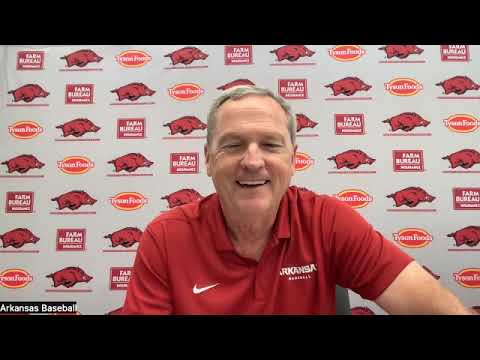
Dave Van Horn addresses Parker Coil’s return and several other post-MLB Draft topics here:
***
More coverage of Arkansas baseball from BoAS…