
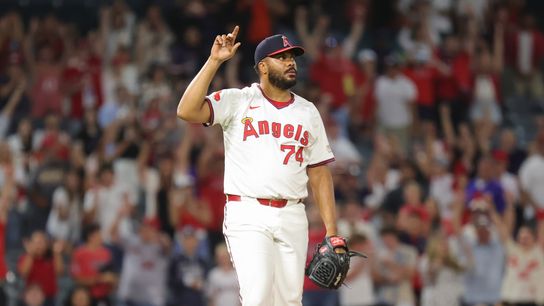
ANAHEIM, Calif. — It’s another moment in time where the Angels left people scratching their heads.
Sitting three games under .500 and four and a half games out of the final wild card spot with five teams ahead of them for that last spot, the Angels appeared to be in a prime position to sell at the trade deadline.
Instead, they added two relievers in Andrew Chafin and Luis Garcia, and infielder Oswald Peraza. Not selling their tradeable assets, and not fully buying. The Angels stayed relatively the same.
“We’re very competitive,” general manager Perry Minasian said. “‘Why don’t we keep this group together?’ It’s a really good mix. It’s the best clubhouse I’ve had in the five years I’ve been here. The players would tell you the same thing.”
To Minasian’s credit, the Angels have been competitive outside of a disastrous April when they went 9-16. Take out April, and the Angels have played 44-40 ball.
With reliever Robert Stephenson, outfielder Jorge Soler and top prospect Christian Moore nearing a return from injury, there are some reasons to believe that the Angels can remain competitive.
Another reason Minasian gave to defend the inactivity at the deadline is that he wants the young core to experience playing meaningful games in September.
“Being competitive in August and September is really, really important for this group,” Minasian said. “Not only for the now, but for the future. Playing meaningful games, understanding there’s an expectation to win, showing up to the ballpark every day feeling like you have a chance to win over a six-month period.
“It’s hard to quantify, but I felt like it was very, very important for this group to go through that and to see what playing in August and what playing in September is like with the amount of want to and the experience around them, will only benefit going forward.”
In today’s baseball world, which is ruled by analytics, many will roll their eyes hearing “it’s hard to quantify,” but there can be something to it. Playing for a playoff spot down the stretch is a different game than being out of the race and just playing to finish the season.
“You really can’t put into words how important that is,” right-hander Kyle Hendricks said. “It’s the only way you’re going to learn how to do it is by being in those situations.”
It’s the time of year that Hendricks says is when the day-in and day-out things make the difference. Teams that don’t do the little things right don’t make it past September.
“We know where we’re at in the standings,” Hendricks said. “We have to put a lot of wins together. But just being in that win-every-game mode, win-every-day, those are the teams you see really get hot at the end sometimes and really make a run through October.”
The Angels can bear the fruits of their labor in the future by playing for a playoff spot in late September. The uphill battle the Angels face, though, is getting to that point in the first place.
August has not been kind to the Angels in recent history. The Angels haven’t had a winning record in August since 2017. Over the last two years, their August records have been 9-19 in 2022 and 8-19 in 2023. The 2023 collapse in August came after going for it and buying at the deadline.
It’s known as the dog days of summer for a reason, but it’s been especially tough on the Angels.
“It’s hard mentally to understand what it takes to push through when you’re not maybe necessarily feeling 100%,” interim manager Ray Montgomery said.
When looking at the Angels’ schedule in August this year, it appears it could be another rough August for the Angels.
The headlining opponents feature trips to face the Detroit Tigers, Texas Rangers and Houston Astros while being at home to face the Los Angeles Dodgers and Chicago Cubs. They also are home to face the Tampa Bay Rays and Cincinnati Reds, who are above the Angels in the standings.
All of the Angels’ opponents in August combine for a .516 winning percentage.
A team that hasn’t been over .500 since April 20 being tasked with competing for a playoff spot while no major upgrades were made to the roster seems like a recipe for disaster. Not to mention the opportunity the Angels had to sell some pieces, such as a Kenley Jansen or Taylor Ward, to help supplement a bottom-ranked farm system.
There’s a chance that the Angels do play competitive baseball down the stretch and make their critics look foolish. But until then, this is another head-scratching decision in a decade-long run of head-scratching decisions to the point where heads are beginning to bleed.