
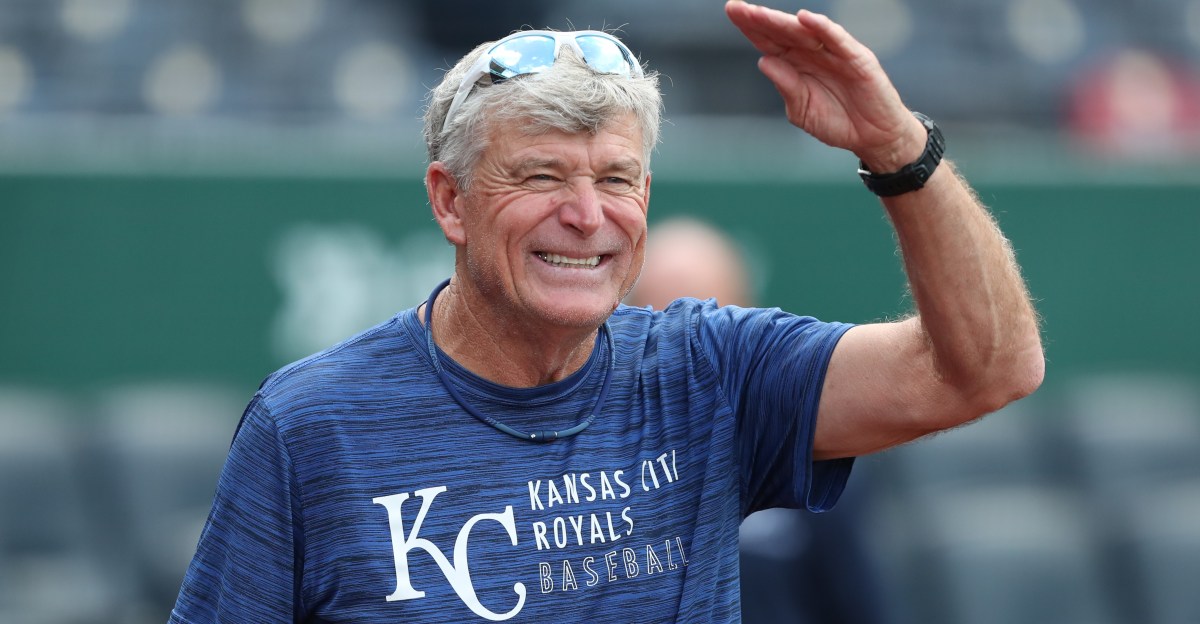
Lately, I’ve been fascinated by the more unusual and flamboyant personalities of the game. There were many in the old days, guys like Babe Ruth, Satchel Paige, Yogi Berra, Marv Throneberry, Bill Lee and Al Hrabosky. It doesn’t seem like there are as many now. Everyone is more corporate and concerned about their “brand”. Who among recent past and current players would you say? You ask ten fans, you’ll probably get ten different answers. With Bob Uecker moving on to the big ballpark in the sky, my choice for the heir apparent for the title of baseball’s most interesting man is our own Rusty Kuntz.
Every Royal fan worth their salt knows who Rusty Kuntz is. Rusty is a living legend. He’s the Mick Jagger of Major League Baseball. A timeless treasure worth the price of admission.
Speaking of Jagger and the Stones, is there a better intro to a concert than what the Stones employ? The stage is blocked by a large curtain. The crowd stirs with anticipation. Then you hear the strains of a classical music piece, maybe something by Handel or Aaron Copland. This alerts everyone, fans, roadies, and the band, that the concert is about to begin. Big-name acts rarely start on their appointed time, so this is the cue. Then you hear Keith start playing the opening riffs of Start Me Up. The crowd roars as the curtain parts, and Mick explodes to the front of the stage. Maybe there’s a better intro, but I’ve yet to see it.
Rusty was born February 4, 1955, in Orange, California. The family lived in Wichita for a short time before relocating permanently to Paso Robles, California. Rusty was a three-sport star (baseball, football and basketball) at Paso Robles High Schoo,l with baseball being his least favorite sport.
Kuntz played all three sports at Cuesta College, a community college in San Luis Obispo. After hitting over .400 in two seasons at Cuesta, he then moved on to Cal State University, Stanislaus and directed his concentration on baseball. He helped lead the Warriors to two titles in the Division III World Series. His performance attracted the attention of major league scouts, and the White Sox took him in the 11th round of the 1977 draft.
Rusty made quick work of the White Sox minor league system, playing in only 286 games between Rookie ball, AA, and AAA before making his major league debut at the tail end of the 1979 season. He collected his first major league hit during his last at-bat of the season, a ninth-inning single off the Mariners’ Rick Honeycutt.
Kuntz made the Sox out of spring training in 1980, made a few starts, but was squeezed for playing time with Chet Lemon, Harold Baines, Thad Bosley, Claudell Washington, and journeymen Bob Molinaro and Wayne Nordhagen, who hit .291 and .277, respectively, getting most of the outfield reps. Kuntz spent most of the summer in Des Moines, where he proceeded to tear up the American Association to the tune of .292/.360/.460. The Sox brought him back up in early September, where he made 24 more appearances.
Kuntz spent all of 1981 in Chicago but only appeared in 69 games. 1982 and 1983 were split between the White Sox and their AAA affiliates. The Sox were a formidable team in those years with many good outfielders, guys like Steve Kemp, Harold Baines, Rudy Law, Vance Law, Ron LeFlore, and a young up-and-comer named Ron Kittle.
The Sox finally broke through in 1983, winning the Western Division crown. Unfortunately, Kuntz wasn’t around to enjoy it. The Sox traded him to Minnesota in June of 1983.
Kuntz got a measure of revenge on June 23rd when the Twins visited the White Sox. Rusty led off the game with his first major league home run, off Floyd Bannister. It was an awkward encounter, as the two were friends and up until the previous week, teammates. Bannister knocked Rusty down with the first pitch, one that “got away from him”. Rusty hit the next pitch into the left field bleachers at Comiskey. Never much of a power hitter, Kuntz victimized Bannister again on July 4th at the Metrodome.
With a young Kirby Puckett in the wings, the Twins sent Kuntz to the Tigers in December of 1983 for pitcher Larry Pashnick. The move came at the right time for Kuntz. He was joining a powerhouse Tiger team that started the 1984 season on a 35-5 heater. Manager Sparky Anderson was a master at deploying platoons. His three starters, Larry Herndon, Chet Lemon, and Kirk Gibson, got most of the at-bats, but Anderson found plenty of playing time for guys like Ruppert Jones, Johnny Grub,b and Kuntz, who responded by hitting a very respectable .286.
In his final at-bat of the season, Kuntz stroked a seventh-inning double off the Yankees’ Dennis Rasmussen at Yankee Stadium. It would be his final major league hit.
Rusty made an appearance as a pinch hitter in Game One of the ALCS against the Royals. He made two appearances against the Padres in the World Series, and his Game Five, bases-loaded fly ball to right, or as Rusty calls it, “a dying quail”, drove home the winning run. In his 6th big league season, at the age of 29, Rusty Kuntz was a World Series champion.
He returned to the Tigers in 1985 but only got into five games before being sent to the Tigers’ AAA affiliate in Nashville. After being released by the Tigers, Kuntz caught on with the Oakland Athletics but didn’t see any action.
In 1986, for the first time in his life, he was out of baseball. He went to work delivering packages for UPS before joining the Houston Astros for the 1987 season as a coach. The move to coaching was more like a calling to Kuntz. Over the years, in addition to the Astros, he worked with the Mariners, Marlins, Braves, and Pirates, earning rave reviews from his pupils.
Rusty joined the Royals for the 2007 season and over the past 18 years has served in a variety of capacities. He’s coached first base, been a field instructor, a special assistant to the GM, and a general manager of quality control. His work at first base and his dedication to watching film have made him a legend in Royals Nation. Former manager Mike Matheny said of Kuntz, “I believe he’s one of the best coaches I’ve ever been around,” adding that Kuntz’s infectious zeal has led him to profound knowledge of the game. “You just kind of watch how he goes about his business; he makes people better.”
Kuntz’s dedication has sometimes come with a cost. In 2014, he took a batting practice line drive off his wrist, which resulted in a fracture. The scariest incident happened in 2017, when Kuntz took a Mike Moustakas line drive off the head. The blow caused Kuntz to miss some time with vision problems.
Rusty’s dedication to video and scouting is legendary and was one of the key components to the Royals’ 2015 World Series title. He has an almost photographic memory of players’ tendencies. Here are a few examples:
– He noted how Toronto right fielder Jose Bautista would often lob his throws back to the infield. In Game Six, with the score knotted at three and Lorenzo Cain on first, Eric Hosmer dumped a single to right. LoCain just kept running and scored the winning run, which gave the series to the Royals.
– In the World Series, he noted how New York first baseman Lucas Duda had a somewhat erratic arm, and the Royals could run on him. In the ninth inning, of Game Five, with the Royals trailing by one, Hosmer was on third when Sal Perez grounded out to third base. Hosmer audaciously broke for home, and Duda airmailed the throw. The Royals of course, won the game and title in extra innings.
Those two plays not only won the games but also remain two of the most iconic plays in Royals history. That’s how you coach.
Most recently, Kuntz has been working with rookie wunderkind Jac Caglianone on his transition to the outfield. While Jac’s work at the plate has been slow to develop, I think he’s looked good in right field, considering that it’s a new position for him and he’s had to learn on the job.
The Royals have been blessed with some good coaches over the years, but like Jagger, I can’t think of anyone better than Rusty Kuntz.