
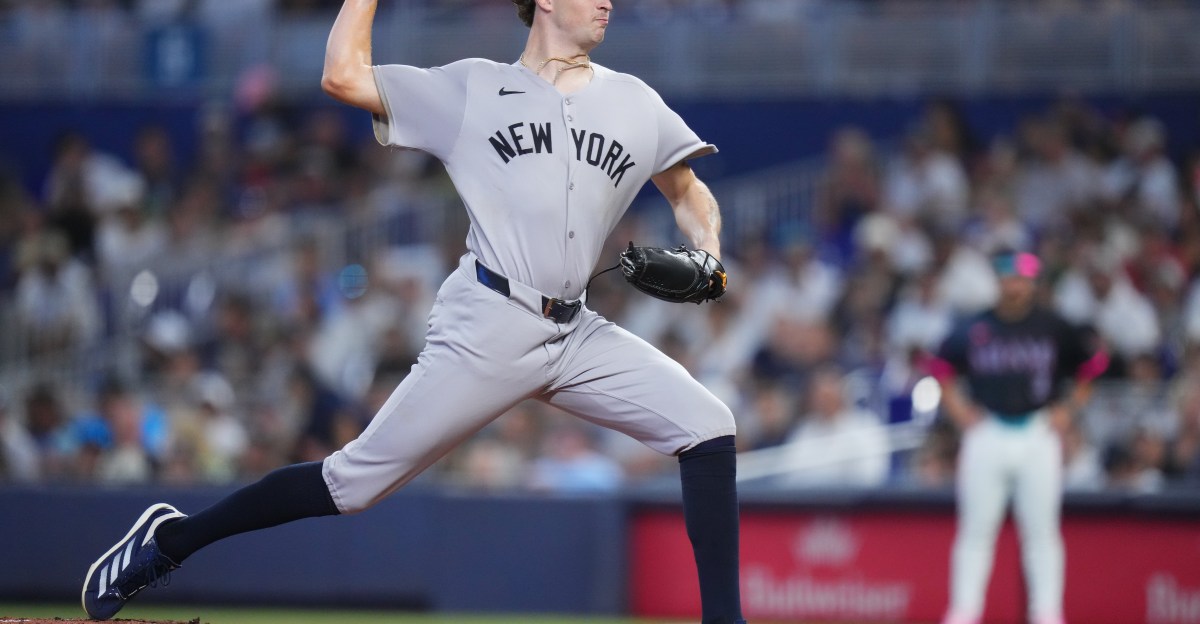
The day after the trade deadline, the Yankees made a big decision in regards to their pitching staff ahead of what turned out to be a miserable weekend in Miami. Facing a roster crunch with the impending return of Luis Gil to the rotation, the front office elected to cut bait on Marcus Stroman, releasing the disappointing veteran one day after he took the win in the series finale against the Rays and eating the remaining sum of his 2025 salary while officially taking his 2026 vesting option off the table.
The biggest part of that decision was the vote of confidence that the organization displayed in rookie Cam Schlittler, who has three options and could’ve been demoted to the minor leagues had the Yankees gone with a different option. Instead, the team viewed the 24-year-old the best of their choices, giving him a green light to remain in the rotation for the foreseeable future.
Schlittler’s spot in the rotation is not guaranteed, however. Ryan Yarbrough, who was impressively steady as a backend starter before going down with an oblique injury in late June, will face hitters for the first time in his rehab process today, with a return not out of question before the end of August. Before he’s back, it’ll be on Schlittler to show enough to move Yarbrough into long relief instead of having him pluck the rookie’s spot in the rotation.
There’s been some good, some bad, and some question marks through his first four big league starts. Overall, he has a 4.58 ERA (90 ERA+) and 5.96 FIP with 21 strikeouts and 11 walks in 19.2 innings. Just off the baseline stats, a big mixed bag. Ahead of his fifth career start on Friday against the rival Astros, let’s dive in on what we’ve seen from him so far.
For one, Schlittler has provided something that, prior to the deadline, the staff just did not possess. Prior to Schlittler’s debut, the hardest pitch thrown by a Yankee was a 98.5 mph sinker by Yerry De los Santos. In his major league debut against the Mariners, Cam threw six pitches harder than that in the first inning. His four-seam fastball averages 97.8 mph.
That heating is electric, posting a 29 percent whiff rate, a .227 batting average against, and running up to nearly 2,500 RPMs. As much as it’s probably his worst-located pitch, it’s so overpowering with an average Induced Vertical Break of 16.7 inches that he can overcome shaky placement by just blowing it past people. He’s throwing it 57 percent of the time and it’s ultimately been the pitch to bail him out of trouble a lot.
The problem is that he can’t find a consistent secondary pitch. His slider is his bread and butter complement to his fastball, throwing it 21 percent of the time, but he’s struggled mightily with locating it. Look at the heatmap of the pitch. You typically don’t want sliders above the zone or over the heart of the plate:

That location has caused him to allow a .381 wOBA and .428 xwOBA with an average exit velocity of an untenable 96.8 mph against the slider. Agustin Ramirez, a one-time battery mate of his, blasted a slider that stayed up (albeit out of the zone) for a home run last time out. In his start against the Blue Jays, he couldn’t get it down at all, leading to a lot of misses upstairs that led to a real grind of an outing.

In the remaining 21-ish percent of pitches, Schlittler throws a curveball, sweeper, and sinker. The curveball is his third offering against lefties, while his sweeper is his third offering against righties. He’s located the sweeper well but has perhaps gotten unlucky. The same cannot be said for the curveball, which is not getting down at all and is landing in the heart of the plate much too often.
His inconsistent offerings, along with a concerning lack of command at times, have led to an alarming WHIP of 1.68. Yet he’s shown real guts by being able to make pitches with his back against the wall on the verge of a blowup inning. He allowed ten baserunners in five innings against the Blue Jays on July 22, but made the right pitches. Take this sequence against Alejandro Kirk, where he continued to climb the ladder ahead in the count and struck him out to avoid a big inning.
As much as he’s had moments where he can’t find the strike zone (the first inning against the Rays, namely), he has guts. Later in that Toronto start, he walked the bases loaded in front of Vladimir Guerrero Jr., but got ahead in the count and located a sweeper on the outside half to induce a pop-out.
In my eyes, the start against the Rays was probably his worst. He had the worst command we’ve seen from him and allowed 11 baserunners in 4.1 innings. Still, he executed after two singles to start the fourth in that outing to retire the soft-hitting Matt Thaiss and Chandler Simpson to at least keep his team in the game when it could’ve gotten so much worse:
Despite this only being a small sample size of starts, it’s hard to envision Schlittler figuring out his issues with command, giving up hard contact, and location midseason. There’s a really good pitcher here to be molded, but the Yankees will need to work with him to fine-tune his command and flesh out his arsenal. He had a changeup in the minor leagues and reportedly worked on a splitter in spring training, but has carried neither over to the bigs. Something that runs arm-side to be a better neutralizer against lefties feels like the next step in his progression.
Can he do enough in the meantime to make it work in the bigs, at a time when the Yankees desperately need him? That’ll be up to him to determine.