
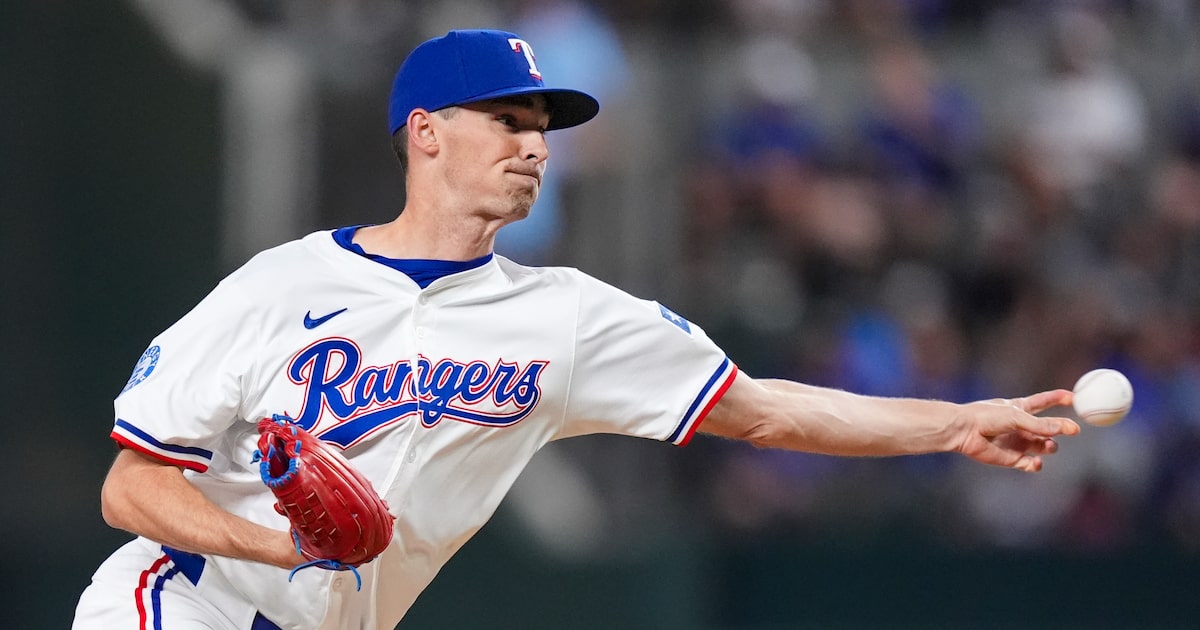
ARLINGTON — Texas Rangers bullpen coach Jordan Tiegs once warned left-handed pitcher Hoby Milner that he’d approached “hitting speed” with his fastball.
Milner, a funky sidearm thrower, had only touched 90 mph.
“He’s right,” Milner said. “There’s something to it.”
In the Texas bullpen, at least, there is. Baseball is in the midst of its velocity era, where arms that consistently pump triple digits are both sought after and no longer a rarity, though the Rangers bucked that trend when they built one of baseball’s best bullpens this previous winter.
Rangers
Rangers relievers have combined to throw the slowest-average fastball in baseball at 92.5 mph this season, and despite that, have yielded some of the league’s best numbers. Batters hit just .224 against Texas bullpen fastballs, the third-lowest mark in baseball, and have posted a league-worst .305 on base percentage vs. the pitch. Their 25.4 fastball runs above average metric, according to FanGraphs, is the best among all American League bullpens.
“Velocity is just one aspect of what makes pitchers successful,” Rangers president of baseball operations Chris Young said. “There’s certainly a correlation with good velocity and success, at times, but there are other metrics that are equally important that we look at.”
The Rangers rebuilt their bullpen from scratch this winter and had to do so in a fiscally conscious manner as the club’s offense garnered the large portion of available offensive resources. Velocity — especially velocity well-wielded — often requires a premium payment.
Young said that the front office “studied other bullpens without a ton of financial resources thrown at them” and in turn identified a core of low-cost veteran arms whose strengths favored an ability to throw strikes instead of high velocities.
The Rangers will spend just under $13 million this season on the six relief pitchers they signed this past winter. There were 11 different relief pitchers who signed contracts with an average annual salary of $10 million or more — including former Rangers right-handers Kirby Yates and José Leclerc — this past offseason. Right-hander Chris Martin, who signed a $5.5 million deal, is the highest paid Texas reliever and is among the bullpen’s hardest throwers with a 94.7 mph average fastball.
FanGraphs estimates that their financial worth this season — a formula which converts performance into a dollar value — is close to $30 million. The veteran-laden group, which right-hander Luke Jackson aptly dubbed “a bag of misfit toys” before he was designated for assignment, has posted a 3.38 ERA that ranks fourth-best in baseball.
They’ve done so with that abnormal lack of heat. Their 92.8 mph average four-seam fastball velocity is the fifth-slowest of any bullpen in the 2020’s. The New York Yankees bullpen has thrown the second-fewest fastballs (182) at 97 mph or greater this season. The Rangers are dead last and have thrown just 35 fastballs that speed or faster. None were thrown by one of the team’s high-leverage relievers.
The consensus explanation for the success, according to those directly involved in the operation, is twofold.
First, they throw strikes. Their 54.6% in the strike zone percentage and 102 Location+ rating are both the second-best among all bullpens leaguewide. Their 9.4% walk percentage on fastballs specifically is the second-best rate in the American League and their 8.7% overall walk percentage is the league’s ninth-best. Their fastball command, according to FanGraphs’ PitchingBot modeling system, is tied for the best.
“Generally speaking,” Tiegs said, “they’re all strike throwers, so when they do throw their fastballs, they get production from it. They’re either really intentional on where it goes or there’s a component to it that isn’t accounted by velocity.”
Said Young: “I think the commonality is that these guys attack the strike zone. That was a must. The walk rate, and the ability to throw quality strikes, was very important in our targets.”
Second, they are put in favorable positions, a staple of Bruce Bochy-led teams. Armstrong, for example, has held right-handed batters to a .111 batting average with his 93.4 mph four-seam fastball this season. He’s faced nearly twice as many right-handed hitters (127) as left-handed ones (69) because of that.
“They know who they are,” Tiegs said. “They know what their strengths are. They know what kind of tools they possess and what’s going to either make them good or get them in trouble.”
Milner, possibly more than any Ranger, understands who he is. He said that he was unable to blow his fastball past hitters since he arrived at the University of Texas more than a decade ago. It forced him to “pitch” as opposed to “throw” in order to survive.
His fastball holds hitters to a .135 average when it runs 86 mph or slower. They hit .195 when it’s 87 mph or faster. It’s only broken 90 mph once this season. The 34-year-old Fort Worth native said that he’s “dead in the water” when he pitches to high school hitters in the winter because those batters are accustomed to mid 80’s fastballs. Professional hitters, though, need to be on time for pitches that run significantly faster.
“They’re geared up to be able to hit 95,” Milner said. “If you’re throwing 87, it might be just off of what they’re used to seeing and they’re out front.”
The average fastball velocity among all pitchers in baseball has increased by more than three miles per hour from 2007 to 2025, according to FanGraphs, and it’s increased by more than two miles per hour among strictly relievers in that span.
It’s a characteristic often seen in baseball’s best high-leverage arms. Los Angeles Dodgers left-hander Tanner Scott — the top closer on this winter’s free agent market who will make $18 million this season — averages 96.3 mph with his fastball. The two top closers dealt at last months’ deadline, Philadelphia Phillies right-hander Jhoan Duran and San Diego Padres right-hander Mason Miller, both sit 100 mph plus. It took a top 100 prospect from each team to acquire.
The Rangers did not intend to specifically build a soft-throwing bullpen. They were engaged in conversations with a number of hard-throwing relief pitchers at the deadline, including right-hander David Bednar who was traded from the Pittsburgh Pirates to the Yankees, but balked at some price tags and instead acquired left-hander Danny Coulombe (90.4 mph average fastball) and right-hander Phil Maton (89.5 mph average fastball) from the Minnesota Twins and St. Louis Cardinals.
“After the deadline, somebody made a comment,” Milner said, “‘Oh, yeah, we definitely have the slowest throwing bullpen in the league now.’”
They already did.
It’s hardly been an issue.
“Velocity is just one way to create a margin of error for hitters,” Coulombe said. “There’s also other ways to create a margin. There’s guys who spin the ball really well, guys who have a lot of deception and there’s guys who can do other things. Velocity is one component, but I think the way this team is put together, there’s a lot of different looks.”
 Watch: Josh Hamilton receives his Rangers Hall of Fame jacket, throws out first pitch
Rangers senior adviser John Blake, a fellow Hall of Famer, presented the jacket before Hamilton threw out the ceremonial first pitch to Tony Beasley.
 Texas Rangers still struggling vs. elite pitching, but reinforcements are on the way
The Rangers moved a step closer to a fully healthy lineup on Friday, despite being shut down by one of the NL’s best arms.
Find more Rangers coverage from The Dallas Morning News here.
Click or tap here to sign up for our Rangers newsletter.