
For the second time in three years, the Padres enter the draft with the third-smallest bonus pool. San Diego forfeited their second-round draft pick for signing Nick Pivetta, who received a qualifying offer from the Boston Red Sox, which leaves the team with only two picks in the top 100 and a $6.57 million pool amount to spend.
Jackson Merrill with the Lake Elsinore Storm in 2022. (Photo: Jerry Espinoza)
A year ago at this time, the outlook seemed more promising as Ha-Seong Kim appeared on his way to a qualifying offer and Jackson Merrill‘s chances for the Rookie of the Year award and its accompanying Promotion Incentive Pick could have given the team two more high selections and moved them into the top third of money to spend.
Instead, the Padres will have selections 25 and 99 on day one and will make 19 total selections.
MLB Draft Day Economics
Each pick in the top 10 rounds has a value assigned to it, from just under $11.1 for the top pick to $187,300 for each of the final five picks in the 10th round. However, teams can allocate those dollars – and an extra five percent over the total – however they want across their entire draft class. Should a player go unsigned, the team forfeits the slot value assigned to that pick.
After the 10th round, any bonus amount over $150,000 a player receives also counts toward the team’s pool spending. The same is true of players who sign as undrafted free agents, an area where the Padres have been both aggressive and effective in recent year.
These rules mean that draft position and signing bonus often don’t correlate.
Kash Mayfield in his professional debut. (Photo: Robert Escalante)
Last year, for example, the Padres selected Boston Bateman in the second round and Kale Fountain in the fifth, knowing that each had bonus demands well above their draft positions. To meet those expectations, the club drafted six college seniors between rounds four and 10 who agreed in advance to five-figure bonuses. The club then used most of their picks on day three of the draft to sign players right at the $150,000 threshold, agreeing to an extra $25,000 with 11th-rounder Sean Barnett.
Clark Candiotti, Darrien McDowell, Kai Roberts, Nick Wissman, Zach Evans, and Jack Costello, who were all selected on day two of the draft, combined to earn $130,000 in signing bonuses, only slightly more than Alex McCoy got after the draft.
It wouldn’t be surprising to see the Padres do something similar to what they did with limited resources in 2023, saving money on several picks to be able to give the equivalent of fourth-round money to players in the second half of the draft.
What the Experts are Predicting
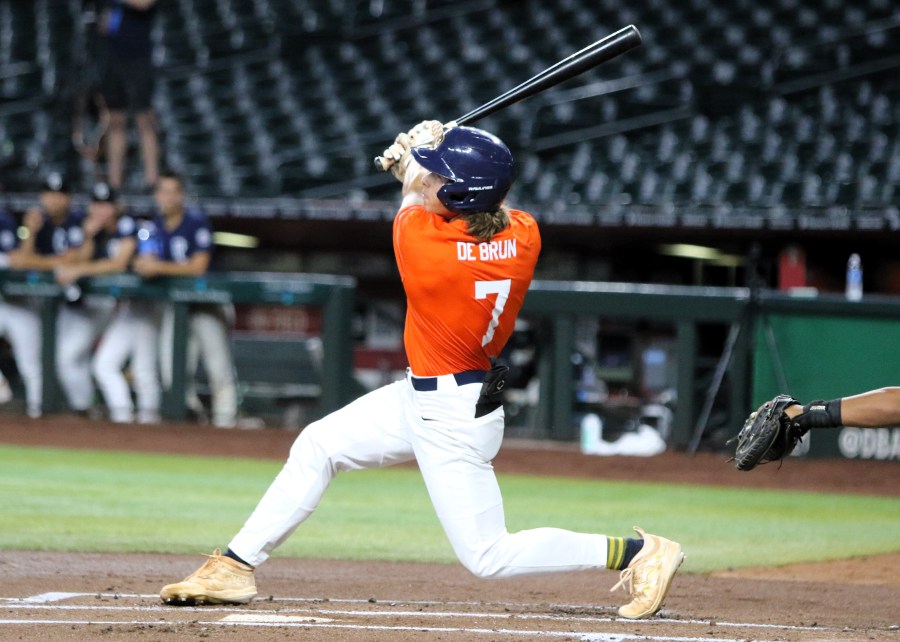
Slater de Brun checks many of the boxes the Padres typically look for in their draft picks. (Photo: Jerry Espinoza)
While there are many mock drafts floating around in the ether, we focus on what the writers for four key publications have to say.
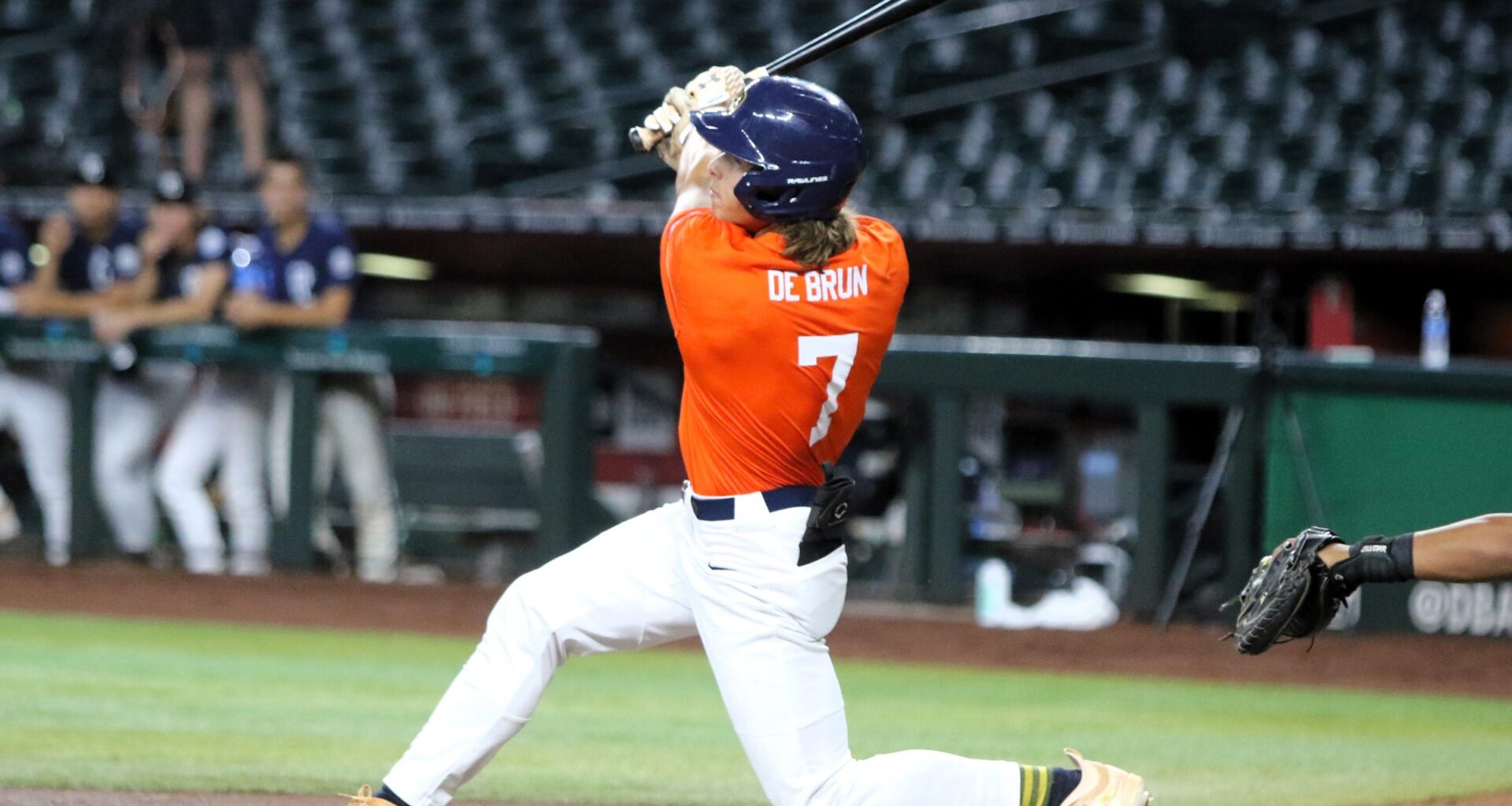
Jim Callis, writing for MLB Pipeline, Carlos Collazo of Baseball America and ESPN’s Kiley McDaniel all had the Padres selecting high school center fielder Slater de Brun in recent mock drafts, while The Athletic‘s Keith Law saw them going with fellow Pacific Northwest performer, third baseman Xavier Neyens.
Baseball America is the only outlet that hasn’t shifted the projection in the final 24 hours before the draft. McDaniel now sees the Padres going with second-generation slugger Quentin Young, Callis has them calling Neyens, while his MLB partner Jonathan Mayo sees middle infielder Kayson Cunningham falling in their lap. Rather surprisingly, Keith Law now has them bucking their long-held preference for toolsy high school players to select left-hander Zach Root out of the University of Arkansas.
Both players fit the profile of many of the current Padres’ brain trust’s top picks: left-handed hitting high school players with clear carrying tools, while playing up the middle defensively.
Update – Draft Day
On the day of the draft, three of the four writers have updated their final picks. Jim Callis now has the Padres taking Xavier Neyens, while his colleague at MLB Pipeline, Jonathan Mayo, has San Diego selecting Kayson Cunningham, a 2B/SS from San Antonio. Kiley McDaniel has the Padres selecting 6-foot-6 infielder Quentin Young, the nephew of Dimitri and Delmon Young, from Oaks Christian High School in Westlake Village, California. Carlos Collazo is the lone writer to stick with his original pick, noting the Padres have scouted de Brun heavily, and if he’s there, that’s the one. Finally, Keith Law goes out on an island, predicting that San Diego will take University of Arkansas left-hander Zach Root, if Kruz Schoolcraft isn’t available.
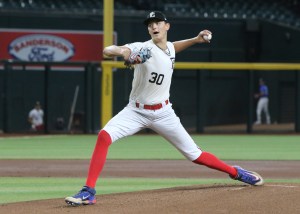
Kruz Schoolcraft could be one of the Padres’ top targets. (Photo: Jerry Espinoza)
Five Questions with Jim Callis
Jim Callis will once again anchor the MLB Network’s draft coverage. He began writing about baseball and prospects in 1988 and has written for Baseball America and STATS Inc. He has also headed coverage for MLB Pipeline since 2013.
We caught up with Jim to hear his thoughts about who the Padres could take with their first selection.
MadFriars: A.J. Preller has been running the Padres’ drafts since 2015. What are the general characteristics of a high pick by his organization?
Jim Callis: To me, I think the biggest thing about them is that they aren’t afraid to take a risk on the ceiling, mainly on high upside high school players. The last time they drafted a college player with their first pick was Cal Quantrill in 2016, a year when they had three first-round picks, and I believe they even still took a high school player [Hudson Potts] with one of the three.
So, yes, they will look for someone who is seen as having more upside than a floor.
San Diego has the third-lowest amount of pool money in the draft. How will that affect their first-round selection at #25?
Jim Callis: It could affect their ability to take someone who wants significantly more than slot money. From what I understand, Kruz Schoolcraft, a 6-foot-8 lefthander from Oregon, has a very good NIL deal with the University of Tennessee and might fit that model. They could meet his demands, but that might be the majority of your draft, because you will need to take players who will sign at underslot amounts to afford him.
The Padres’ next pick is scheduled for number 99 in the third round, so they may also have someone in mind whom they want to sign for an overslot bonus.
If you look at what the Padres did in the international markets with Ethan Salas in 2023 and Leo De Vries in 2024, they don’t have a problem putting all their chips on one player, if they think it’s the right player.
Jim Callis: That’s a good point. The Padres really believe in scouting. From what I understand, they also believe in analytics, but they are a very scout-driven organization. Even though they have traded away many prospects over the years, they believe that they are good enough to restock their system in the next draft. That may be arrogance, but they have also been able to back it up.
So, yes, if they think someone like Schoolcraft is the right player, and it’s going to cost more than someone else, they’ll take him.
In the past, you have put the draft into context by saying that if a team can secure one regular or starter in the draft and another player who can be of some help, then it’s an excellent draft. Is that still your perspective?
Jim Callis: Absolutely. That’s a significant reason why the 2021 Padres draft was so successful. The Padres were picking at number 27 and then got James Wood in the second round at number 62, which was very, very good. We are talking about two all-star-level performers in one draft, which is extremely rare.
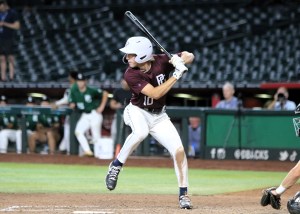
Sean Gamble, an infielder/outfielder from the IMG Academy, could be a Padres’ selection. (Photo: Jerry Espinoza)
Five high school players have been connected with the Padres frequently in this year’s draft; Sean Gamble, out of IMG Academy in Florida, Alabama shortstop Steele Hall, Schoolcraft, de Brun, and Xavier Nayens.
Who is the player with the most upside they could take without worrying about financial concerns, and is there any player on that list who might sign for an underslot deal?
Jim Callis: Of those five, Schoolcraft has the most upside, but I don’t see him going that far down in the draft. The other four will likely go in the first round, and I can envision a scenario where only two of the five are available when San Diego picks at number 25.
There are a few other players like Dax Kilby, a prep shortstop from Georgia, or Ryan Mitchell, a prep shortstop/second baseman from Tennessee, who can also be in play.
When you are picking that far down in the first round, there are a lot of variables, but A.J. and his group are usually good with multiple scenarios.