
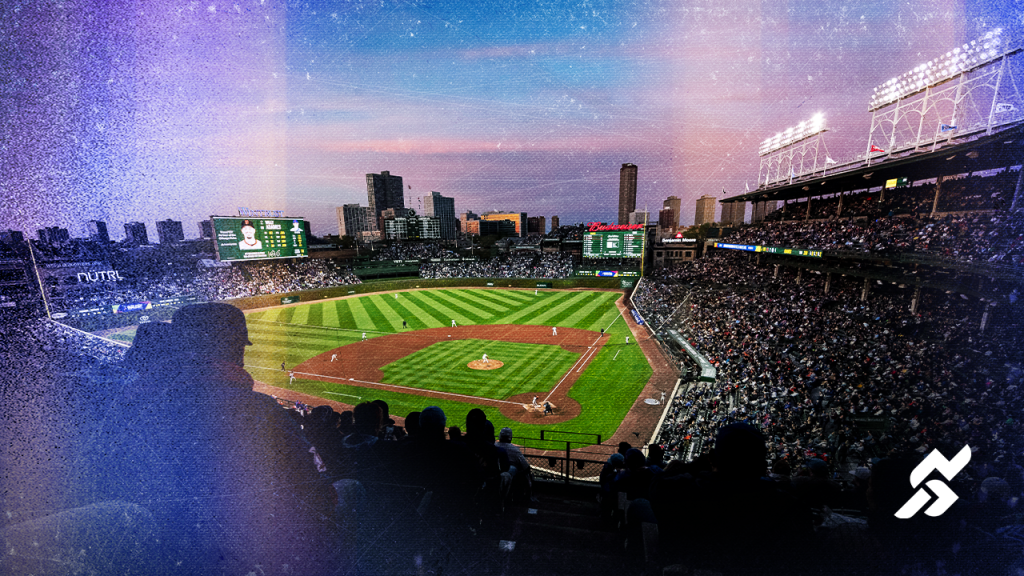
As the Chicago Cubs continue their legal battle against Wrigley View Rooftop—a company that provides 200 guests with a view of neighboring Wrigley Field in exchange for fees—a case from 1886 involving a grandstand on the roof of a barn next to a ballpark could take center stage.
That’s if Wrigley View Rooftop gets its way.
The core of the dispute is whether Wrigley View Rooftop can lawfully sell seats to watch Cubs games, concerts and other events from its property on 1050 West Waveland Avenue, which is right across the street from the famed ballpark. In recent court filings, the Cubs and Wrigley View Rooftop have debated whether the company and its owner and president, Aidan Dunican, are liable for misappropriation, unjust enrichment, unfair competition and unauthorized use of trademarks.
Wrigley View Rooftop and its attorney, Matthew De Preter of Aronberg Goldgehn Davis & Garmisa, contend it is simply using its property as it sees fit. To bolster that argument, De Preter highlights the Michigan Supreme Court decision in Detroit Base-Ball Club v. Deppert (1886).
In the 1880s, John Deppert. Jr. lived in a house on Brady Street in Detroit, and his property also had a barn next to Recreation Park, where the Detroit Wolverines of the National Base Ball League played. Tickets to the games cost 50 cents. This was an era, of course, long before sports made money on broadcasting deals, and the Wolverines relied mostly on ticket sales to financially support their operations.
The team built a nine-foot fence, Justice Thomas Russell Sherwood explained, “to protect itself in the rightful use and enjoyment of the property,” and to mitigate the risk of people watching games without paying an entrance fee. Deppert, meanwhile, built seats in his barn to accommodate about 100 people; the seats were positioned higher than the ballpark fence and overlooked the field. Deppert charged less for his seats than the cost of Wolverines tickets and sold refreshments, too. The Wolverines argued Deppert was stealing their profits.
Deppert countered that the Wolverines damaged his property since “ball plays had seriously injured the quiet use of his premises.” He also complained about having to call the police “to quell fights and brawls of the roughs who assemble there to witness the games.” Deppert further pointed out that Detroit building inspectors had examined his property and pronounced it “safe and secure.”
Sherwood wrote the Wolverines had no case against Deppert. The team lacked a legal right to use or control the use of an adjoining property it didn’t own. Sherwood also wasn’t convinced that people who paid to watch games from Deppert’s barn would have paid more to go to the ballpark instead.
“Courts,” Sherwood wrote, “cannot limit the extent, up or down, to which a man may enjoy his property; and if he goes higher than his neighbor, so long as he does not interfere with the rights of others, or injure his neighbor, he subjects himself to no liability.”
Back to Wrigley View Rooftop, which insists the same set of issues are in play in its dispute with the Cubs. Wrigley View Rooftop emphasizes it has never prevented anyone from going to Wrigley Field, and there’s no allegation that any of its customers “actually attend any event on the property of Wrigley Field.”
The company also maintains its customers “are only able to see sights” from its property—which, Wrigley View Rooftop acknowledges “includes whatever view of Wrigley Field” but that “may be due to Plaintiff’s intentional lack of fencing or other enclosure.” To that point, Wrigley View Rooftop suggests the problem is the Cubs failure to build higher fencing to shield viewpoints from taller buildings that are nearby.
In a brief authored by Martin L. Roth and other attorneys from Kirkland & Ellis, the Cubs contend Wrigley View Rooftop has constructed a “strawman” argument in depicting the case about whether it “must somehow pay the Cubs” for Wrigley View Rooftop’s “right to enjoy their own private property.” The Cubs underscore they do not “allege any claim concerning [Wrigley View Rooftop’s] property rights.” Instead, the case regards whether Wrigley View Rooftop has “misappropriated the Cubs’ property rights by selling tickets to games and events at Wrigley Field” since—the Cubs insist—activities at Wrigley Field and the right to sell tickets to them “belong exclusively to the Cubs.”
The Cubs also emphasize different precedent from a long time ago, including Pittsburgh Athletic Co. v. KQV Broadcasting Co. (1938). The Pirates sued a radio station that used paid observers to watch games from the rooftop of a building adjacent to Forbes Field and announce the play-by-play of Pirates home games. The Pirates, which had an exclusive broadcasting deal with a different company, demanded an injunction against KQV.
U.S. District Judge Frederic Palen Schoonmaker agreed with the Pirates, noting the team possessed an exclusive property right over its live games. He said KQV had engaged in unfair competition by using “paid observers stationed at points outside Forbes Field for the purpose of securing information which it cannot otherwise acquire,” and added that because the Pirates create the games played in a ballpark they control, they can also restrict “the dissemination of news therefrom.”
The Cubs maintain this precedent supports their argument that a property owner does not have a right “to sell tickets to events at a neighboring sports team’s stadium.” The team also says that Wrigley View Rooftop acknowledges the Cubs have a property right in recordings of Cubs games “but illogically argue—without any case law—that such rights do not extend to the live game itself.”
The case is before U.S. District Judge Sharon Johnson Coleman, who, as Sportico has detailed, has already made several key rulings in the case.