
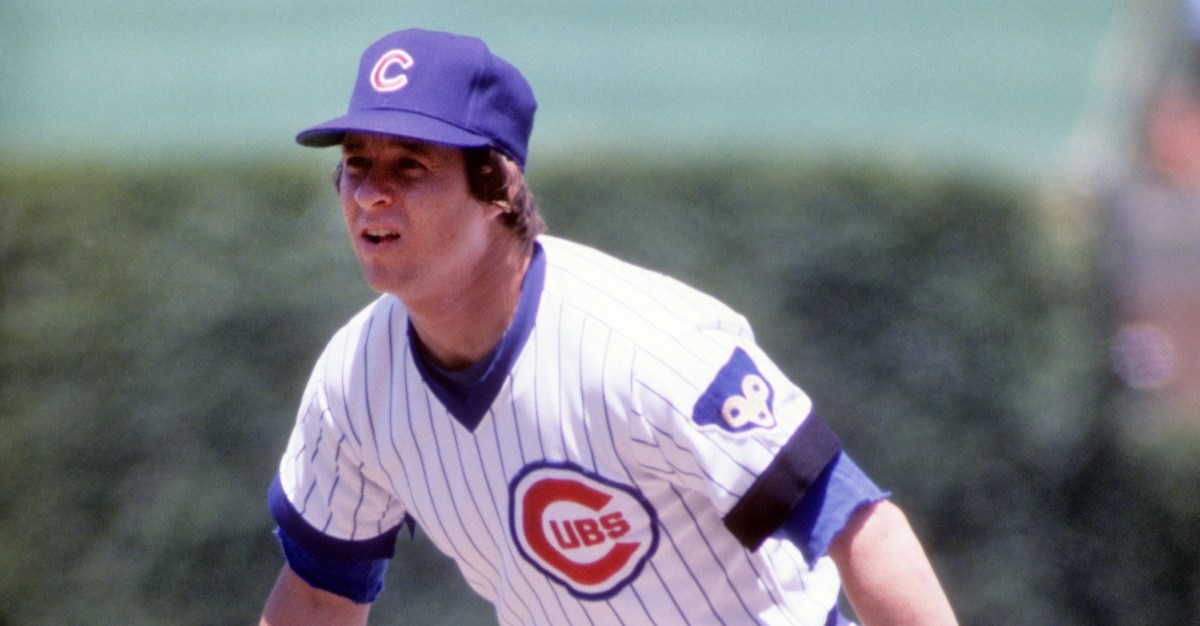
Those of us who lived through the disappointments of Cubs seasons from 1969 through 1973 were suddenly, we thought, granted a reprieve with the play of the team in 1977.
The 1977 Cubs started out muddling around .500 until early May, then went on a 19-4 run that put them in first place May 28 after a three-game sweep of the Pirates. They continued playing this way until late June, when a 4-2, 10-inning win over the Expos in Montreal gave them a 47-22 record, 25 games over .500. In that era, some road games were not televised and that one wasn’t, so I listened on WGN radio. After the game, Lou Boudreau famously said, “They can kiss the .500 mark goodbye!” Of course, as you know now, that team finished exactly at .500 — and had to lose their last five games to do it.
When they reached 47-22, the 1977 Cubs led the NL East by 8.5 games. More losses than wins came in July, but the team managed to hold on to at least a share of first place until Aug. 6, when a 10-5 win over the Padres put them at 63-44, tied with the Phillies for the top spot.
From then to season’s end they went 18-37, tied with the woeful Mets for the worst record in the National League. Only the American League’s two expansion teams, the Mariners and Blue Jays, were worse over that span (16-35 and 16-39, respectively).
Largely because several key players who had performed well in the first half stopped doing so. Rick Reuschel had a 2.25 ERA in 27 games (25 starts) before Aug. 6 and a 3.86 ERA in 12 starts after that. Bill Bonham — same thing, basically — 3.67 ERA in 17 starts before the end of June, 5.12 in 12 starts after July 1. Bruce Sutter made 47 appearances through Aug. 1 and posted a 1.06 ERA with 101 strikeouts and only 15 walks in 85 innings. Then he missed three weeks with a shoulder strain and wasn’t the same after returning — 2.42 ERA in 15 games with seven saves and three blown saves. The rest of the bullpen couldn’t hold things together.
The biggest mystery in 1977 was the utter collapse of Bobby Murcer. Through Aug. 22 — when his eighth-inning homer was the difference in a 3-2 win over the Giants — Murcer was batting .280/.374/.492 with 24 home runs, 83 RBI and 81 runs scored in 119 games. For the rest of the season Murcer hit .216/.288/.328 with three home runs, six RBI and nine runs scored in 35 games. He wasn’t injured — he started and played full games in all but four of those 35. It was inexplicable, and his power didn’t return in 1978, either (just nine home runs in 146 games). In fact, the 1977 team had very little power. Murcer had 27; no one else hit more than 12 (Larry Biittner) and the team finished 10th of 12 NL teams in home runs (111).
Lastly, Jerry Morales, who had gotten off to a great start in 1977 (.331/.391/.502 in 86 games pre-All-Star break) and got his only All-Star selection, got hit in the knee in the ASG by Sparky Lyle. He didn’t miss any time but wasn’t nearly the same hitter after (.218/.269/.352 in 50 games).
If this sounds familiar, well, quite a few of the 2025 Cubs have slid from their first-half performances, mostly hitters. On July 19, the Cubs defeated the Red Sox 6-0 and moved to a season-high 20 games over .500 at 59-39. They had 522 runs scored, second only to the Dodgers at 525, and were scoring 5.33 runs per game. Their run differential was a MLB-leading +128. The 394 runs allowed up to that time were 4.02 per game.
Since then, the Cubs are 8-12 and have been outscored 93-78. The runs allowed in that span equate to 4.65 per game, higher than before but not hugely so. The difference is in the failure to score; the 78 runs is just 3.9 per game, a significant drop.
So the pitchers have generally held up okay, though it will be good when Jameson Taillon returns.
Here are some of the hitter numbers through July 19, then since:
Pete Crow-Armstrong: .268/.304/.551 with 26 HR in 97 games through 7/19, .197/.237/.366 with 1 HR in 19 games since.Kyle Tucker: .281/.385/.504 with 18 HR in 97 games through 7/19, .200/.377/.233 with 0 HR in 18 games since.Seiya Suzuki: .263/.318/.549 with 26 HR in 94 games through 7/19, .167/.309/.242 with 1 HR in 19 games sinceMichael Busch: .289/.374/.552 with 20 HR in 92 games through 7/19, .147/.227/.250 with 1 HR in 20 games since
I could go on, but you get the general idea. The only Cub who’s hit well recently is Matt Shaw, who is batting .323/.354/.758 with seven home runs in 21 games since the All-Star break. Ian Happ and Dansby Swanson have done all right in the post-July 19 team funk, but have basically treaded water on their season OPS.
So the question is: Is this going to turn into a 1977-style collapse?
First, there is, of course, a difference in the playoff structure now. Then, teams had to win division titles and there were only four postseason teams. Now there are 12, and the Cubs, for now, are in the wild-card lead (though virtually tied with the Dodgers and Padres). If there had been six NL playoff teams in 1977, the Cubs would have tied with the Astros for the final spot — and they were 6-6 vs. Houston that year and no, I don’t really want to go through that tiebreaker scheme retroactively.
The point of the exercise above is to show you that the Cubs have just stopped hitting. I’ve listed four key Cubs hitters who have been mediocre to terrible over the last three weeks after they all hit very well for more than three months. PCA was considered a candidate for MVP.
If those four start hitting, and the other starters keep doing what they’re doing, the 2025 Cubs should make the postseason fairly easily. If they don’t? Well, then we could be looking at a 1977-style collapse. This Cubs team would have to go 14-30 for the rest of the year to match that ‘77 team’s final record.
They can’t possibly play that badly. Right? Right?