
Admittedly, I was excited about Minnesota electing to undertake a massive roster reconstruction at the 2025 MLB trade deadline, parting ways with 11 players from its 26-man roster. Yes, it would have been nice to watch the Carlos Correa-led collective demonstrate resiliency, pick themselves up by their bootstraps, and triumphantly return to the postseason after enduring a cataclysmic collapse late last season, but the club losing four straight series out of the All-Star signaled they were, in fact, prepared to go gentle into that good night. Change was in order.
Many assumed that the team’s fire sale at the deadline was evidence that a sale was near. Recent comments from MLB commissioner Rob Manfred and a report from Front Office Sports reinforced a sense of confidence and optimism that the club would pass into the hands of a different billionaire or three. Unfortunately, instead, the family announced on Wednesday that they will remain principal owners, albeit with new limited partners coming aboard. So it goes.
Thus, the Twins front office will be forced to continue operating under significant spending restrictions, with major implications for this upcoming offseason. As of right now, Minnesota has $48 million in committed salaries next season: Byron Buxton and Pablo López‘s contracts ($38 million) and $10 million owed to Correa. Including expected arbitration payouts, FanGraphs projects Minnesota’s 2025 Opening Day payroll to be $66.8 million, which would be a $67.2 million decrease from its 2024 Opening Day payroll, which settled around $134 million.
Despite how bleak times are in Twins Territory, there is reason to believe the Pohlad family (and their new partners-slash-benefactors) will be charitable enough to allow the front office to spend roughly $30-40 million, increasing the club’s payroll to roughly $100-110 million. That’s a fairly negative outlook; it would still constitute a $20-30 million decrease from this season. Still, if Minnesota were to allocate that much money toward the club’s payroll, it would be operating under a payroll similar to the thriving Milwaukee Brewers.
Milwaukee’s 2025 payroll stands at $121 million. Like Minnesota, however, the Brewers are expected to have a significant amount of money come off the books this fall. FanGraphs expects Milwaukee’s payroll to decrease to $60.4 million at the end of the season, placing them in a similar ballpark to Minnesota. (Importantly, these figures don’t account for arbitration awards; both the Twins and the Brewers will almost certainly spend much more than their current projections, even if they don’t make noteworthy forays into free agency.) Like Minnesota, Milwaukee is expected to raise its payroll back to the $115-120 million range. However, what separates Milwaukee from Minnesota is that the Brewers have been operating under these constraints for a significant amount of time, while recently blossoming into the platonic ideal of how a small-market team should construct its major-league roster (and farm system) to become sustainably successful.
Under Derek Falvey, Minnesota already operates like Milwaukee in notable ways. For example, Minnesota, like Milwaukee, has grown a knack for drafting college pitchers from small schools and adding more velocity to their arsenal to make everything pop. The two organizations also similarly spread their money around in Latin America, rather than concentrating their bonus money on individuals perceived as the top prospects in each year’s class. Also, the two clubs value depth in the high minors and at the major-league level. However, there are key differences between the two clubs that Minnesota needs to shore up if it wants to become a sustainable small-market winner in the same vein as Milwaukee.
What separates Milwaukee from Minnesota (or Matt Arnold from Derek Falvey) is Milwaukee’s nimble roster-building and willingness to transact often. A primary factor that led to Minnesota’s descent after its magical 2023 run was Falvey’s unwillingness to shake up the roster’s core. Instead of parting ways with players like Max Kepler, Chris Paddack, and others at opportune times, Twins decision-makers elected to hold on to them, creating a sense of stagnancy within the club and restricting its ability to combat mediocrity.
On the other hand, the contemporary, successful iteration of Milwaukee, led by Arnold (and formerly David Stearns), has been exceptionally active in recent seasons, trading away star players nearing free agency—like Josh Hader, Corbin Burnes, and Devin Williams—for hefty packages. Indirectly, the team got William Contreras by trading Hader. Directly, they acquired the left side of their infield (Caleb Durbin and Joey Ortiz) in trades that gave up Burnes and Williams, and those deals also yielded pitching depth and an extra draft pick.
In prior seasons, Falvey demonstrated an unwillingness to make momentous transactions like Stearns or Arnold do. Yet, Minnesota’s organization-altering deadline indicates that they (be it Falvey himself or Jeremy Zoll, the new nominal general manager) have become willing to make a meaningful shift in roster construction approach that more closely resonates with Milwaukee.
If Minnesota continues to execute transactions similarly, star players like López (who possesses an expensive contract) and Ryan Jeffers (who will be a free agent after next season) could also be moved in the offseason. Trading López and Jeffers are moves Milwaukee decision-makers would seemingly make. However, if Minnesota were to mirror Milwaukee’s mode of operation, it likely wouldn’t part ways with Ryan, given that he’s relatively inexpensive and an exceptionally talented pitcher.
Beyond a willingness to make high-impact transactions, Minnesota should also become more like Milwaukee in its player development program. A driving factor in Milwaukee’s success is its ability to field a roster filled with elite defensive players who make exceptional swing decisions at the plate. In recent seasons, Minnesota has existed on the complete opposite end of the spectrum. Instead of fielding players like Brice Turang, Sal Frelick, or Isaac Collins, Minnesota has provided extended opportunities to players like Trevor Larnach, Ty France, and Edouard Julien.
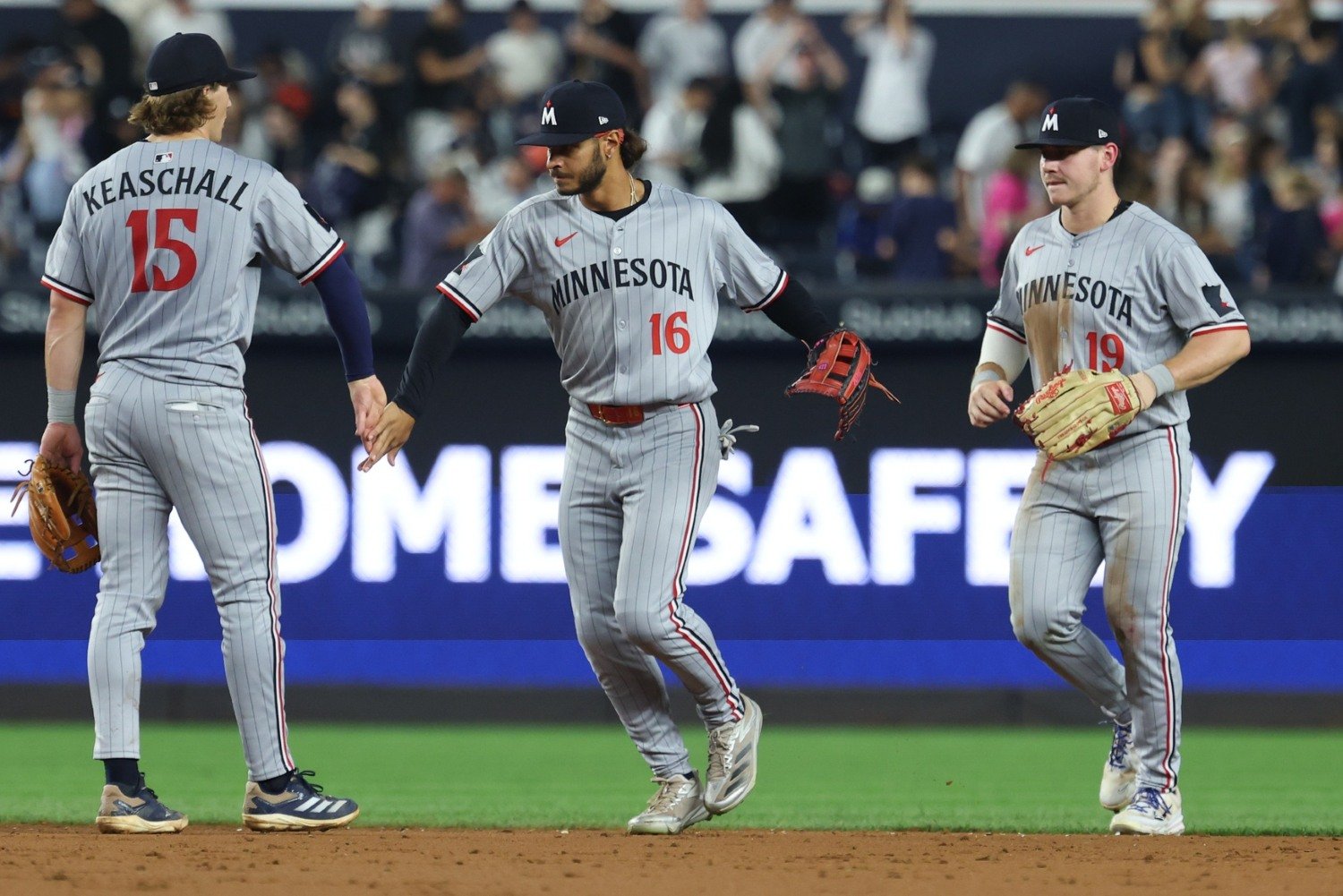
Still, given the recent development of players like Luke Keaschall and Austin Martin, there is reason to believe Minnesota has already begun mimicking Milwaukee’s approach to roster-building. Also, Minnesota has developed one of the more admirable internal pitching development programs in baseball, meaning the club should be able to continue developing cost-controlled, above-average starting pitching and reliever talent, like Milwaukee.
Minnesota possesses the young, cost-controlled talent necessary to take the steps toward creating a major-league club that could win again in the near future. Twins decision-makers need to become more willing to make consequential transactions, while placing more emphasis on acquiring and developing good defensive players with exceptional plate discipline and contact skills. However, given the recent overhaul the front office engaged in during the deadline and prioritization of providing players like Keaschall, Martin, and Alan Roden extended opportunities, there is reason to believe the transition into being more like Milwaukee has already begun.