
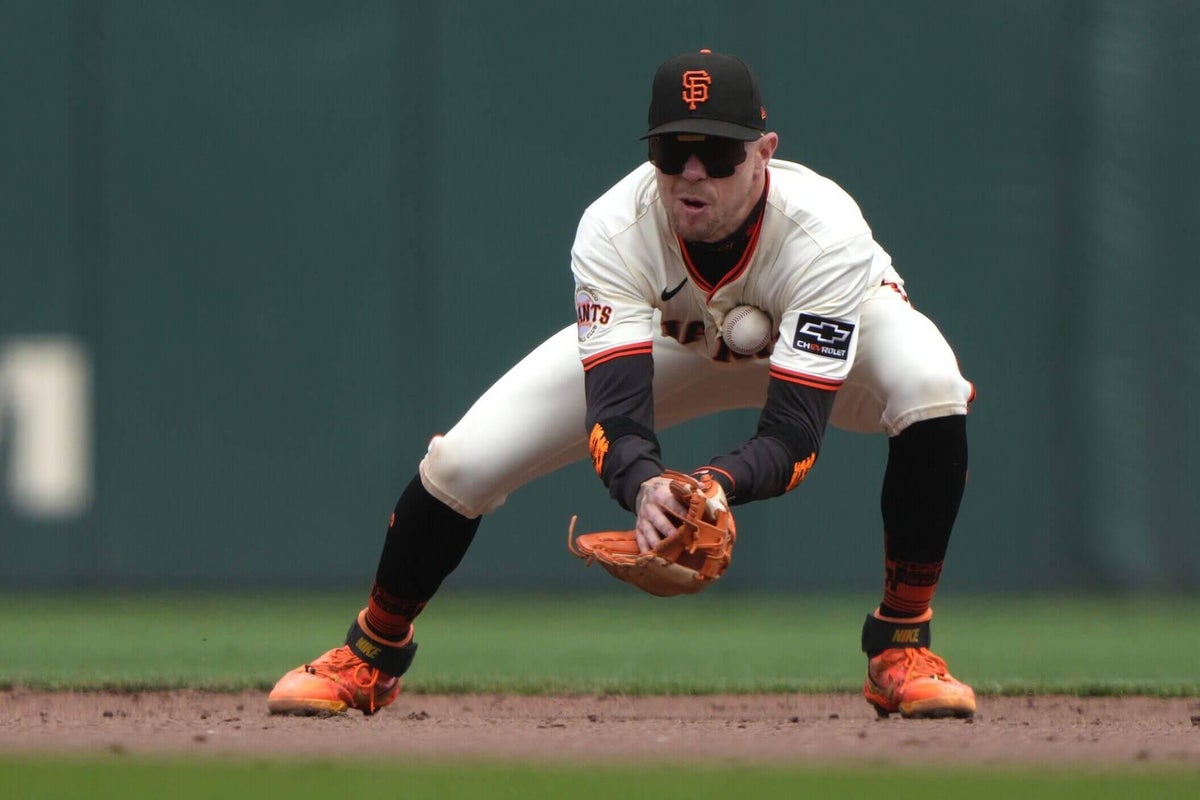
The San Francisco Giants have lost 13 out of their last 14 games at Oracle Park. That’s not a record, but it sure doesn’t happen very often. Only one team had a stretch that bad throughout the entire 1980s, and the last time the Giants did it was 1940. Some of the original 16 MLB teams haven’t done it in over 100 years.
Last time losing 13 of 14 at home
Only 11 teams in history have lost 14 consecutive games at home, which means the Giants are now in a tie for the second-worst 14-game home park stretch in baseball history. It’s a 74-way tie, and you have to use the cherry-picked endpoint, but it still gives you a sense of how uncommon this kind of home futility is.
That would be a discouraging standalone tidbit, but it gets even worse. The Giants (59-62) lost their final game of the homestand by 10 runs, which is precisely how many runs they’ve scored in the six games to start the homestand.
They’ve scored 25 runs over these 14 games, which means they’ve been outscored 65-25 over their last 14 home games. The paid attendance for those games was 533,045, which is roughly a quarter of the season attendance so far. There have been more fans who watched the Giants at home during this stretch than there were in the entire 1974 or 1975 seasons, and they got to watch those 13 losses stretch out over the 129 innings. They’ve led in four of those innings.
What sticks with me, though, other than all the losing in front of people who paid to watch exactly the opposite, is the company they’re keeping. Among the 43 teams that have lost at least 13 games out of 14 at home since the Giants moved to San Francisco, here are the best final winning percentages from them:
1971 White Sox: .488
2018 Mets: .475
1994 Red Sox: .470
2002 Mets: .466
1975 Angels: .447
There are two teams to do this and finish with a winning record — Cleveland in 1931 and Detroit in 1956 — but that was before the Giants’ San Francisco era. There’s an apparent reason for this. If you start any team with a 1-13 record in any split, they’ll need to play .543 baseball over the remainder of the season to get back to .500. That’s an 88-win pace, and most of these teams couldn’t fake that kind of play for a couple of weeks, much less several months.
However, how many of these 13-of-14-ers even had a .500 record if you removed the historically lousy home stretch? That’s a more interesting question, suggesting a team that’s oh-so close to being perfectly OK and even competitive, if not for that one unthinkable stretch where nothing went their way.
Only the top four teams on that list played .500 outside of the losing stretch, which means that it’s difficult to fake your way into an inability to win at home. A team that does this is probably just bad, not unlucky.
Which brings us to the most remarkable part, at least to me: These aren’t garden-variety losers. These are the worst teams of all time. The 2024 White Sox are on there, but so is the team whose modern-day record they broke, the 1962 Mets. There are several expansion teams on there, including the 1969 Expos. Some teams were so historically awful over decades that their cities told them to get out and not come back (Philadelphia Athletics and St. Louis Browns).
It’s also impressive to think about the teams that didn’t lose 13 out of 14 at home, like the butt-slide-era Astros or the 2003 Tigers, which were sneaky good at incubating championship outfields. The 2025 Rockies are not in this group, at least not yet.
If you want to throw a smoke bomb and leave the vomitorium of sad factlets, I don’t blame you. It’s not like I’m saving a fun one for the end. What we’re getting at here is that the Giants are keeping company with some of the worst teams in baseball history. The 14-game stretch is an arbitrary endpoint, but it still includes things that are hard to fake.
Of the five teams that played .500 ball outside of the home losing streak, only four of them had winning records the following season. None of them won more than 87 games. Even the redemption stories are kinda sad.
Armed with this information, we get to something that sets the Giants apart from all these teams: They’re trying. They’re not the afterthought of some early-century steel baron. I’m not about to research the relative payrolls of every bad team throughout history, but the Giants are trying harder than almost any of these teams.
They had high expectations. The losing started after a thrilling win against the Los Angeles Dodgers, which in turn came after an exciting series win against the Philadelphia Phillies at home. When Will Smith hit into a double play to end that win against the Dodgers, listen to how excited the crowd was:
They’re excited because that was one of the expected possible outcomes for a team that you respect. A good team, a contending team, can get a double play with two on and one out in the ninth. It wasn’t the likeliest scenario, but once it happened, it felt entirely natural. The Giants, why, they’re just one of those teams that know how to win close games. They’ve done it all year.
Then they stopped. And how.
In my decades of following the team, I’m not sure I’ve watched a Giants team that’s anything even close to this one. They’re probably the most confounding team in San Francisco history, and I’m not sure it’s even close. That franchise history includes several teams that had trouble scoring runs with Barry Bonds hitting .899/.999/3.999 in the middle of the order, but this team has them licked. Back then, the solution was simple: Get better players around Bonds. Don’t get sucked into the Brower-Eyre trap.
This team, though? They mostly just need everyone to be better versions of themselves, and the best-worst part is that you’ve seen it from every single player with expectations.
Jung Hoo Lee, Heliot Ramos, Willy Adames, Matt Chapman and Rafael Devers have all had hot stretches this season where you think, yep, that’s what he’s supposed to do. That’s why the Giants got that player. They’re never lengthy hot stretches, and the laws of Newtonian physics prevent any two of them from being hot at the same time. However, you have 5/9ths of a lineup that should be good right now, while also having a strong chance to be productive next season (with the jury still out on Lee).
That’s just the lineup, too. With Robbie Ray and Logan Webb both All-Stars under contract for next season, the Giants also have a head start on the rotation. It’ll need some additions and tweaks, not a major overhaul, to be the kind of rotation that worries opponents in the postseason. That’s also 40 percent of the rotation that’s currently contributing to the historically miserable home ballpark experience.
Which means that we’ll be right back here next season to discuss a lot of the same players who are contributing to the slide right now. There are no other options. The most important parts of the 2026 Giants are set in stone. While there could still be essential contributors we’re not accounting for now — rookies, free agents, players acquired in a trade and minor-league free agents who break out — the bulk of the crucial contributors aren’t going anywhere. And it’s even reasonable to expect them to rebound. The famously fussy and pessimistic projection systems should even predict as much.
And unlike the typical also-ran, it’s not a bad plan. This isn’t one of those things where you need to dig up the apocryphal quote from Albert Einstein about the definition of insanity. The definition of insanity is probably assuming that all of the Giants’ best hitters are cooked forever, not trying the same thing and expecting different results. That’s almost what they have to do.
If the players have to stick around — and if it’s the only reasonable option — the Giants will have to improve as an organization to help them reach their full potential. I’ve never been the kind of pundit who calls for people’s jobs, at least, not since 2010, but it’s not hard to start connecting dots with the Giants’ predicament.
The players aren’t going anywhere. Can’t go anywhere. Shouldn’t go anywhere, in a lot of cases. If they can’t be swapped out for someone more effective, the next step is to look for ways to make the existing players more effective. Because whatever’s going on this season can’t be sustainable.
It’s just bad business for the Giants to play like this. Ask the half-million fans who paid money to watch them play like some of the worst baseball teams in history. They may be one of the worst baseball teams in history, but I still can’t believe that yet. Too much talent. Until they prove otherwise, they’ll remain one of the most confounding teams in franchise history. There’s still a little bit of season left. They might end up the most confounding team in franchise history.
Hey, at least there’s still something to root for.
(Photo: Thearon W. Henderson / Getty Images)