
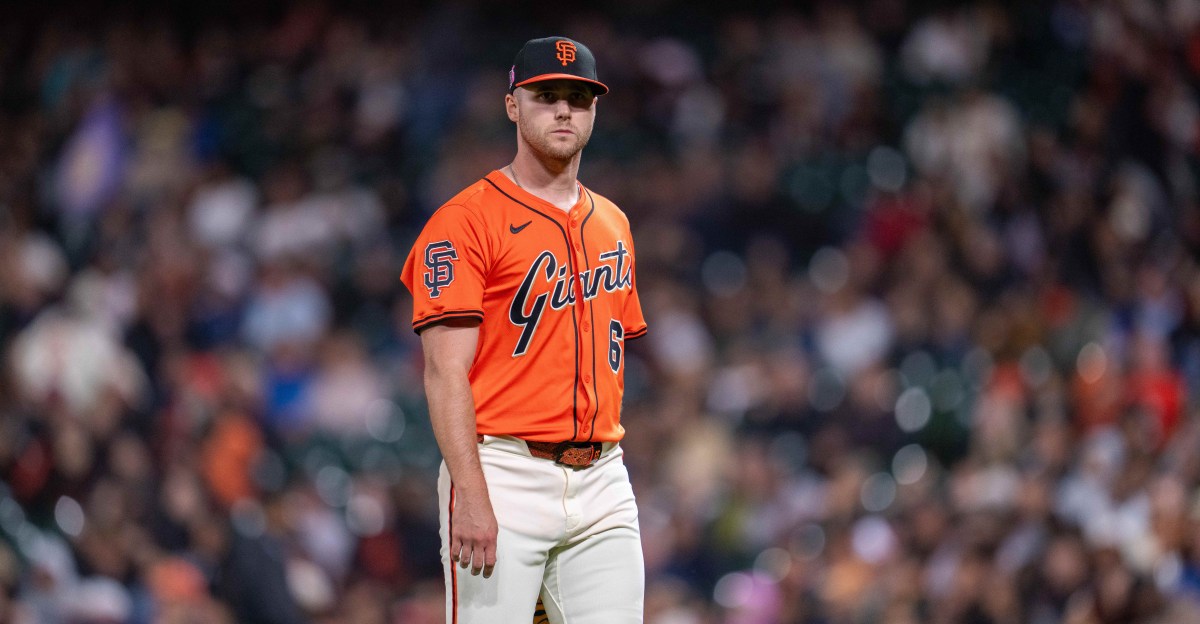
The San Francisco Giants had scored just five runs in their past five games before Friday night. Five losses that pretty much ensured their irrelevancy in the late-season push for the postseason, sinking them three games below .500 — their worst winning percentage of the season. But this wasn’t rock bottom. Of course not. Nor was an unresponsive offense the only way this team could lose a ballgame. There are a million ways to not score as many runs as your opponent, and the Giants, plumbing the depths of their own extraneousness, found another way on Friday in a 7-6 loss against the Tampa Bay Rays.
The game was weird at first. The line-up was putting runners on base and figuring out ways to bring them home. That kind of satisfaction felt foreign. It had been awhile. Offensive closure? A run scored in the 1st? Early runs? Who are these guys?
Facing off against the Rays hard-throwing 6’8” starter, Joe Boyle, the line-up dug into the box with a clear mode of attack. The right-hander Boyle rolls out of bed and throws triple-digits, but like a lot of young gassers, command has been in issue in his previous seven starts. He walked 5 in just 3.1 innings while surrendering 6 runs to the Seattle Mariners. He can get in his own way — so don’t get in the way of him doing that. Work deep into counts, acclimate to the fastball but still see it deep and shoot it the other way.
This was the plan, and the Giants executed. Boyle struck out Heliot Ramos and Rafael Devers (they’d K 7 times on the evening) with a selection of fastballs and hard sliders, but after putting Willy Adames in a 1-2 hole his fastball started getting lost on its way to the plate. Adames worked a walk and took advantage of Boyle’s lumbering delivery by swiping second easily, putting himself in scoring position for the hottest bat in the lineup, Dom Smith. As expected Smith, ever the consummate professional, worked the count full, forcing Boyle to fall back on a middle-middle fastball, which he redirected into right for San Francisco’s first run and first lead of the game.
There’d be three more. The Giants had a one-run lead after the 1st, then a two-run lead after the 2nd, then a three-run lead after the 3rd, and…none of them stuck. None of them lasted half-an-inning. The line-up was actually doing its job. Adames launched his 20th homer of the season, but for the most part, the bats were jut keeping things simple, not trying to do too much with pitches, putting the ball in play, making aggressive moves on the base paths. Things were happening, runs were scoring.
The problem, at least in the early frames, was the Rays kept doing the same dang thing. Each offensive result San Francisco put up was mirrored by Tampa. The Giants couldn’t pull away, like trying to shake a reflection.
The Giants through 4 innings: 6-runs. 4-for-10 w/ RISP, with 4 2-out RBIs.
The Rays: 6-runs, 4-for-6 w/RISP with 3 2-out RBIs.
Landen Roupp in his first start back from the IL, just couldn’t find a way to string together three outs in a frame without giving up a run.
I thought his stuff looked pretty, considering his absence — but I feel like I’ve been saying that a lot recently about pitchers who give up 5 earned runs over 3+ innings. Maybe I’m a helpless optimist. Maybe I need to be more critical. Maybe I don’t know anything about baseball. Or we’re just in a stretch where the gap between performance and results are an abyss. Like throwing a devastating sinker with armside run…at an oncoming freight train. Nice pitch, but I’d probably still get off the tracks ‘cuz that thing is still chugging.
Roupp struck out 5, walked only one, but the Rays had just as good of an approach against him as the Giants did against Boyle. Roupp was aggressive in the zone, and their hitters were often aggressive early in the count. He got Junior Caminero to nearly swing out of his shoes on a 2-1 curveball in the 2nd — again, nice pitch, but one whiff ain’t an out. Roupp pushed his luck with another breaking ball and Caminero roped it into the bleachers for his 35th homer in the 2nd.
In the 3rd, Roupp gave a one-out double followed by an infield single by Chandler Simpson, setting up an 8-pitch AB with Brandon Lowe that ended with a sacrifice fly that also advanced Simpson into scoring position and came home on a single by Yandy Diaz.
Down again, this time by three in the 4th, Roupp met his pitch limit after allowing the first two hitters he faced to reach by way of a walk and a single. Reliever Matt Gage came in and calmed some nerves by getting Bob Seymour, in his MLB debut, to chase an elevated fastball out of the zone. Nice pitch — but the train is still a-coming. The night’s “routine grounder deflecting off a base” (i.e. “the world is conspiring against us” moment) came from a come-backer that Gage weirdly couldn’t field with his hip bone. The ball deflected within range of Gage, but instead of a potential double play ball, the bases were loaded. Another weakly hit grounder brought in a run, and Simpson, again, Dom Smithed an inside sinker into left for a 2-out, two-run single — once again tying the game.
Situational hitting, scrappy hits, speed — no, the Giants did not invent this kind of run-scoring profile, and the Rays did everything right with men on base to keep San Francisco from leaving them behind.
Knotted up at 6, the run spigot got turned off after the top of the 4th. Tampa’s other Seymour, Ian, after giving up two runs in the 3rd, cruised into the 6th.
Desperate to see more Seymours, San Francisco countered with Carson who threw 1.2 scoreless innings, then linked up with Joey Lucchesi and Jose Butto to keep the Rays off the board. Unfortunately, the Giants did not invent this kind of run-prevention either. Tampa manager Kevin Cash relieved lefty Seymour with another lefty Garret Cleavinger and more, as they answered with zeros of their own.
San Francisco’s best chance against the Rays’ bullpen came against RHP Edwin Uceta in the 8th. In just four pitches, Uceta loaded the bases by hitting two batters (Casey Schmitt had to leave the game) and a Jung Hoo Lee single.
Three-on, no-outs — when has this ever gone wrong? The well of goodwill bloops and falling flares in the early innings had run dry by the 8th. Patrick Bailey lined a pitch to short that was speared by Ha-Seong Kim for a tough-luck first out. Drew Gilbert, still searching for his first RBI, rolled a grounder to first, before Ramos grounded into another fielder’s choice to end the inning.
Almost as quickly as it appeared, the rally *poof* was gone in a cloud of three unproductive balls in play. And as they had been rehearsing all game, the Rays offense followed up with their part of the song, singing “Anything you can do, I can do better.” And they were right. This time, there was no more back-and-forth of No you can’t; Yes I can… The Rays just did it better — end of song.
Tasked with maintaining the tie in the 9th, Randy Rodriguez instead gifted the Rays a lead-off runner by hitting Nick Fortes with a no-slide slider in a 2-2 count. A free 90 feet that soon took 180 more on another Simpson single. With the go ahead run at third, Yandy Diaz delivered again with a 2-strike single to right.
The RBI knock broke through a scoring gridlock that had been backed up since the 4th inning, and gave Tampa their first lead of the evening. It proved to be an unanswerable hit. Devers lined a lead-off double in the bottom of the 9th, but nothing came of it against closer Pete Fairbanks.
The Giants needed the late-inning hit with runners on and couldn’t get it — and the Rays did.
The Giants needed a shutdown inning from a pitcher, and couldn’t get it — and the Rays did.
The promising production early in the game proved to be available for only a brief window. They’d end the night going 4-for-18 with runners in scoring position. That’s a lot of opportunities — just good enough for their sixth-straight L.