The Colorado Rockies might find themselves in a different competitive landscape very soon, potentially escaping the Los Angeles Dodgers’ reign over the National League West, as Major League Baseball Commissioner Rob Manfred has recently signaled a possible shift towards a geographical realignment of the sport’s divisions, one that has seemingly been in the works for a while.
During an interview with the broadcast at the Little League Classic on Sunday, Manfred shared his post-expansion dream for baseball that includes geographically realignment.
“I think if we expand, it provides us with an opportunity to geographically realign. I think we could save a lot of wear and tear on our players in terms of travel. And I think our postseason format would be even more appealing for entities like ESPN because you’d be playing out of the East and out of the West. And now that the 10 o’clock time slot, where we sometimes get Boston-Anaheim, it would be two West Coast teams in that 10 o’clock slot.”
“I think the owners realize that there is demand for Major League Baseball in a lot of great cities, and we have an opportunity to do something good around that expansion process.”
The clip is below
Rob Manfred says that MLB could geographically re-align if the league expands
(via @ESPN) pic.twitter.com/w1g510LIUS
— SNY (@SNYtv) August 18, 2025
Expansion is the big if in this scenario moving forward, since that hasn’t happened in MLB since 1998. Yet baseball has cleared just about every other hurdle that existed back then when this “radical realignment” plan was first proposed by former commissioner Bud Selig. Between uneven leagues, interleague play and the split ruling on the DH, all the way down to just one set of umpires, baseball has gone from two separate leagues operating that way for 100 years to a pretty consistent entity across the whole sport.
The Astros’ move to the AL, allowing for more interleague play and evening the divisions, as well as the elimination of the DH, have been the two major changes allowing for the ability to realign when baseball so chooses. Among the best candidates are Nashville, Charlotte, Portland and Salt Lake City, with baseball likely to take one city from each side of the country, which might not even happen until the tail end of this decade.
For a while now, baseball has been held back on expanding by the poor stadium conditions of the Athletics and Rays, but each team has been playing in a new (temporary) home in 2025 with a clearer plan for the future for the first time.
This all sets up for another or possibly more teams to switch leagues and divisions once baseball moves to 32 teams. Instead of six divisions of five, baseball is expected to make there eight divisions of four or four divisions of eight — all the while, most likely getting rid of the American League and National Leagues.
Arguably, no team in baseball is quite in no man’s land like the Rockies, projected to move to just about every single possible league and division depending on who is asking. This is likely due to several factors, including a relative lack of team history, no notable rivalries and the simple math of the team being further from the next MLB city than any other franchise in the sport besides Seattle — and the Rocies, unlike the Mariners, are in the middle of the country.
So here’s a map of North America and the closest MLB team by drive time? How would you split the divisions? There are some experts’ thoughts and my pick below:
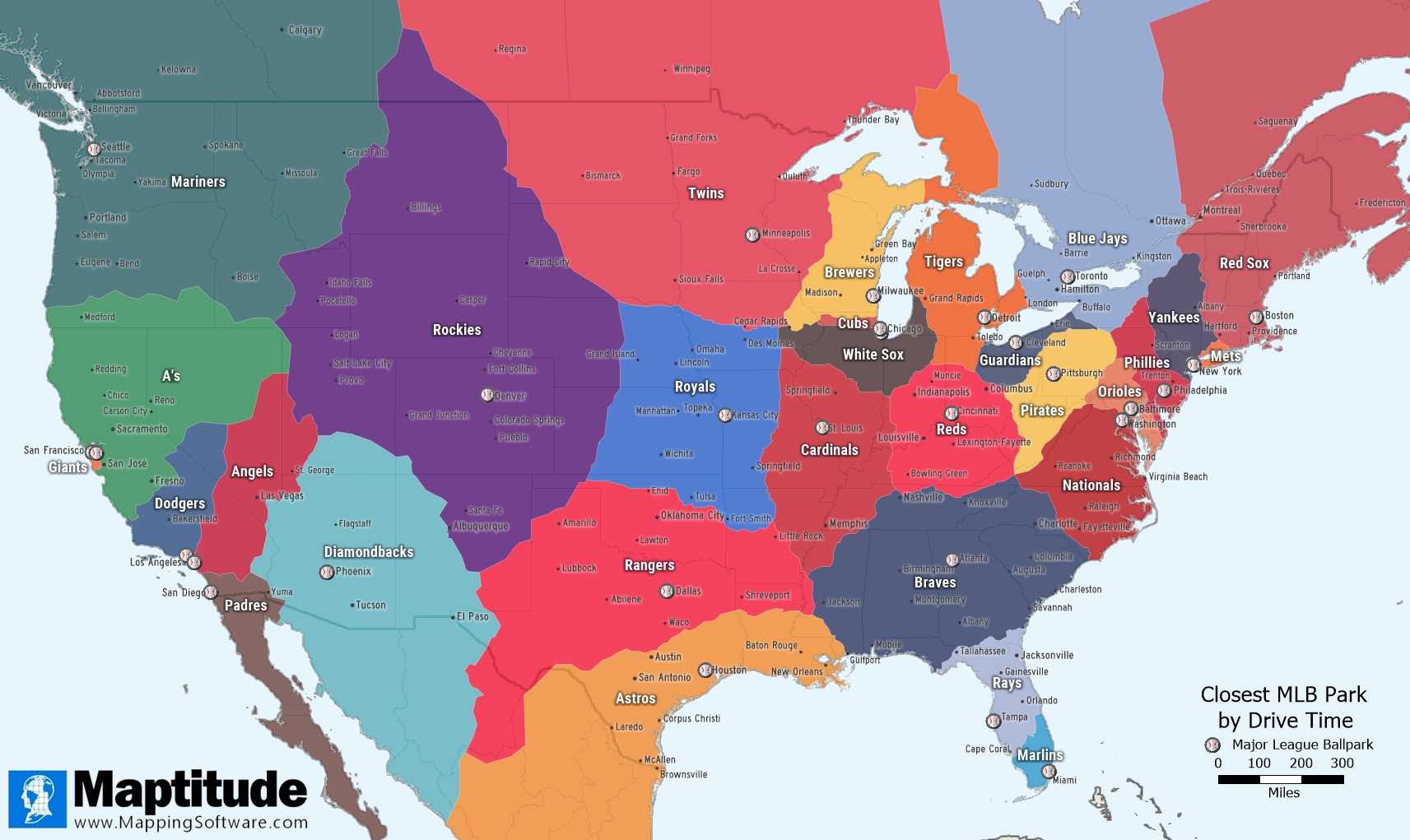
 ©Caliper, HERE. Maptitude® mapping software.
East: Braves, Orioles, Reds, Marlins, Phillies, Pirates, Rays, Nationals
North: Red Sox, Guardians, Tigers, Twins, Montreal, Mets, Yankees, Blue Jays
Midwest: Cubs, White Sox, Rockies, Astros, Royals, Brewers, Cardinals, Rangers
West: Diamondbacks, Angels, Dodgers, Athletics, Portland, Padres, Giants, Mariners
Ringolsby’s way of doing it is the only one that picked eight teams per division, with four of those. He highlights the need to shorten the schedule at least to 156 games, with his way of doing it having 12 games against each of the seven division opponents, and three against each of the 24 other teams.
He would make the playoffs, the four winners and eight wild cards. His proposal has Montreal, but a quick switch of Charlotte and the Nationals keeps his thinking alive. Historically, baseball had divisions this large, but it may seem kind of crazy to do it this way when the NFL is the most popular sport in the country, and does it by eight divisions.
AL Northeast: Yankees, Mets, Red Sox, Phillies
AL Mid-Atlantic: Orioles, Nationals, Pirates, Guardians
AL Great Lakes: Twins, Brewers, Tigers, Blue Jays
AL Southeast: Braves, Marlins, Bay Rays, Charlotte (Expansion)
NL Midwest: Cubs, White Sox, Cardinals, Reds
NL Central: Rockies, Royals, Rangers, Astros
NL Southwest: Dodgers, Padres, Angels, Diamondbacks
NL Northwest: Mariners, Athletics, Giants, Portland (Expansion)
This is probably the worst way of doing it and highlights the need to dump the league names if MLB separates the conferences by sides of the country. There’s just something wrong about the Athletics in the American League and the Phillies in the National League. This proposal is the only one where the group the Rockies are in is the same as in another one. And grouping the Rockies with their Interstate 70 rivals and two Texas teams does kind of make sense.
How would MLB’s divisions and rivalries shift if the league expanded and realigned? We explored the possibilities.
Read more on what MLB could look like after expansion on https://t.co/dZjUrEAqQT ➡️ https://t.co/fyg1h3m0LJ pic.twitter.com/bM4v4Nrvws
— FOX Sports: MLB (@MLBONFOX) August 19, 2025
East: Yankees, Mets, Red Sox, Phillies
North: Blue Jays, Tigers, Guardians, Pirates
Mid-Atlantic: Orioles, Nationals, Braves, Charlotte
South: Rangers, Astros, Rays, Marlins
Great Lakes: Cubs, White Sox, Brewers, Twins
Midwest: Royals, Cardinals, Reds, Nashville
Southwest: Dodgers, Angels, Padres, Diamondbacks
West: Rockies, A’s, Giants, Mariners
Ditching the league names, we get a simple approach here, but like the one above, the Dodgers and Giants get separated. This time, the Rockies have an LA, Bay Area and Northwest team in their division, which would be by far the most travel distance of any of the eight divisions in this hypothetical. The Cubs and Cardinals as well as a few other historic rivals, get split up, and for what? So that the Royals and Reds and Mets and Red Sox can be in the same division?
AL East: Orioles, Red Sox, Yankees, Blue Jays
AL West: Athletics, Angels, Salt Lake City or Portland***, Mariners
AL North: White Sox, Guardians, Tigers, Twins
AL South: Rockies**, Astros*, Royals*, Rangers*
NL East: Mets, Phillies, Pirates*, Nationals
NL West: Diamondbacks, Dodgers, Padres, Giants
NL North: Cubs, Reds, Brewers, Cardinals
NL South: Braves*, Marlins* Nashville or Raleigh***, Rays**
*changed division, **changed league, ***expansion team
This is by far and away the best proposal for radical realignment I have seen, and maybe because it’s the only one that’s not too radical. The Rockies and Rays, who each have almost no history compared to the other franchises, switch leagues. That opens the door up for pods of four teams in each league that are much closer together.
Almost all rivalries are preserved, with the biggest one gone being a relatively more recent addition in the Mets and Braves. The Rockies get to dip out of the loaded NL West for an AL South with teams that were proposed by somebody else above as well. If MLB does go to Salt Lake City, it’s kind of a bummer that the two Mountain Time Zone teams will get split up, but in the current league map, this change for the Rockies would make a ton of sense.
Here’s how the new map would look below:
MLB expansion is on the horizon, and so is geographic realignment. Here’s my stab at projecting realignment. You must admit, the map makes more sense like this.https://t.co/4StizljcVl pic.twitter.com/6ucdXx1wW1
— Stephen J. Nesbitt (@stephenjnesbitt) August 19, 2025
The result in all of these is that the Rockies get shifted east. Adding Portland would give MLB eight West Coast teams, and when splitting in groups of four, it makes the Rockies’ going east fairly obvious. Heck, the CU Buffs just did this same thing. But in baseball, it’s even more extreme since the Rockies are the only team in Mountain Time (Phoenix technically is, but spends all of baseball season with its clocks aligned to Los Angeles).
Los Angeles won’t win everyone forever, but it does give the Rockies a way out of the Dodgers and Giants war they’ve never been able to escape from. Heck, Dallas and Houston are two of the biggest markets in the country, so it’s not like those teams are going to cry poor. Still, almost every move that MLB could make to realign would be better for the Rockies — even if it’s not better for baseball as a whole and its storied history.