
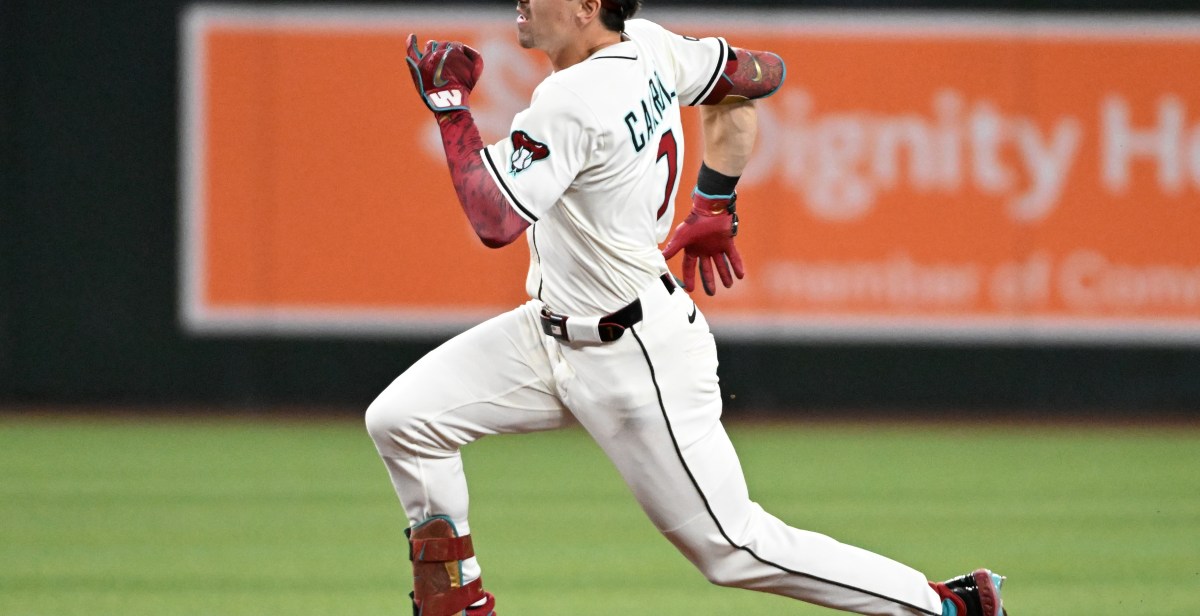
There has been an undercurrent of discontent within the Arizona fanbase about the style of offense the team has utilized this year. I often see complaints on the D-Backs’ subreddit, comments on articles or game day threads here, and even on other platforms about the move away from the “chaos baseball” style that characterized the upstart 2023 squad. These complaints have even invaded the television broadcast as one of Bob Brenly’s keys to the game yesterday was a return to the playstyle. In my mind, this playstyle emphasized aggressive baserunning, stealing bases whenever possible, and utilizing contact to get on base. And for the record, it’s not hard to see why it’s such a popular phenomenon – myself included. Who among us doesn’t want to see world-class athletes demonstrate their raw athleticism and ability? There’s certainly some credence to the complaints as the eye test alone makes it seem like the team is less aggressive on the base paths. But my parents always taught me to approach broad claims with some skepticism. So let’s dive into the data and see how accurate that eye test actually is.
Let’s start at the top and look first at stolen bases where the evidence is pretty definitive. If we use 2023 as our baseline (when the rule changes made stealing significantly more accessible), then there’s an undeniable downward trend for the D-Backs’ would-be base stealers. That season, they were second in the majors with 166 swiped bags as a team, trailing just the Cincinnati Reds who stole an eye-popping 190 bases on the season. It also marked the season when Corbin Carroll managed to steal an absurd 54 bases on the year, putting him in third behind Ronald Acuna Jr and Esteury Ruiz across all of baseball. The following season, the team dropped down to 119 stolen bags, just under the league average of 121, and they’ve stolen just 92 so far this season with 38 games left to play. When we visualize that trend over the past three years, it doesn’t take a rocket scientist or professional data analyst to recognize the downward trend we can see below.
But as I always like to mention, the context around these pieces of data are just as valuable – if not more so – than the piece itself. In this case, we’d like to know how the team’s stolen base count compares to their peers (i.e. the other teams). When we have this kind of context, we can see that the D-Backs might actually just be part of a larger trend where teams are de-emphasizing stolen bases because of the inherent risks involved in limiting scoring opportunities when those attempts are unsuccessful. And there has been a barely-noticeable dip in success rate for stolen bases since 2023 from 80% to 77% across the league. That’s a small enough difference that it could be statistical noise or a fluke, but it is worth considering that pitchers and their position players are adjusting to the new rules and are catching those base thieves more often. Regardless, there’s been an incontrovertible move away from stolen bases by the D-Backs over these past three seasons.
Of course, stolen bases are just one aspect in the “chaos baseball” playbook that we’ve previously seen. It also included a more aggressive approach on the basepaths more generally – including taking an extra base when possible. As the name would suggest, there’s a metric dedicated to measuring when a runner takes an additional base on a play (i.e. reaching second base on a single or third on a double) as well as measuring how other baserunners advance on the batted ball. If we follow a similar mental path for this extra base taken metric as the stolen base numbers from above, we arrive at the following visualization which also shows a slight decrease in the team’s success in advancing an additional base. However, this metric has some flaws that should be noted. One, there is some subjectivity involved as official scorers are the ones that determine what’s a single, double, etc. Second, there are no situational splits so all hits are evaluated similarly which might penalize baserunners that don’t try to advance in two-out situations. Even with these flaws, it gives us another data point that shows some credence to the complaints.
As it turns out, there is certainly some evidence to support the fans’ frustrations with the lack of aggressive baserunning this year. Some of the results we’ve seen above might stem from the incomplete nature of this season and we’ll need to check these numbers once it’s concluded. It’s also possible that we are still seeing some statistical noise in the data given the ridiculously small sample size in play here. But I think there’s also a larger conversation to be had on whether or not the “chaos ball” style was actually more effective. And for that discussion, we may need another article.