
TAMPA — Sometimes, fate hands you a gift. A life-changing revelation unearthed by accident or happenstance.
This is not one of those moments.
After a hurricane-induced relocation to Steinbrenner Field, there has been no epiphany about outdoor baseball in Tampa Bay. No a-ha! No smacking of the forehead or divine inspiration. Just rain, heat and sweaty pits.
Also, the confirmation that Tampa Bay’s next baseball stadium will need some semblance of a roof.
Not that this was a surprise. Major League Baseball officials were nervous enough about weather conditions at Steinbrenner that they readjusted the Rays’ schedule to limit the number of summertime games in Tampa, as well as shifting starting times to avoid heat and afternoon thunderstorms.
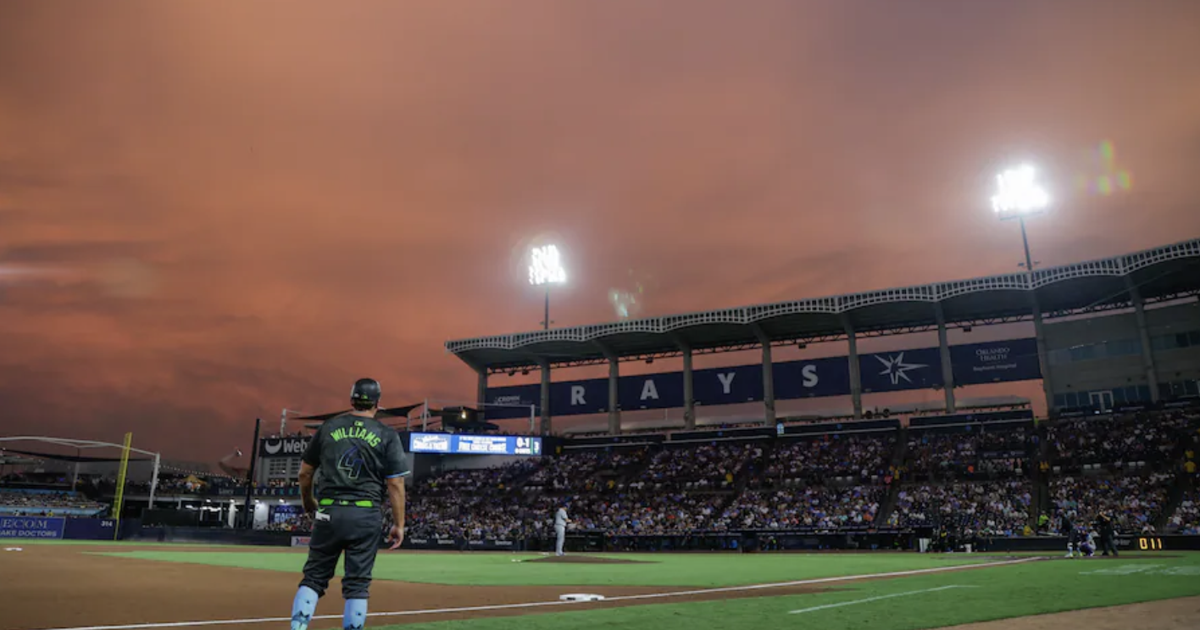
And, for the most part, the plan worked. While seven games have had rain-related delays, there have been no postponements at Steinbrenner through 62 dates. If you were following the Rays on television this season — and optimistically changed your computer wallpaper to a dramatic, pink-tinged sunset beyond the Steinbrenner bleachers — you might even be under the impression that an open-air ballpark is a gift from the heavens and should at least be part of the conversation in Tampa Bay.
That would be an emphatic no.
“Oh, definitely need a roof. Yeah. Oh, yeah,” said Rays pitcher Ryan Pepiot, who has had the misfortune of starting six day games at Steinbrenner this season. “Not just from the baseball perspective, but the fan perspective as well. You see the crowds on a Friday night game — or whatever night — and it feels electric. And then you see the people who brave the heat on a day game and, man, more power to them because it’s a grind.”
Most players surveyed in the Rays clubhouse had similar thoughts. They can survive the game — it is their job, after all — but talked about the toll on their family and fans in the stands. The players have plenty of fluids available and every half-inning they’re back in the dugout where there are mist devices and they can hide in the shade, but the family of four sitting on hard plastic seats in the middle of a crowded row have fewer luxuries at their fingertips.
“I went to the (Evan Longoria) retirement game, which was a 4 o’clock game so at least there was shade by the fifth inning, but I remember looking around at all the families with small children and they were burning up,” said Elijah Flewellen, a St. Petersburg resident who has been to 21 games at Steinbrenner this season. “Every half-inning or so, you’re seeing EMS coming into the stands to take care of a fan or somebody is trying to flag down a fan host or security because somebody is overheating.”
Everyone seems to like the idea of outdoor baseball, it’s just the ensuing dermatologist visits that are troublesome.
Which might explain why six of the nine games that have failed to sell out at Steinbrenner this season were day games, including a couple of weekend games.
For all of the concern about rain, it appears that heat has had a bigger effect on the ticket-buying public. Which, as Fox13 chief meteorologist Paul Dellegatto points out, makes sense when you consider other baseball markets with similar heat concerns. Miami, Texas, Houston, Arizona? They all have retractable roofs.
“Everything in our latitude, except for Atlanta, is indoors. And there’s a good reason for that,” Dellegatto said. “I just don’t think it’s a good idea to ask someone to sit in 92-degree heat with a 75 dew point and stay there for three hours to watch an event. I just don’t think it’s safe, unless the person knows how to hydrate.”
What’s interesting about this conversation is that most of the complaints have centered around the heat, and not the rain. The perception of late-afternoon thunderstorms causing havoc at Florida ballparks may be misconstrued, if not overblown.
Before LoanDepot Park opened in 2012, the Marlins played nearly 20 seasons in an open-air stadium and averaged only 1.4 postponements per season. Delays, rather than rainouts, were a much bigger factor. The Marlins averaged 9.3 rain delays per season, which is pretty close to the pace the Rays are on this season.
And while no one enjoys sitting through a rain delay, the real cost may be in the loss of ticket revenue. The Marlins often lamented that the threat of rain kept fans from going to the ballpark, even though actual postponements were rare.
So fan comfort? Requires a roof. Ticket sales? Better with a roof. Player preference? Definitely a roof.
But what does that mean as we approach 2030?
If the Rays had gone through with plans to build the pavilion-style ballpark in the Historic Gas Plant District, it would have been the first fixed-roof stadium in Major League Baseball since … Tropicana Field.
The seven other covered stadiums in MLB all have retractable roofs. The problem with that, at least in this community, is the excessive cost and space. A retractable roof can add hundreds of millions of dollars to the price of a stadium. Depending on the style of roof — whether it’s attached to the upper deck or surrounding the stadium — it can also increase the footprint of the building.
Hillsborough County Commissioner Ken Hagan says technology has evolved since the Rays began exploring the idea of a new stadium nearly 20 years ago, and so a fixed roof doesn’t necessarily need to be as bland and utilitarian as Tropicana. However, even the translucent roof the Rays were considering for one of their Ybor City models would have cost $245 million, or nearly 30% of the ballpark’s then-projected $892 million price tag. And that was back in 2018.
Hagan’s larger point, however, is that the conversation no longer needs to be limited to fixed or retractable roofs.
“Coming from a fan’s perspective, I’ve gone to a lot of games (at Steinbrenner) and I’m sweating profusely by the time I get to my seat,” Hagan said. “So I understand that, but I don’t think it needs to be an either/or scenario. It’s not a Steinbrenner (versus) a stadium that’s completely covered. I think there are other options.
“And the reality is new ownership may have entirely different thoughts on what they would like to see, but I think it’s safe to say that our previous efforts were driven by the need to be cost conscious.”
The pending sale of the team from Stuart Sternberg to a group headed up by Jacksonville home builder Patrick Zalupski could certainly change the direction of the team’s stadium plans. But, because the Zalupski group has been mostly silent during the sale process, it’s hard to know what they want from a new ballpark, aside from a Hillsborough County zip code.
When Sternberg first broached the idea of a new stadium in 2007, his idea was a waterfront ballpark at the Al Lang Field site with a sail-like covering for a roof. That later evolved to the translucent roof in Ybor and then the pavilion-like plan with open breezeways on the Trop property.
Then Hurricane Milton came along and not only ripped the roof off Tropicana Field, but led to a rethinking of the entire concept of a stadium.
“When the idea was to build a new stadium at the Al Lang site, I remember Stu talking about how baseball was supposed to be played outside and on real grass and not artificial turf,” said Ed Montanari, a former St. Petersburg City Council member who was involved in several stadium discussions.
“But the way things have played out at Steinbrenner Field … it’s just really uncomfortable outside in that heat.”
John Romano is a sports columnist for the Tampa Bay Times.