
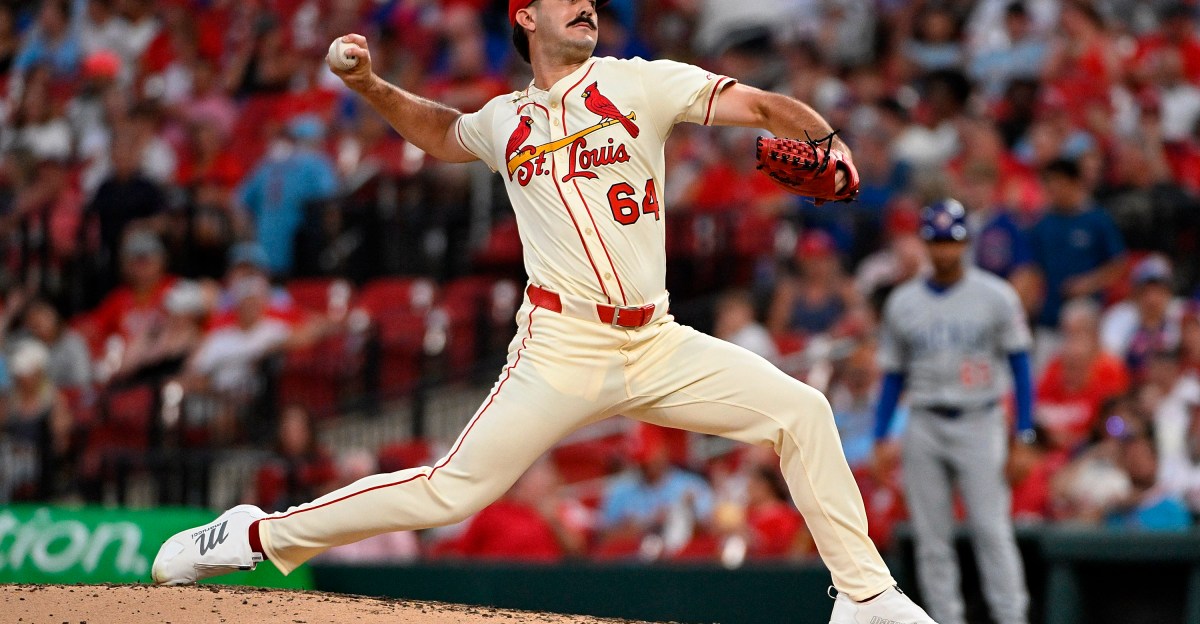
The St. Louis Cardinals are finally seeing some of the few benefits of being completely inactive on the offseason market. After only signing reliever Phil Maton to the major league roster in the offseason, the Cardinals were betting on their young relievers replicating their success from previous seasons. A dangerous game to play with the bullpen.
John Mozeliak announced there would be a “transition” of sorts and that made fans expect at least some roster turnover outside of Paul Goldschmidt and Andrew Kittredge, but we were left with much of the same underwhelming rosters from the previous two seasons. Despite what appeared to be a clear way of thinking, Mozeliak refused to deal any of Ryan Helsley, Steven Matz, or Erick Fedde when their value was the highest and now, none of those three are with the team for a minimal, if any, return. Last year’s bullpen production, though, was solid enough that it looked like it would be a strength of this year’s team, so there was some argument to holding onto these arms while the Cardinals balanced competing with transitioning. With Helsley and Maton filling in the backend of the pen with JoJo Romero, Kyle Leahy, and last year’s success story in Ryan Fernandez, the relief corps was set to provide plenty of support for the pitch-to-contact rotation.
As we have seen, the decisions to hold onto bullpen arms has not worked out for one reason or another, ranging from a decrease in performance (Fernandez) or potentially receiving less value than if they were to be dealt in the offseason (Helsley). Bullpens are such a volatile piece of a major league roster that betting on your inexperienced arms to replicate their success is a fool’s way of thinking. Because of that, my hope is that Chaim Bloom will not be as gun shy either trading pitching pieces at peak value or ponying up the cash for arms with a solid track record.
Chaim Bloom needs to be more aggressive with the pitching staff
Paying top dollar for pitching is always a risk, so most of my gripe with the offseason is built around the bullpen. Yes, it was clear that the starting rotation this year was not built to compete, but doing nothing to shore up any relief question marks had to be either naivety to regression or taking orders from ownership to spend as little as possible. Either way, poor leadership all the way around.
Depending on how you look at it, the Cardinals were either blessed or doomed by great health with the big league pitching staff. Besides John King hitting the shelf with an oblique issue, no other pitchers were placed on the injured list at any point this year meaning the pitchers the Cardinals started the season with have received the vast majority of the innings. This would be great if all, or really even the majority, of these arms were effective, but the performances have been up and down, falling in line with the season as a whole.
The Cardinals currently sit 29th in baseball in K/9, and the sad part is that is helped by the bullpen’s strikeout rate which sits at slightly less terrible 21st place. In terms of “stuff”, the staff ranks 17th in average fastball velocity at 94.2mph and the pitch-to-contact mentality has pitchers giving up a .253 opponent batting average (26th) and a 1.30 WHIP (18th). The group ERA sits at 4.26 (22nd) but their 3.91 xFIP puts them at 6th place in all of baseball. Hopefully, this is enough for Bloom to realize it is time to update the antiquated way of pitching in the zone with mediocre fastballs and expecting major league hitters not to adjust.
Command has not been an issue for the staff as they sit in third on the leaderboard for BB% and BB/9, but there terrible other numbers show they are simply giving up too many hits. Two things I personally would like to see Bloom do to show he is different than his predecessor: emphasize stuff and capitalize on pitching assets. With the stuff portion, we have seen how guys with command issues are still able to be effective in short bursts. Riley O’Brien is averaging 98.3mph with is fastball but is walking batters 12% of the time. However, he has a 1.56 ERA (3.55 FIP) and is limiting damage thanks to a .195 opponent batting average. The same story can be told for Matt Svanson, who is pushing towards 97mph average fastball velocity and a .150 batting average against with a middle of the road 8% walk rate. It looks like Bloom started to make this adjustment in the 2025 draft and at the trade deadline, acquiring many high-octane arms even though there may be questions about their ability to find the strike zone. Four of the top five pitching staffs in terms of fWAR also have the highest average velocity but only one of them (Phillies) sit in the top-10 when it comes to walk rate. Hitters will get themselves out more than pitchers get hitters out.
To help with this, I believe the Cardinals could find plenty of low-cost relief options similar to how they signed Phil Maton in the middle of March. Every year, competitive teams are always in the hunt for bullpen pieces so it was confusing to me when St. Louis felt that, even though the 2024 results were there, their reliever options were good enough. This is especially interesting seeing as how they were expecting to transition to a retool of sorts so Helsley, Steven Matz, and Maton would be on the move at some point. Relievers are extremely tough to predict, especially the young guys, so if the Cardinals were serious about competing, spending more money on a short-term reliever makes sense.
Capitalizing on assets is something that the Cardinals have not been able to do recently, either on the trade market or on the major league roster. This was evidenced by the decision to keep Fedde and Helsley into the season, not giving Michael McGreevy a shot earlier, or even cashing in on prospects in trades or making aggressive promotions. In order to move to the next level, Bloom and the organization will have to be comfortable with taking greater risks. The minor league pitching staff has been absolutely hammered by injuries this year, so it will be interesting to see if Bloom and Co. decide to take advantage of the pitching prospects next year while they are still healthy. I will specifically be watching Quinn Mathews, Tink Hence, Liam Doyle, and Tanner Franklin as guys that could/should be in the conversation for major league innings before the injury bug bites them. If they wanted to get aggressive with spending, I am still hesitant to offer long-term contracts to starters and love the idea of opt-outs or vesting options for pitching. The starting pitcher market looks decent enough to find an above-average arm for a middling cost, so if it does not work, the team will not be hamstrung financially or be able to recoup some value on the trade market.
Beyond the pitching side, I want to see Bloom cash in while value is high and be okay with the risk of a player taking off elsewhere. Fielding offers on Brendan Donovan, Lars Nootbaar, Alec Burleson, a catcher, or infielder makes organizational sense, at least to me, if they really believe a retool is the best path. The redundancy of the roster keeps getting lumped into the mythical 40-man roster crunch and well run organizations tend to deal from positions of depth to fill needs elsewhere.
Overall, while I am still remaining focused on the last month-plus of the current season, I am very excited to get some answers to the questions fans have been having about what Chaim Bloom will actually do. There has been very minimal face time with Bloom since being announced as the future POBO, so we do not have a lot of information for his plan. If he really wants to make his mark on the organization, he will leave the John Mozeliak way of thinking behind… as long as ownership allows.