
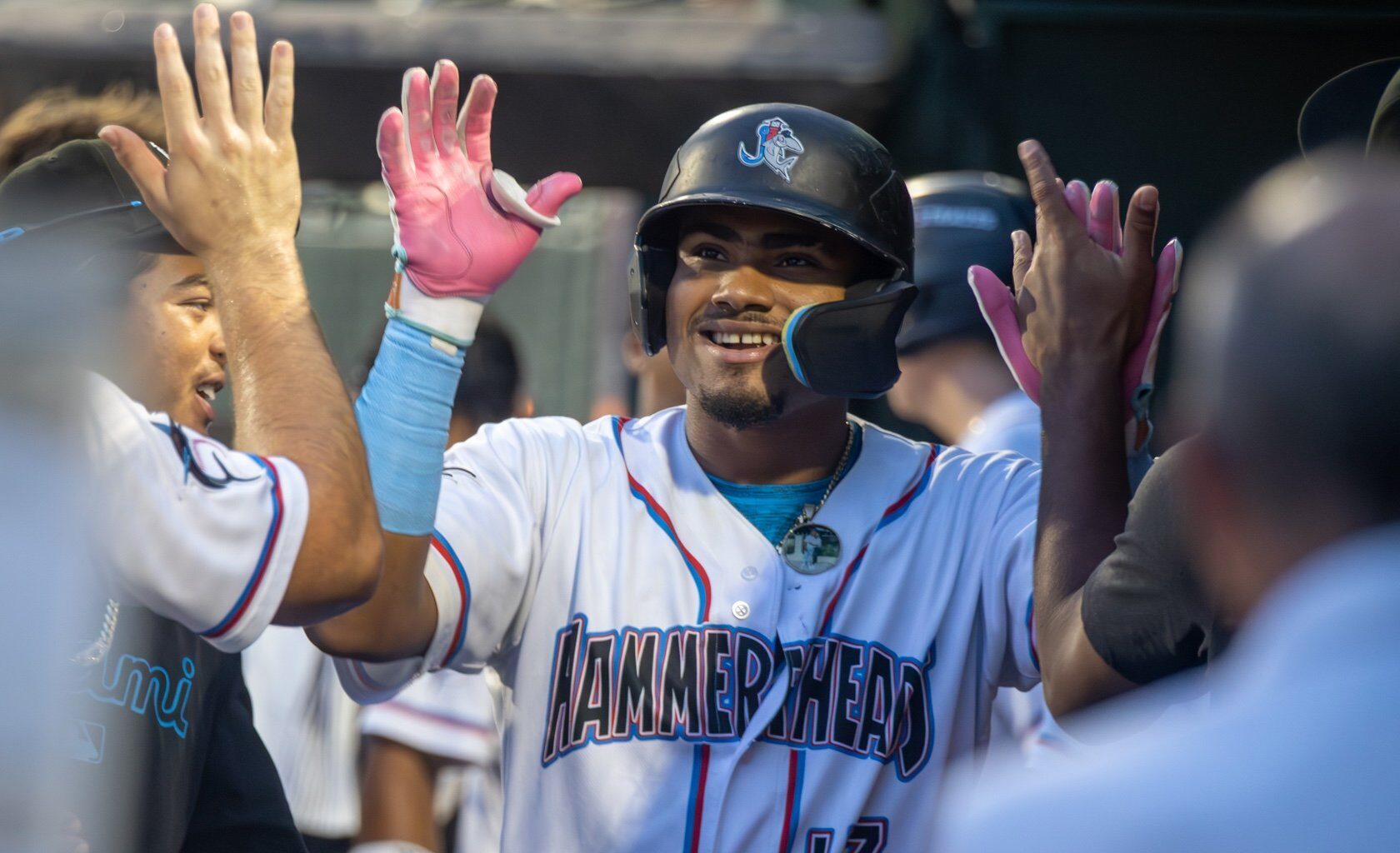
Who was the “centerpiece” of the Jesús Sánchez trade from the Miami Marlins’ perspective? It was hard to tell in the moment. Nearly a month later, outfielder Esmil Valencia has been making a compelling case for himself.
At first glance, acquiring Valencia looked like a bet on his speed and defense. In 87 rookie ball games with the Houston Astros organization, he had racked up 27 stolen bases while playing primarily center field. His SB volume doubled upon being promoted to Low-A with 50 steals in 83 games this season prior to the trade. He ranks 11th among all minor leaguers with 59 SB in 2025, and his Sprint Speed is second-best among current Jupiter Hammerheads, according to Statcast.
All of a sudden, though, Valencia’s bat has also caught fire. With a full week left in August, he has more total bases (35) than he had in any previous month of his professional career. His pre-trade track record was that of a league-average hitter, with wRC+ marks of 100, 98 and 103 during his three seasons with Astros affiliates. Since becoming a Marlins farmhand, he’s slashing .362/.403/.603 with just as many walks as strikeouts and a 172 wRC+.
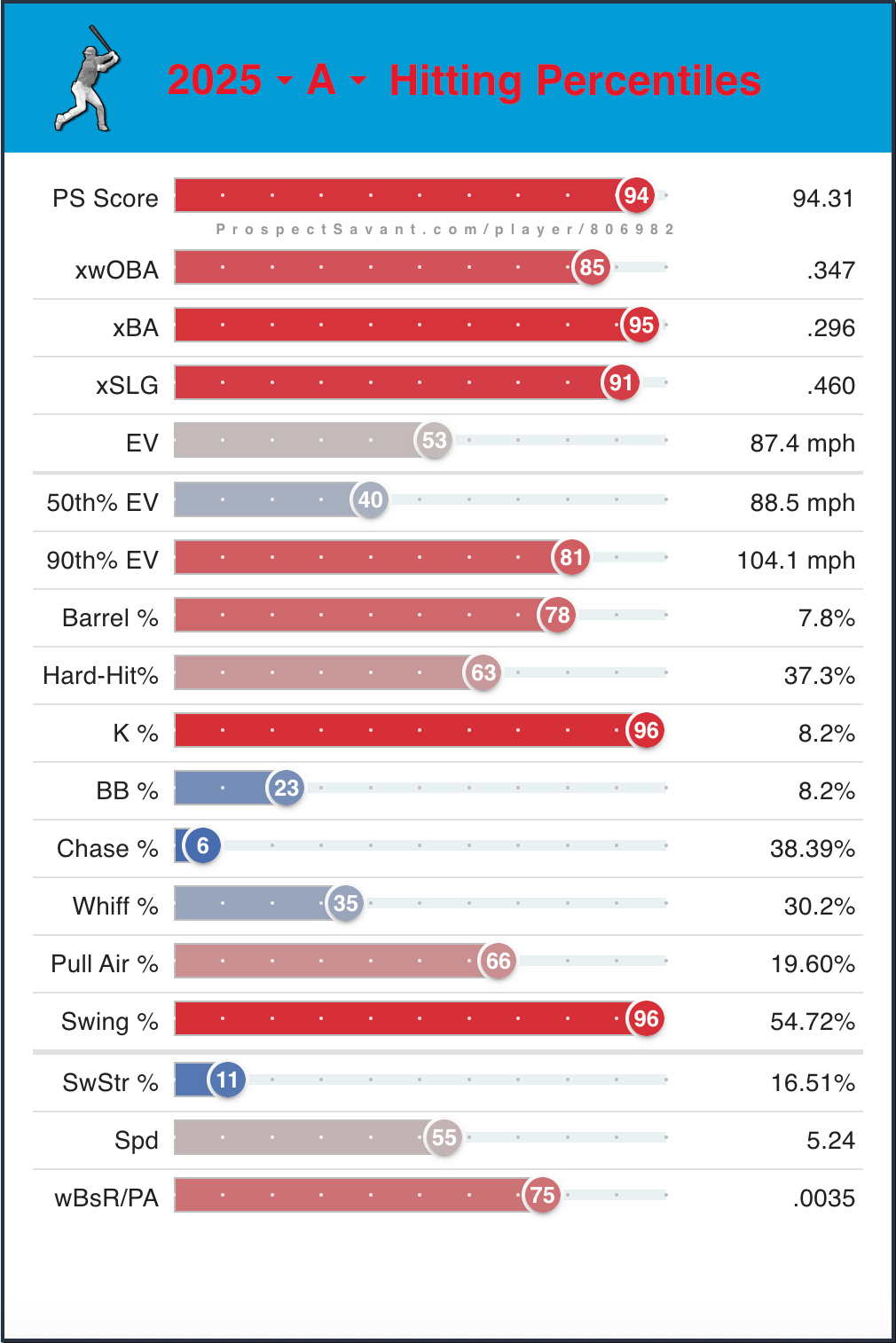
Valencia is not particularly projectable for a 19-year-old, listed at only 5’10”. Fortunately, he is making lots of quality contact as it is. He has a 90th-percentile exit velocity of 104.1 mph with Jupiter, per Prospect Savant. He has peaked at a 112.0 mph exit velo so far; for context, that exceeds the MLB/MiLB career-best EVs of Marlins outfielders Heriberto Hernández and Dane Myers.
With that being said, I believe Valencia in his current form would get blown up by upper-minors pitching. His unorthodox hitting mechanics are easy to exploit.
Valencia’s setup and the finish to his swing remind me of former Marlin Yuli Gurriel—needless to say, that would be an incredible career outcome. The concern is what happens in between when he freezes his entire body for about half a second prior to the pitcher’s delivery. He can overcome that to arrive on time and crush 86 mph sinkers like this one:
NHl5YWpfV0ZRVkV3dEdEUT09X1Z3TURCbDBEVjFjQUNsb0ZWd0FIQmxWWEFGbFdVd0lBQndBRVVsQUZDVlVHVkZRQw==.mp4
However, that won’t work versus high-end velocity. A statistical red flag has already popped up.
Valencia is whiffing against 32.4% of the four-seam fastballs that he swings at. Only 18 of the 349 Statcast-qualified MLB hitters this season are north of that, per Baseball Savant, and they’re obviously facing better four-seamers than Valencia. The average velocity of four-seamers thrown to him in the Florida State League has been 92.5 mph, whereas the MLB average is 94.5 mph.
Valencia is maintaining an elite strikeout rate since the trade because opponents are trying to finish him off in two-strike counts with breaking balls and offspeed pitches. They are inadvertently doing him a favor! As he climbs the minor league ladder, the pitch-calling will be geared more toward his specific weaknesses, and his production will crater unless an adjustment is made.
Valencia is 26th on the Fish On First Top 30 and likely to rise a bit in our end-of-season update. From there, we’ll have to see what he changes about his pre-pitch routine in an effort to close this hole in his hitting profile.
Interested in learning more about the Miami Marlins’ top prospects? Check out our comprehensive top prospects list that includes up-to-date stats, articles and videos about every prospect, scouting reports, and more!