
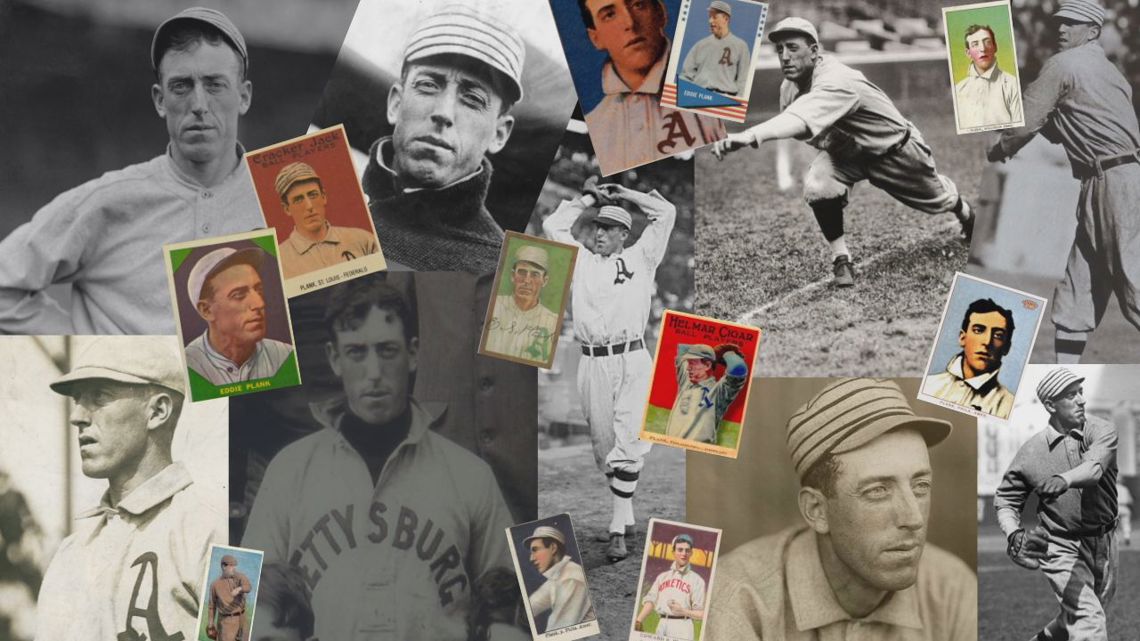
There are 351 people in the National Baseball Hall of Fame, including Gettysburg’s Eddie Plank. Look back on his life and legacy at home and on the game he loved.
GETTYSBURG, Pa. — “This is the birthplace and childhood home of Eddie Plank, the Hall of Fame baseball player,” said Dr. Lawrence Knorr, standing off Keller Road in Adams County. “It really all began here for him, back in the, I’d say, 1880s and early 1890s, as he and his brothers got into some organized baseball.”
Knorr is the author of ‘Gettysburg Eddie — The Story of Eddie Plank.’
Edward Stewart Plank was born on Aug. 31st, 1875, at a unique time in Gettysburg’s history.
“Gettysburg was just emerging out of the American Civil War, so a lot of people were coming to Gettysburg, and it was starting to thrive as a tourist destination,” said Adams County Historian Tim Smith. “His grandfather owned a farm that would become part of the Gettysburg Battlefield, and his father grew up in a house that was used as a hospital after the Battle of Gettysburg and one of the things in our collection that we’re very proud of is 12-pound solid shot that actually came through the Plank family to us, that was on that farm after the battle.”
Growing up on the farm in Straban Township, Plank and his brothers had a short walk to school, down a dirt road that’s still there to this day.
“The rural schools were one-room schoolhouses that were in communities, and the Plank boys only had to walk about a mile past the farm down a dirt lane to the Good Intent School. And that’s where RK Major, who was the school master, also organized their baseball activities,” added Dr. Knorr.
“The schools had younger kids, and they had all had their own baseball teams. The different town teams would travel around, like McSherrystown, Gettysburg, Littlestown, New Oxford, and play each other,” Smith said. “And one thing I noticed in the newspapers, Eddie Plank’s name appears consistently on these various town teams. It seems like when he plays, everybody wants him to be on their team; they pick him first.”
Plank’s game is hardly the only thing that’s growing during this time.
“In the 1890s, due to a certain degree of middle-class growth and economic growth, colleges grew too, and so Gettysburg finally hit the 200-student mark,” said Dr. Michael Birkner, a Professor of History at Gettysburg College. “When you reach that point, you can start organizing clubs and sports.”
But you can’t exactly call the lefty a Gettysburg College student.
“Plank would have come to Gettysburg Academy, which was on the grounds of Gettysburg College, then called Pennsylvania College,” stated Dr. Birkner. “It didn’t change its name formally until 1921, but it was renamed Gettysburg College, because people were calling it Gettysburg College, just out of simplicity, and to avoid confusion with Penn State.”
“This is sort of his late bloomer thing. So, he’s older than the typical college student. I don’t think he had the prerequisites to get into the college,” added Dr. Knorr. “But, they found a way for him to be approved to play on the baseball team, and to do that, you had to at least be at the Academy, which was sort of a remedial school.”
“At that point, Eddie Plank, for the first time, had professional coaches that were actually helping him improve his game,” Smith said
Over his time on campus, Plank made plenty of headlines and box scores, and even showed some improvement when it came to his test scores.
“There’s a general assumption that he was a terrible student. He wasn’t a terrible student, and in fact, his grades are very mixed. He, in certain disciplines, actually shows significant progress in his time at the Academy,” corrected Dr. Birkner. “But his real love was baseball, so he joined the baseball club, as it was called in 1900, full-time. Everybody who commented said this was a guy who really had it as a pitcher, and then in 1901, he’s just even better.”
And 1901 was a better year for baseball fans, because that’s when Major League Baseball added the American League and its eight charter teams. That also means that scouts and coaches are looking all over the country for new talent. While there are different takes on how Plank caught the eye of the majors, historians key in on one Keystone State connection.
“He actually left Gettysburg College, his team, about two-thirds of the way through the season,” said Dr. Birkner.
“Coach [Frank] Foreman, who had been at Gettysburg College coaching the team for a little while,” Dr. Knorr said, “it’s Foreman, we think, is the one who tipped off Connie Mack about Eddie Plank up the road at Gettysburg College.”
“Connie Mack invited him to a game with the Philadelphia Athletics against the Baltimore Orioles in Baltimore. Connie Mack saw him pitch, and then actually allowed him to pitch a few innings in that game without actually being part of the Athletics, and after the game, Connie Mack signed him,” added Smith.
“He has to say goodbye to his friends and teammates, and he goes, and he immediately, like the next day, is pitching in the bigs,” laughed Dr. Birkner.
“He left Gettysburg for the Philadelphia Athletics on a Friday and arrived in Washington, D.C. On Saturday, the Philadelphia Athletics played against the Washington Senators. He pitched the game, and he won the game,” Smith said.
As seamless as it may have seemed at the time, Plank had put in a lot of work to reach the level of play that the Philadelphia Athletics’ fans had come to know, expect, and love.
“He actually did not enter the major leagues until he was almost 26 years old,” stated Smith.
“He himself would acknowledge that he had the advantage going into the Major Leagues of being a little more mature and having had more life experience and also learning some things about how to be a better pitcher when he started his Major League career,” added Dr. Birkner. “Which is how it was possible for him to win 17 games his first year when he only joined the team in the middle of May.”
For more than a decade, the Athletics were no strangers to World Series expectations, and Gettysburg Eddie was one of their anchors.
“In the early days of the Athletics, they were one of the top teams of the American League in that era,” stated Dr. Knorr. “They won several championships. At one point behind Eddie was what was known as the $100,000 infield, which today, if you had $100,000 infield, you know you’re probably talking about an A-ball team, but back then, that was big news. They were the stars of their day in Philadelphia, a big market. They had the Phillies, which usually weren’t very good, although in 1915, they were. But most other years, the Phillies weren’t. The A’s were. The A’s become the darlings of the town.”
Left-hander Eddie Plank delivers the first pitch in the first game at Philadelphia’s sparkling new Shibe Park on April…
Posted by Harrisburg Baseball on Thursday, March 13, 2025
“He had a good arm. He had a really good curveball. He was left-handed, which, at the time, you probably know, is unusual for pitchers, and he was methodical in his approach, and that annoyed a lot of people. Apparently, he took a long time between pitches. He would not survive in a world where you have a timer,” said Smith with a chuckle.
“There’s a book by Lawrence Ritter where he writes about the players of that era, and they talk about different players and their experiences, and Plank would come up in that,” Dr. Knorr recalled. “He was a very tough left-hander because he threw three-quarters sidearm, which was a little bit different, more unorthodox. So, if you know anything about pitching, he started on the left side of the rubber and threw across his body so the ball would come at an angle across the plate. So, if he threw a curveball or some kind of curving pitch, it would really tail away from the left-handed hitter. If you ever saw Steve Carlton pitch to Dave Parker or Willie Stargell back then, Randy Johnson trying to pitch to John Kruk, that was Eddie Plank against Babe Ruth, Ty Cobb, and all those other left-handers. He did well against the right-handers, too.”
Plank and the Athletics won the World Series in 1910, 1911, and 1913. A’s manager Connie Mack recalled Plank’s only superstition before any start was that he always ate a bowl of tomato soup. Plank usually found himself matched up with some of the best pitchers in the game, the opposing team’s ace, and on the game’s biggest stage.
“In 1913, when he was 38, which is pretty old for a baseball player, he pitched in the World Series and was in New York at the Polo Grounds. So, he’s the visiting team. The A’s win the series. I think four games to one. Game 5, Eddie’s on the mound the whole game. These guys pitched complete games most of the time. So, he’s on the mound. He wins the game and the fans come on the field and they carry him off the field at the Polo Grounds and the newspaper account said these couldn’t have been all Philadelphia fans, there had to have been New Yorkers that were just celebrating Eddie Plank’s success, and were thinking this was his send off, he’ll probably retire, he’s 38, he won the World Series, he won the last game he pitched, that kind of thing. Of course, he goes on to pitch a few more years,” laughed Dr. Knorr.
October 11, 1913 – The Philadelphia Athletics win the World Series as Eddie Plank outduels New York Giants pitching…
Posted by When We Wore Fedoras on Wednesday, October 11, 2023
“After Eddie and his team won the 1913 World Series, Gettysburg had a banquet for him, and there are photographs at this banquet. And when he came to Gettysburg, he took Connie Mack around the battlefield, and we have photographs in our collection from William Tipton of the tour of the Gettysburg Battlefield. And you can imagine the World Series pitcher Eddie Plank with the World Series manager Connie Mack, and it’s in November of 1913, when they’re touring the battlefield. And ironically, they’re touring in a 1914 Oakland,” smirked Smith.
And long before the Athletics left Philadelphia for Kansas City, and then on to Oakland, before heading to Las Vegas, by way of Sacramento, they would first part ways with Plank.
“Mack had a habit of trading or releasing some of his best players because he didn’t want to pay them their salaries,” recalled Dr. Birkner. “In 1915, after having this amazing career with the Athletics, he won’t pay Plank a decent salary, and Plank goes over to the Federal League.”
Plank would pitch for the St. Louis Terriers in 1915, where, at 39 years old, he won 21 games, with what would’ve been a 2.08 ERA, if they had kept that statistic back then.
He returned to the American League in 1916 with the St. Louis Browns and re-upped there for the 1917 season. His rights were traded to the Yankees for the 1918 season, but he never wore the pinstripes, and after pitching in the MLB for 17 seasons, at 41 years old, Eddie Plank retired. Just as he did every offseason or every extended break, Gettysburg Eddie made his way back to Gettysburg.
“He just loved this area and was just part of, I mean, everybody knew him, and I guess he was very approachable. He was very generous,” said Dr. Knorr. “He was a Mason, but also a very generous person who loaned small loans to people around town, but he never really asked for them to pay him back. So, you know he’s a man who did well. I don’t think he spent a lot of money. He didn’t waste his money.”
Plank had quietly married Anna Myers in 1915, and they had a son, Edward Stewart Plank, Jr.
He’d own a Buick dealership in town and operate a garage with his brother, Ira, who was also the baseball coach at Gettysburg College. The game was never too far away.
“A boy was pumping gas at the plank garage, and Plank one day comes to the garage, and he sees him, and his name was Charles Bream, and he went by a nickname of Junie, and I don’t know that Plank addressed him by his nickname. But he said, ‘Young man, would you like to take a drive with me over to Emmitsburg, Maryland, because, Connie Mack has asked me if I would scout a third baseman and I’d like to have the company,’ and of course Judie Bream, who I interviewed, told me that this was really an exciting moment for him and so he got to talk baseball with Eddie Plank as they drove,” said Dr. Birkner, recalling the conversation. “It’s about a 12-mile drive, and he got to spend an afternoon with Eddie Plank. It was a highlight of his young life. He had a further highlight with Eddie Plank in the sense that a few years later, Bream attended Gettysburg College and played for the college baseball team. And guess who hit fungos for the outfielders for the college baseball team, Eddie Plank. This would have been in the early to mid-1920s. Plank was retired, but he was still physically active in his 40s, and he liked baseball, and he was helping out his brother.”
At his home in February of 1926, Plank suffered a stroke. The left side of his body, which struck fear into some of the biggest hitters of that era, was paralyzed. Two days later, Plank died. He was just 50 years old.
“It was surprising to people, because he was an athlete, that he died at such a young age,” added Smith.
He was laid to rest in Evergreen Cemetery, but Plank, in a way, was set to become a permanent part of campus.
“Gettysburg College was building a gym about the time Eddie Plank died. It was planning the gym. It was hiring an architect, and he had pitched for the college. So, the President of the college came up with this notion that they would name a gym for Eddie Plank,” stated Dr. Birkner. “He contacted Connie Mack in 1927 and said, ‘Would you hold an exhibition game between your team and another Major League team?’ If they would agree, the proceeds of the game would go to Gettysburg College to build Plank Gym, and Connie Mack said, ‘Absolutely. I thought Eddie Plank was a great guy. I’ll check with my team members, and I’ll also talk to another owner of a team, and we’ll see what we can work out.’ Everybody was agreeable. They worked it out. They were selling tickets in advance, and they were hoping for a very good crowd. It would have been a September game, and wouldn’t you know it, the day of the game, it just absolutely poured all day, and they had to call the game. So, then they didn’t give up, they said, ‘Could we try next year to do this?’ and Max says, ‘OK,’ and they work it up again, and they have another team that’s willing to do this in memory of Eddie Plank. They scheduled the game, and on the very day of the game, it’s the same result. It pours, and they play two innings, and they couldn’t do any more.”
While there were local efforts to give towards the Eddie Plank memorial fund, his national impact on the game helped it reach rivals in big league cities across the country. Boston held an Eddie Plank Day, as did Detroit, where even Ty Cobb, of all people, referred to Plank as a best friend.
Years later, in 1939, a new museum opened in Cooperstown, New York. The National Baseball Hall of Fame inducts Gettysburg Eddie as part of the class of 1946.
“At the time he was put in, I think he might have been the leading left-handed pitcher in the game in wins and definitely in shutouts,” said Smith. “He was the head of a lot of pitching categories at the time he was put in. So, I think it was a no-brainer to include him in the Baseball Hall of Fame. For the people who lived here, when he’s put into the Hall of Fame, it was a huge honor for all the people in Gettysburg and Adams County that supported him over the years.”
This Sunday marks the 150th Anniversary of the birth of Eddie Plank. And just as Gettysburg Eddie never forgot about Gettysburg, Gettysburg has never forgotten him.
“People who love history and people who love baseball are a lot of times one and the same,” claims Adams County Historical Society Chief Marketing Officer Michaela Shaffer. “A lot of our visitors that come in are also sports fans, whether it be baseball, football, whatever, and we have some ties to all of those sports here in Adams County and Gettysburg.”
Markers can still be found throughout Gettysburg with Plank’s name on them. The Gettysburg Beyond the Battle Museum has exhibits honoring the Hall of Famer with items that once belonged to the ace.
“Eddie Plank is the perfect person for our type of collection,” claimed Smith. “We have a variety of things that we’ve gotten over the years from the Plank family, but also from other people in the community. Now, of course, I wanted to mention that we don’t have an Eddie Plank T206 baseball card that was issued from 1909 to 1911, and is worth a few hundred thousand dollars. If anybody would like to donate one, we’d love to have it. We do have one of the 1906 fan craze cards of Eddie Plank that would be worth a considerable amount. If someone had not cut out the center of it, so you know, we’re always trying to look and see what is in the community, that can help better tell our story, and Eddie Plank is one of those fascinating stories that is perfect for us to tell.”
If visitors to the area are hungry to learn more, there’s a place they can go for both.
Eddie Plank’s birthday weekend celebration with Gettysburg History just keeps getting better and better! 🤩⚾✨
Posted by Gettysburg Eddie’s on Wednesday, August 20, 2025
“Gettysburg is a unique town. I mean, obviously, we got the battlefield and all that goes with it, but there’s still a lot of other things here that people come to visit and do, and owning a piece of that has just been a blessing,” said Gettysburg Eddie’s owner, Steven Rasmussen.
Cassie Probst has worked at the restaurant since it was called the Gingerbread Man. Now the General Manager, she knows the name change helped spread the legacy of Plank to their regulars, as well as anyone just wandering in off the battlefield.
“Brian Kennel, a local guy who was friends with the old owner, either owns or takes care of the Evergreen Cemetery where Eddie’s buried. So, it’s like, ‘Why don’t you do this? A cool baseball sports bar,’ and he had a lot of photos to help with that. It gives people something different to do. With all the Civil War, it’s still history, so it fits in, but it’s baseball,” said Probst.
The staff find themselves answering questions from out-of-towners, from time to time. But for Rasmussen, when it came time to add on to Gettysburg Eddie’s, he leaned into the baseball pitch.
“Upstairs, we call it the Jewel Box Lounge. Not a lot of folks put the connection together that back in the early 1900s that the baseball stadiums that were being built were called jewel boxes,” Rasmussen said. There’s a whole history of jewel box stadiums. Eddie Plank actually pitched the first game at Shibe Park, and so it was just a natural progression to add to Gettysburg Eddie’s.”
When it comes to the diamond sports locally, the restaurant makes sure its namesake would be happy to see it helping from the ground floor.
“We try to support local organizations with baseball too, whether it be Little League softball, baseball, and just keep the whole baseball theme going all year round,” added Probst.
The Eddie Plank items, like the ones seen in the Gettysburg College Special Collections and Archives, as well as sought-after cards and artifacts up for sale, can go for thousands of dollars in today’s market. But they’re only rare, because Plank himself was one of a kind.
“Now that I’ve learned about the man and his history and the legacy, it’s a privilege and an honor to continue that namesake moving forward. So I’m just glad I’m a little part,” said Rasmussen.
“I’ve always had a picture in my office of Eddie Plank, so this has been a very special experience to get to know more about his background and just to honor him and share that love for baseball and that love for Eddie with others,” Shaffer added.
“He had a phenomenal career, very steady,” claimed Dr. Knorr. “Of course, he had good teams behind him, too. So, yeah, I’d say he was not flashy. He was certainly more of a quiet gentleman.”
“I think it’s amazing to me, Eddie Plank being able to handle not just pitching on the Major League level from just town teams and then college, and then quickly making that transition. But imagine all the pressure of pitching, you know, for 10, or 20, or 30, or 100 people, and then all of a sudden, thousands of people are in the stands, and I just can’t imagine how cool he was,” marveled Smith.
“I think the part about Eddie Plank that appeals to me the most was that he never was a swelled head, prima donna-type person, that he was a down-to-earth ball player and human being, and he treated people well, and that’s something that we’d like to see more of, right?” asked Dr. Birkner. “We’re doubly proud. It wasn’t just the records. It was the kind of approach he had to treating people well.”