

Like most rookies, Braxton Ashcraft is an unfinished product on the mound. We’re seven years removed from him being taken in the second round by the Pirates, who have largely played it slow and safe with his development. Adding in that he missed time in 2019, then lost a year like every other prospect did in 2020, and then also lost most of 2021 and all of 2022 to Tommy John surgery, his timeline suddenly makes more sense. Not to mention, he was considered an exceptionally raw “bet on the athlete” kind of prospect during his draft cycle to begin with.
Getting more to the point, Ashcraft is having a strong rookie campaign thus far. He was called up and put into a multi-inning relief role, and is currently in the process of being stretched back out to start again, like he did in AAA at the beginning of the season. He’s performed admirably since his call-up, pitching to a 2.70 ERA across his 46.2 innings of work. It’s the way he’s doing it that interests me, though. He both is and isn’t what you would expect a hard-throwing rookie to be.
A Scorching Arsenal
Like many pitchers, his best pitch from a stuff perspective is his slider. Unlike most rookies, he’s well aware of this and uses it more than anything else he throws. It always inspires confidence in me when a pitcher is called up and is already throwing breaking balls or offspeed pitches as much as, if not more than, their fastballs. I tend to view it as a sign of intelligence and good coaching, being aware of their strengths on the mound and capitalizing on them.
He might be able to shave a bit of IVB off of it and achieve more depth if he eased back and threw it in the high 80s instead, but that’s nitpicking on my part. His higher-than-average release combined with the power of this pitch makes it difficult for hitters to do anything with it when he’s locating it well. We’ll get into this more later, but it should be noted that he does do this most of the time, earning a plvLoc+ of 108 on this pitch.
Ashcraft’s 4-seam is an interesting study. By stuff measures, all it has going for it is that he throws it very hard. It lacks good movement for his release. What it does have is a good fit in his pitch mix. His 4-seam plays well off of everything else he throws, even if it can’t stand alone. It comes out of his hand with a highly similar spin direction and active spin percentage as his sinker and changeup, and isn’t far off in spin rate either. He also doesn’t modify his delivery much to throw any of these pitches, so they all look the same out of his hand.
He also creates a strong spin mirror between his fastball and curveball, coming out a minute away from perfect opposites, even if their active spin percentage isn’t quite a match. His whole arsenal is built around making everything look the same as he releases it. It’s exceptionally difficult to pick up the spin off of Ashcraft, taking away a common tool for hitters to identify pitches. I wish he would throw the 4-seam less often to protect it a bit more, but it hides well in his arsenal and can be effective when used in tandem with his other pitches.
On top of the spin deception, Ashcraft’s curve is just plain nasty. Thrown with both power and movement, there are only a handful of breaking balls thrown harder than his that have more total movement. Between its velocity, high release, and downward action, this pitch is very difficult to get under if you can get the bat on it at all. It has an exceptionally steep approach angle for its velocity. As the year has gone on, he’s gotten more comfortable throwing it to same-handed hitters, realizing that it’s good enough to do that with instead of exclusively using it against lefties.
Speaking of using specific pitches against each handedness of a hitter, Ashcraft’s sinker is currently only deployed against righties. As a result, it is his lesser-used fastball by a good margin. I find this odd considering it’s a better pitch from a stuff perspective. It has above-average depth for his release, and the high release gives it a steeper VAA, helping it induce more ground balls. He also employs a strong seam-shifted wake on it.
Ashcraft’s changeup is a distant fifth pitch, not thrown enough to even show up on his PLV chart. What few he has thrown have been interesting. He’s located them reasonably well, but the way they move is strange. Like many supinators, Ashcraft struggles to separate his changeup from his sinker. They move extremely similarly, with only 5 mph of velocity separating them. Surprisingly, if it’s sold well, that can be enough. Given that the 4-seam is his primary fastball, though, comparing it to that would be more fair and also produce a friendlier outlook for him. What it lacks in velocity separation, it makes up for with good vertical separation and consistent release and spin data across the two pitches. I don’t understand why he isn’t throwing this pitch more.
Flying Close to the Sun
So, we’ve established that Ashcraft has excellent stuff. A do-it-all gyro slider that can function as his most thrown pitch, a hard 4-seam that works well in his repertoire, a devastating curveball that looks like it’s being struck by gale-force winds on its way to the plate, a heavy sinker, and an intriguing changeup. This is easily a starter’s mix. If you’ve looked at Ashcraft’s stats, you may have noticed he doesn’t carry particularly high walk or strikeout rates, at 7.3% and 21.9% respectively. This is abnormal for a rookie pitcher with his kind of stuff, but it’s explainable. Ashcraft pitches with reckless abandon on the mound. He is going to come right after hitters and throw strikes regardless of the consequences of missing in the zone. He trusts his stuff to carry him through it.
If there were a defined threshold of skills needed to be successful with this strategy, Ashcraft easily clears the stuff mark. His ability to throw good strikes, however, leaves a lot to be desired. He’s not getting the whiff rates you’d expect because even great pitches get beaten more often when they’re thrown in hitter-friendly locations. Let’s break down how he’s working with his pitches.
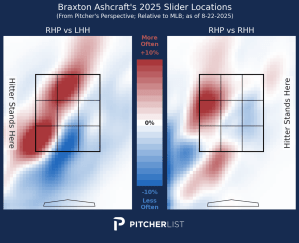
I mentioned earlier that Ashcraft earned a 108 plvLoc+ for his slider. Unfortunately, that’s the only pitch he’s locating well. He has displayed a knack for drilling the low glove-side quadrant and areas off of it with his slider. These locations are why this pitch has a 98th percentile swing rate and 94th percentile chase rate. The way he uses this pitch forces hitters to act. When they do, they have to hope he missed high or to the right of his spot; they aren’t doing anything with it otherwise. The issue with throwing so many of these in the zone is that they’re much easier to make contact with, as you would expect. This diminishes his strikeout potential, though it does potentially allow him to pitch more efficiently.

Ashcraft’s fastball locations have been kind of odd. He heavily favors throwing it low and glove-side, presumably to set up sliders there. Beyond that, it’s hard to make out what his plan with it is. He elevates it sometimes, it’s in the zone a bit more than average, and he leaves it down the middle a bit too much. It’s not unheard of, but his slider command being this superior to his 4-seam command is a bit strange. Progressing this skill is a big thing to watch for him; the ability to avoid bad spots with this pitch would cut back on a lot of the potential trouble he could get himself into on the mound.
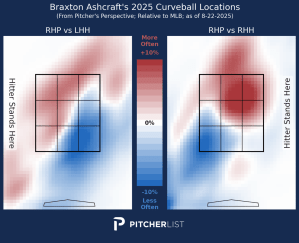
Put simply, his curveball command has been bad this year. This pitch is frequently either down the middle or too far out of the zone to be worth chasing. The mmLoc% on this one is more than double the league average. It also rarely finds itself in ideal locations, as evidenced by the massive blue splotches down and away from hitters, and directly below the zone. He is asking for this pitch to get clobbered, and I’m convinced the only reason it hasn’t is because it’s so good that it’s hard to hit even in bad spots. Against all odds given his locations with it, the curve has produced the most favorable batted ball results for him so far. I don’t know how long that will hold if he keeps hanging them, though. I’d like to see this cleaned up substantially.
I think he’s just trying to zone his sinker as much as possible. He generally tries to keep it low, sometimes runs it in, sometimes aims back door, but there’s no distinct plan of attack with this pitch either. The concepts are there, but this pitch finds itself in the middle horizontal third of the zone too often for my liking. It hasn’t burned him much yet, presumably because it’s a good sinker and he’s only throwing it to righties, but this is another pitch he needs to do better with.
When going over his changeup’s stuff quality, I noted that the few he’s thrown have largely been in good spots. I can’t accurately assess a pitcher’s ability to command a pitch with a sample of just 22 instances, but there are promising signs at least. I would love to see him throw this more, just to get an idea of how real this pitch is.
Where There’s Smoke…
I always wind up regretting structuring articles this way, because I wind up going into the last section on a sour note. This is meant to be a piece showcasing his potential and success despite his daredevil approach to pitching. He’s done nothing but mow down hitters since being called up, and he’s earned his numbers. He’s not flying way below his expected stats; they largely back up his performance. Detractors could say he’s lucky that the pitches he’s leaving in bad spots haven’t been punished worse by hitters. That said, it speaks to the quality of his stuff that they haven’t. Running a 3.7% barrel rate and 36.3% ICR is astonishing with his pitch map. It’s far from abnormal for a pitcher breaking into the big leagues to battle his command a bit. In Ashcraft’s case, he’s in the stage of command development where he’s not wild; he can hit the zone as often as he wants. He just needs to work on precision.
It’s worth noting that he’s doing a good job of drawing chases as well. Throwing well outside of the zone is hard to do for most pitchers. Locating pitches in enticing spots that are out of the zone is difficult. He does it well with pretty much all of his non-curveball pitches. That’s the only one with a below-average O-Sw% right now. Even then, it’s not always in bad spots. For him, it’s mostly about making sure the strikes he throws are better located more consistently.
For what it’s worth, I like his odds of developing better pitch control. He checks all the boxes of what you look for in terms of who stands the best chance of improving that aspect of their game. He has tremendous athleticism as a former Texas football star wide receiver who also played basketball and ran track, along with being a pitcher, of course. It doesn’t take more than watching a single pitch when he’s out there to see how that athleticism translates into his game. Furthermore, he keeps his delivery very simple with no more than a simple turn and leg raise before firing the ball toward the plate. There’s no big fancy windup; he’s essentially just taking a turning step before pitching from the stretch. He also repeats it well across most of his pitches, with no variation of arm angles or releases between them, excluding the curveball. As a note, raising the arm a bit to throw a curve is extremely common; I’m not knocking him for that.
There is plenty of reason to believe he’s not done developing. There’s also a lot to love about his game as it stands and how it looks like it will grow. I would be remiss if I didn’t mention one nagging issue with his profile, though. He needs to stay healthy. This will be his first season as a professional in which he eclipses 100 innings. I’m hopeful it’s the first of many, though, in which he blossoms into a fixture of the Pirates’ rotation for years to come.