
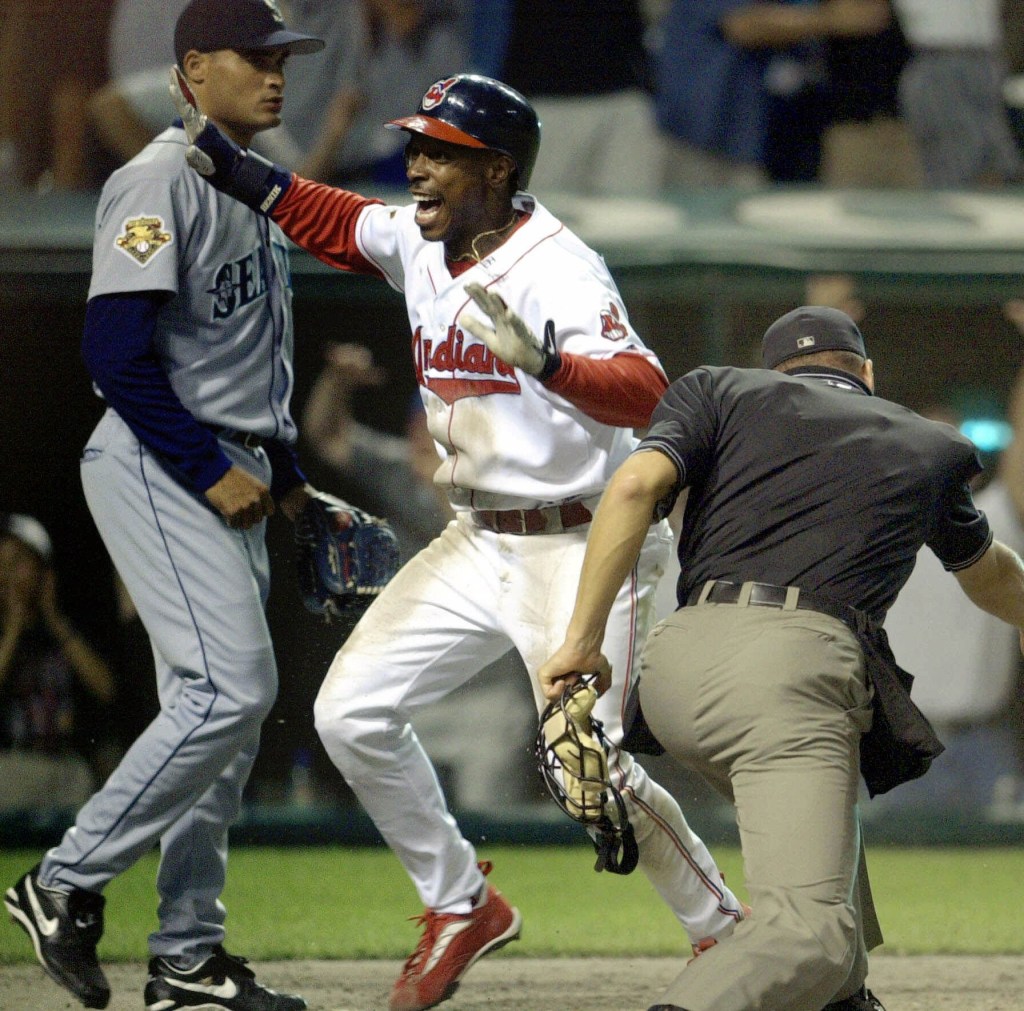
The 1995 American League champion Indians were honored Aug. 29 before the Guardians played the Mariners at Progressive Field for the start of a three-game series critical in the chase for the third A.L. wild-card spot.
One by one, Manager Mike Hargrove and the 12 players from the ’95 team in attendance for the ceremony walked onto the field from the bullpen door in the outfield to cheers from the crowd. The lesser-remembered players were introduced first, building up to catcher and current first-base coach Sandy Alomar Jr., second baseman Carlos Baerga, third baseman Jim Thome and last, but definitely not least, center fielder Kenny Lofton.
Thome is in the Baseball Hall of Fame in Cooperstown, N.Y. He was elected in 2018 in his first year on the ballot.
Why Lofton isn’t in the Hall of Fame is a mystery to Hargrove and Lofton’s former teammates.
Kenny Lofton, star center fielder for the #Cleveland #Indians in the 1990s, says he isn’t “bitter” about not being in the Baseball Hall of Fame. But he is frustrated. Lofton was at Progressive Field on Friday when the 1995 American League champion Indians were honored. #HOF pic.twitter.com/G2eZvaDKCI
— Jeff Schudel (@jsproinsider) August 30, 2025
Lofton played 17 years in the Major Leagues — 10 seasons with the Indians and the rest of his career with 10 other teams. He posted a career batting average of .299, scored 1,528 runs and stole 622 bases. He homered 130 times, drove in 781 runs and hit 116 triples.
“I think Omar Vizquel deserves to be in the Hall of Fame,” Hargrove said in a phone interview in July for a series on the 1995 Indians. “More than anybody, I’m surprised Kenny Lofton isn’t in it.”
Baerga agrees.
“Kenny Lofton could do everything,” Baerga said Aug. 29. “He could bunt the ball, he could hit it, he could steal a base, he could catch the ball. He’s the one that got us going.”
Players can swing and miss twice at the plate and hit a mammoth home run on the next pitch. It does not work that way in the Hall of Fame voting by the Baseball Writers Association of America.
A player must be retired five years before he can appear on the ballot. He must be named on 75% of ballots cast by Hall of Fame voters to be enshrined in the Hall of Fame. If a player is not named on at least 5% of ballots, his name will be dropped from further ballots.
Lofton’s last year in the majors was 2007 with the Indians after starting the season with the Rangers. He appeared on the Hall of Fame ballot in 2013. His name was checked on only 18 of 562 ballots. That converts to 3.2%, so Lofton’s name never appeared again.
“I’m not bitter,” Lofton insisted after a meet and greet with fans before the pregame ceremony Aug. 29. “It was a unique situation with all those guys who came out the same time I came out. I just got caught as the odd man out.”
No one on the ballot received enough votes in 2013 to earn enshrinement. Eventually, eight players who appeared on the ballot that year — Jeff Bagwell, Craig Biggio, Jack Morris, Lee Smith, Edgar Martinez, Mike Piazza, Tim Raines and Alan Trammell — were enshrined.
“If I had even got 5% that first time, I could have stayed and then been on (the ballot) every year,” Lofton said. “I had one time, and then you have to wait 10 years. For me, it’s been 13.”
Politics are involved in Hall of Fame voting some times. If a voting BBWAA member has a grudge with a player, the voter might ignore a candidate’s numbers. Lofton was not cooperative with the media, and since he played in 11 different markets, he probably turned off more than a few voters.
Several former players linked to using PEDs appeared on the 2013 ballot, including pitcher Roger Clemens and position players Barry Bonds, Sammy Sosa and Mark McGwire. Lofton theorizes voters didn’t think the numbers he put up were Hall of Fame-worthy compared to those that used steroids.
There is still a path for Lofton to get to Cooperstown.
Players who have been retired for at least 15 years are eligible for election by the Era Committee, which is what Lofton referred to when he talked about waiting another 10 years after getting only 3.2% of the votes in 2013. Players from the Contemporary Era, covering 1980 or later, are up for consideration every three years. Lofton’s next chance comes in 2025 and then not again until 2028. The same goes for his peers.
“All I’m asking is to put me in an area where you can compare me to other guys,” Lofton said. “I didn’t ever have that chance. If I don’t get on that board (of eight candidates) this year, it won’t be for another three years.
“I just want to be compared. Set me up against guys who are in the Hall of Fame. My numbers aren’t far from theirs. Look at my WAR (wins above replacement) compared to other players. It’s pretty high compared to a lot of players.”
More than three dozen Hall of Famers who played 65% or more of the career in the outfield have a lower career WAR than Lofton’s 68.4, including Andre Dawson (64.8 WAR, 438 home runs, 1,591 RBI), Richie Ashburn (64.3 WAR, 29 home runs, 586 RBI, 234 stolen bases) and Vladimir Guerrero (59.5 WAR, 449 home runs, 1,496 RBI). Ashburn, who spent his entire 15-year career (1948-62) with the Phillies in the days before free agency, was selected for the Hall of Fame in 1995 in a vote by the Veterans’ Committee, which has since been renamed the Era Committee.
Lofton was an All-Star six times. He won a gold glove four times for the way he patrolled center field. He led the American League in stolen bases every year from 1992-96.
“Baseball is not just about home runs,” Lofton said. “It’s about the all-around.”