
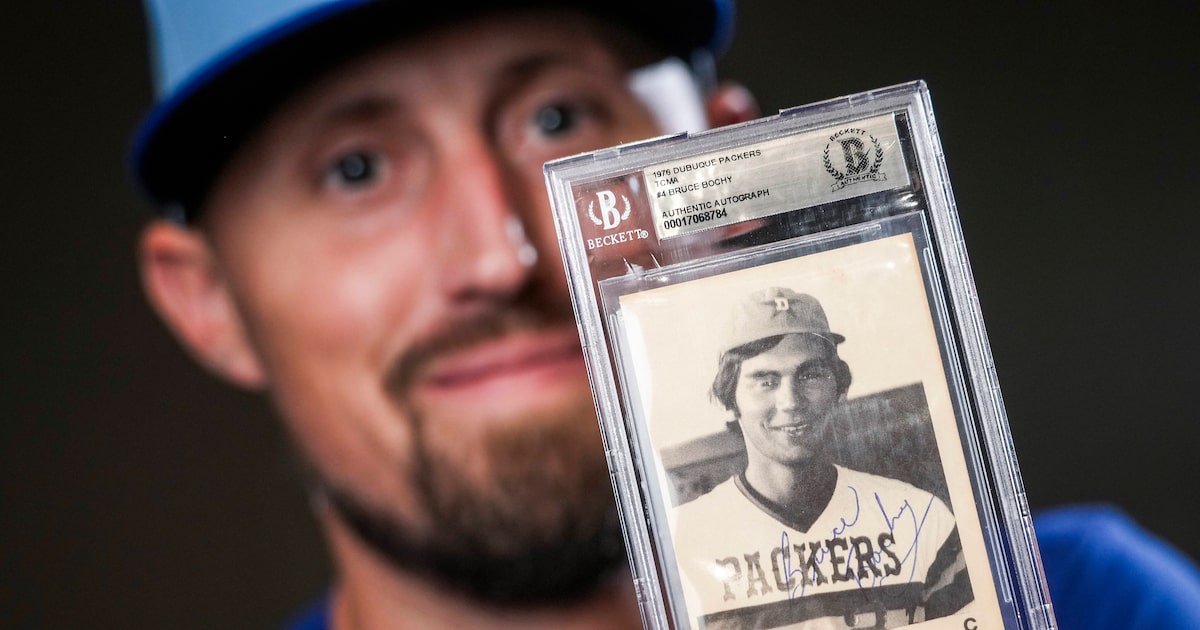
ARLINGTON — Texas Rangers right-handed pitcher Shawn Armstrong entered manager Bruce Bochy’s office one day this season with a memento from the past.
It was a nearly half-a-century old black and white baseball card, protected by a plastic case, that depicted a mustachioed catcher in a Dubuque Packers jersey.
The card was the first that Bochy, then a 21-year-old at Single-A in Dubuque, Iowa, had ever autographed. Bochy, 70, laughed it off as a reminder of his age.
The old — er, how about, historic — finds are partly what’s sparked a hobby that’s swept through the Rangers clubhouse this season. The Rangers, who began September within reasonable distance of the playoffs, have bonded this season over the shared love of a hobby that’s spread like wildfire across both the country and the league.
Rangers
Card collecting, which can include sports, anime and popular movie franchises, has grown into a billion-dollar retail industry (and a multi-million dollar resale market) as the search for vintage, signature one-of-one and autographed cards has taken over the hobby craft and become an uber-popular form of social media entertainment.
The Rangers, led by a host of hardcore collectors, now contribute to it.
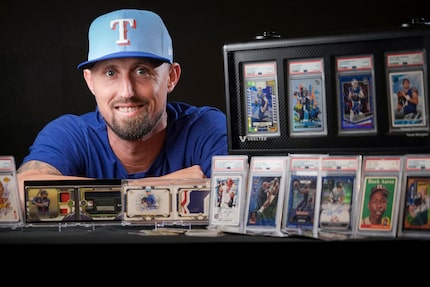
Texas Rangers pitcher Shawn Armstrong with some of his collection of trading cards before a baseball game at Globe Life Field on Tuesday, Aug. 12, 2025.
Smiley N. Pool / Staff Photographer
“It’s really cool because it really does bring us all together,” Armstrong said. “We’re sitting around, we’re talking, we’re seeing what everyone is getting. There’s excitement whenever someone pulls a pretty sick card. You’re never rooting against each other.”
Related
 A clubhouse culture
The tables inside Globe Life Field’s home clubhouse are populated with loose cards on any given day. Players shuffle back and forth between each other’s lockers to show off a hit that they pulled from a pack or to offer their teammate a card.
“Baseball, demographically, we’re all from different areas and we all come from different background,” Armstrong said. “But if you come into our clubhouse, you’ve got …”
Please hold for the team’s sprawling list of interests.
Armstrong prioritizes baseball but owns an expansive collection that includes rare and autographed football, basketball and soccer cards. Patrick Corbin “collects everything under the sun,” according to Armstrong, but primarily hunts for quarterback cards.
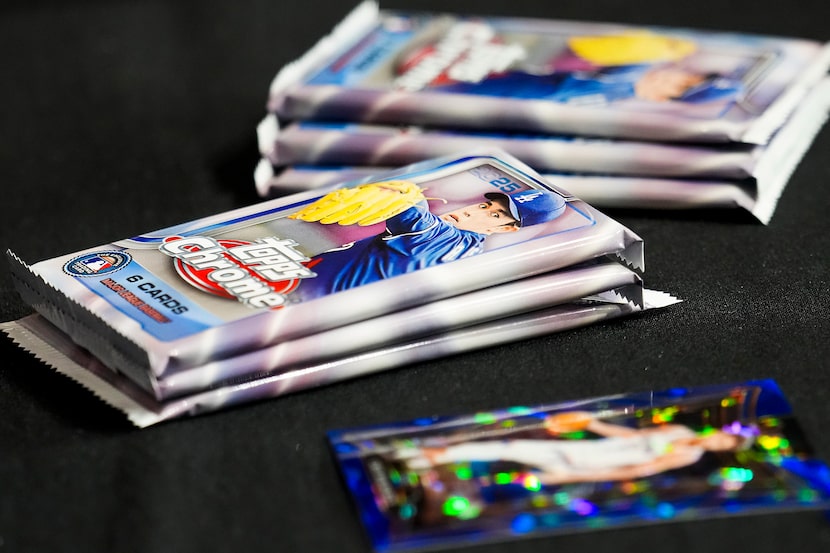
Packages of baseball cards brought to the ballpark by Texas Rangers pitcher Shawn Armstrong are seen before a baseball game at Globe Life Field on Tuesday, Aug. 12, 2025.
Smiley N. Pool / Staff Photographer
“I’m fairly new to it,” said Corbin, a left-handed pitcher whose first-ever major card purchase came in 2013 when he purchased a one-of-one of his own card for several hundred dollars. “It seems like it’s blowing up now.”
Hoby Milner, an avid Pokémon fan as a child who grew up in Fort Worth, has rediscovered his love for those collectibles as he’s picked the video games back up. First baseman Jake Burger collects Star Wars cards — specifically ones from the hit television shows Mandalorian and Andor — and was influenced to partake in the hobby by third baseman Josh Jung this spring.
Jung is an avid collector since childhood and pursues cards from the Marvel universe as well as baseball. He was, in his first three seasons with the Rangers, the team’s most ferocious card connoisseur. He’s no longer alone.
“I think it’s one of those hobbies that guys can talk about,” Burger said. “You can show somebody something that you really appreciate that they’ll appreciate too. I think that’s a really cool aspect of it.”
Milner, a lefty pitcher, played for the Milwaukee Brewers last season where Pokémon cards created a source of entertainment in the clubhouse. He began to play the video games on his Nintendo Switch and is “playing catch up” after a decade-plus removed from the genre. He signed with the Rangers this offseason and, like Burger, was influenced to dive back into the card side of the hobby by a teammate.
Luke Jackson, a right-handed pitcher whom the Rangers signed in spring training, was the de facto leader of the bullpen and the clubhouse’s Pokémon aficionado before he was released midseason. His interested in the hobby permeated through the clubhouse.
“There were three or four of us at on point that were collecting Pokémon cards,” Milner said. “It was like, ‘Hey, what’d you get yesterday?’ It was something for us to talk about and bond over.”
It serves as a change of pace during the rigid and relentless baseball season, too, which offers slim time for players to pursue off-the-field activities. The average team has 25-to-30 off days between opening day and the 162nd game of the regular season.
The average work day for a big league player can last over 10 hours — an estimate that doesn’t include travel to-and-from the ballpark or plane rides to other cities — and can be longer based on how each individual player recovers from the night before or prepares for the night at hand. There’s not much time to hop on a mountain bike or hunt; there is space, however, to parse through packs.
“I kind of found that buying a box of cards and ripping them kind of took away from all the stuff at the field,” Armstrong said. “But it also got you more aware of the younger guys in the league, the older guys in the league, vintage guys.
“I just started getting addicted to it, I guess you could say.”
He’s hardly alone.
The growth of card culture
The expansive card culture has reached far further than just the Texas clubhouse.
Professional Sports Authenticator — a company that grades the quality of cards which, in turn, can determine the value of them — reportedly graded more than 15 million submissions last year alone. Pokémon cards, according to Business Insider, were submitted more frequently than baseball cards in each of the last three years.
The rarest Pokémon items — like first edition Charizard cards — can be sold for hundreds of thousands of dollars and, in the case of few unparalleled pulls, millions.
According to the memorabilia company Vaulted, which recently donated card collector’s boxes to Armstrong and his teammates, 20 different historic baseball cards have been sold for more than $500,000.
The brand Topps sold and estimated $1.6 billion in product last year alone, according to Sportico, and that doesn’t include the voracious resale markets or card shows at which high-priced items are often available. The Dallas Card Show, which is based in Allen, features more than 700 tables of vendors at its events. Rangers shortstop Josh Smith is scheduled to attend their Sept. 6 show at which his individual cards can be purchased and autographed for anywhere between $20 and $60 apiece.
Players acknowledged that the leaguewide interest in cards is not necessarily new. Burger believes it began to pick up extra steam in the midst of the COVID-19 pandemic when everyone, including athletes, sought out indoor activities.
“It feels like in the last five years more and more people are into the hobby,” Burger said. “It’s really cool.”
Armstrong, who’d previously collected sports memorabilia and cards for his son Declan, gained a newfound appreciation for the hobby last season when Chicago Cubs pitcher Ethan Roberts.
He’s now done the same. In August, when the Philadelphia Phillies were in Arlington, Armstrong sent a rare Bryce Harper card over to the visitor’s clubhouse for the All-Star first baseman to autograph. Harper instead asked if he could keep the card to start his own collection and offered Armstrong an autographed bat in return.
“He signed a bat for me and put in quotations ‘Thanks for allowing me to get my very first card of myself,’” Armstrong said. “It’s pretty cool to me to be the guy that got him his first card like that.”
Armstrong — who said the collection at his Raleigh, N.C. home far supersedes the assemblage he’s kept in Texas — parsed through a box of cards that he’s collected this year in an interview with The Dallas Morning News last month.
Among the cards, which he described as “probably not even my good ones,” he had: several Michael Jordan cards from the late 1990s, rookie cards from Harper, LeBron James and Victor Wembenyama, a Wayne Gretzky card with a cut of his jersey, an autographed Tiger Woods card and an anime-style Paul Skenes card which is valued at hundreds of dollars among dozens of others.
“Those GOATS, so to say, those cards are always going to hold their value,” said Corbin, whose collection includes Jackie Robinson, Babe Ruth and signed Jordan cards. “Some of those autographs by Jordan are pretty cool to have. I’ll probably just keep those and hand them down to my kids.”
Armstrong owns a deck of vintage Hall of Famer cards and a handful of Shohei Ohtani cards with a PSA 10 grade.
“My Shohei collection is kind of bananas,” Armstrong said of the Los Angeles Dodgers two-way star. “I actually have his rookie card — three of them, auto’d — that he did for me. They’re at my house. They’ll always stay in the safe.”
Armstrong’s football collection, like Corbin’s, is quarterback-centric and populated by a number of Buffalo Bills quarterback Josh Allen cards. He stopped at one point in the midst of rifling through his trove of cards protected by plastic cases to show off a rare one that includes game-used jersey patches from New England Patriots quarterbacks Tom Brady and Jacoby Brissett.
It’s a Panini Flawless card from the 2016 season in which Brady was suspended due to Deflategate and Brissett started in his place. The card, depending on condition, can be found for sale online at prices that range between hundreds and thousands of dollars.
“I’m not a big Brady fan, being a Bills fan,” Armstrong said, “but it means something.”
A meaningful hobby
The sentimental and personal aspect of the hobby, Armstrong says, means as much (if not more) than the dollar signs attached to it.
The 34-year-old relief pitcher collects his teammates cards and has them sign them. He has two autographed “booklets,” which portray an autographed card and jersey patch, of both right-hander Jack Leiter and second baseman Marcus Semien.
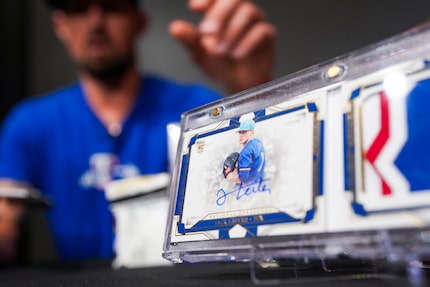
Texas Rangers pitcher Shawn Armstrong reaches for a card featuring teammate Jack Leiter from his collection of trading cards before a baseball game at Globe Life Field on Tuesday, Aug. 12, 2025.
Smiley N. Pool / Staff Photographer
Armstrong said he “idolizes” his teammates. Ditto for any player that, in his words, is his “daddy.” That’s why you’ll find a one-of-one Vladimir Guerrero Jr. card in his collection; the Toronto Blue Jays first baseman is 8 for 12 in his career against Armstrong.
“Historically he owns me,” Armstrong said. “So, respect, I’ll buy your Logoman, and he autographed it for me.”
Boston Red Sox outfielder Jarren Duran, who was named All-Star Game MVP last summer at Globe Life Field, shared stories of his mental health battles in a Netflix documentary and publicly discussed his suicide attempt. It prompted Armstrong to purchase a one-of-one Duran card.
“I have the most respect for him,” Armstrong said. “Like, ‘Glad you’re still here.’ And I told him that when we were in Boston. I went up to him like ‘Mad respect, I ordered your one of one and next year I want you to sign it for me.’”
The hobby can serve as a connector between both players and fans. In June, when the Rangers were in Pittsburgh for a three-game series against the Pirates, the father and son duo of Grant and Walker Smith trekked north from Gainsville, Fla. with a gift for outfielder Wyatt Langford.
The Smiths — two Florida Gators fans who’ve followed Langford since his college days — pulled a one-of-one Allen and Ginter printing plate of the former fourth-overall draft pick’s rookie card. Printing plates, which can be found in assorted packs of Allen and Ginter cards, can be worth hundreds of dollars and scale based upon the prestige of the player or the year that it was crafted.
Walker Smith, 10, had previously met Langford at a Gators game three years ago. He chose to spend his birthday this year at Pittsburgh’s PNC Park and, as part of the trip, flag down Langford before a game to offer him the rare piece of memorabilia that he found.
“Walker’s like, ‘Dad, I should give this to Wyatt, maybe he’ll trade me something,’” Grant Smith said.
Langford swapped an autographed bat personalized “to Walker” in exchange for the plate. Grant Smith joked that he wasn’t sure if Langford, who is not one of the team’s most avid collectors, initially understood the value of the printing plate.
But he has teammates who can educate him.
Find more Rangers coverage from The Dallas Morning News here.