
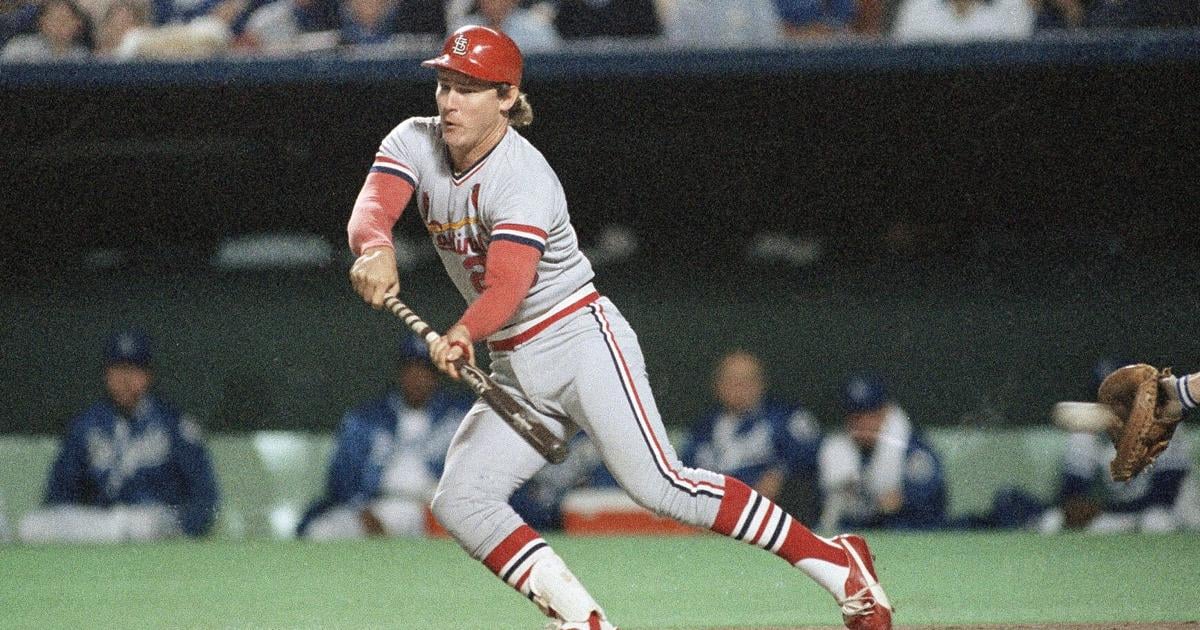
It was Tom Herr’s greatest season and his greatest disappointment. Forty years later, the pride and the pain still resonate.
Every time Herr’s name is mentioned alongside the St. Louis Cardinals, so are two numbers that don’t seem to fit together: 8 home runs and 110 RBIs. That’s what the Hempfield grad posted in 1985.
The performance was a statistical anomaly, duplicated only once since 1950, and a tribute to everything Herr represented as a big leaguer.
The second baseman was old school, from not wearing batting gloves to his helmet not having earflaps, and his approach fit an era when hitting the ball over the fence wasn’t the top priority.
Everything fell into place during one magical summer when Herr was in his athletic prime and found himself living in his baseball Camelot.

Tom Herr explains something to son Aaron in the St. Louis Cardinals’ dugout in 1987.
LNP File Photo
Vince Coleman, the rookie of the year, and Willie McGee, the most valuable player, batted in front of Herr. Jack Clark, one of the great sluggers of the day, batted after him.
Herr was an All-Star. He stole 31 bases in 34 tries, walked 80 times compared to 55 strikeouts, was fifth in the MVP voting and was worth 5.6 wins above replacement.
“It took me to the next level as far as how I was viewed as a player,” said Herr, who returned to St. Louis for the 40th anniversary reunion this weekend. “It’s obviously something I’m proud of.”
Herr played 13 seasons in the majors. It was unlikely he’d play one.
When he graduated from Hempfield as a three-sport athlete, Herr wasn’t sure what came next. He had a memorable exchange with coach Harry Wirth. Herr, who had aged out of American Legion, was worried baseball might leave him behind.
“What am I going to do next year?” he asked his coach. “I’m not gonna have any place to play.”
Wirth smiled.
“Don’t worry,” he answered. “There’s gonna be a place for you.”
Wirth knew something Herr didn’t. Scouts were keeping an eye on him.
There were other options if the big leagues never called. Herr thought he might play basketball at Duke before a coaching change scuttled those plans. He considered going to Delaware to play either football or basketball along with baseball.
The only certainty was that Herr hoped to become a professional athlete. One team allowed him to pursue that dream.
“When I got a chance to sign with the Cardinals, it was like the bell went off in my head,” Herr said. “Here it is. Here’s what I wanted to do my whole life.”
Herr signed when he was 18 and was “about as clueless as you could be” about his prospects. He was undrafted, underestimated and the longest of longshots.
What happened over the next two decades is a remarkable sliver of Cardinals history. Herr taught himself to bat left-handed and climbed through the system as more highly-regarded players fell to the side.
Four years after his debut, he reached the major leagues in 1979. The following year he was a regular on what was to become the team of the 80s.
The Cardinals went to the World Series three times in six seasons, starting in 1982. Herr, McGee, Ozzie Smith and Bob Forsch are the only players who suited up for all three of those teams.
Something about 1985 was different. It was when the Cardinals were at the peak of their runnin’ Redbirds powers. They flipped MLB upside down with their speed, defense and aggressiveness on the basepaths.
It was, Herr quickly points out, a sign of manager Whitey Herzog’s genius that the second baseman with not-so-much power batted third in that fabled lineup.
Herr was perfect for that spot. He took pitches to let Coleman and McGee swipe bags and rarely struck out. All those singles and his 38 doubles allowed him to drive in more runs than any NL player except Dave Parker and Dale Murphy.
It was a perfect story until the end. The Cardinals lost to the Kansas City Royals in the World Series after a missed call damaged their chances of clinching in Game 6.
One of the Cardinals’ all-time teams became victims of what Herr called “bad luck and good pitching.” They fell apart after umpire Don Denkinger said Jorge Orta was safe to lead off the ninth. They couldn’t hold a 1-0 lead in Game 6 and lost 11-0 in Game 7.
Herr was one of the first players on the scene after the call was made. He approached Denkinger with arms spread apart and an expression that mixed anger with disbelief.
If instant replay existed back then, history might be different. The frustration lingered for months and the Cardinals weren’t the same for much of the following year.
“I couldn’t let it go,” Herr said. “It was such a brutal way for our season to end. We had such a great year and I personally had a great year. To not have it topped off with a world championship was a bitter pill to swallow.”
The Cardinals lost to the Minnesota Twins in the 1987 World Series. Herr hit a home run in Game 7, which turned out to be his final postseason appearance and his last hurrah with the Cardinals. He was traded to the Twins six months later.
Denkinger’s call and an inability to win in the quirky Metrodome prevented Herr from being a centerpiece for one of baseball’s dynasties. He retired in 1991 with one championship and two NL pennants.
Herr remains a fan favorite in St. Louis. He was voted into the Cardinals Hall of Fame in 2020 and wears the prestigious red jacket when he returns for the induction of new members each summer. He was voted the greatest second baseman from the Busch Stadium II era when the ballpark closed in 2005.
Only Paul Molitor, in 1996, has driven in more than 100 runs with fewer than 10 homers since Herr pulled off the feat. For one of Lancaster County’s greatest athletes, life was never better than it was in 1985.
“That was a special year, man,” Herr said. “ I wish I could’ve done that every year. That would’ve been fun.”
Success! An email has been sent to with a link to confirm list signup.
Error! There was an error processing your request.