
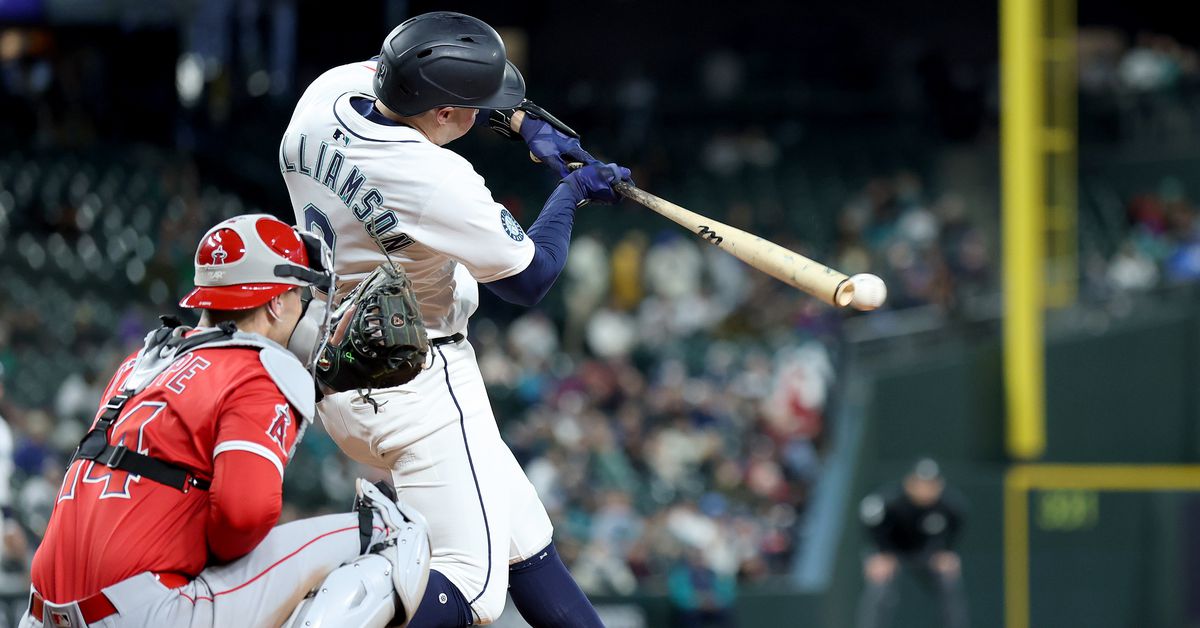
Over 689 plate appearances in the minors, Ben Williamson only hit four home runs. And while some of that is explained by having spent much of his time on the farm in the power-sucking Dickey-Stephens Park, only 211 of his PAs came there, less than a third. So it came as something of a surprise that he hit his first MLB home run in just his fifth game in the show. And on Saturday, he got robbed in the deep part of the park.
But I don’t think these results should be all that surprising. William & Mary’s favorite son (or “Williamson” for short) has both good bat control, and he’s very strong. And that profile—someone who can both make contact and make good contact but who lacks much experience—is exactly the kind of player worth betting on.
The Zone of Interest
Let’s start with the fact that Williamson is making good contact when he swings at the right pitches. On pitches in the heart of the plate—where a hitter is supposed to do damage—Williamson is getting an expected batting average of .319 with an expected slugging of .542, which is shy of the average MLB hitter, who’s at .320 and .583, respectively, but better than the average rookie, who’s at just .310 and .506.
Williamson may be doing fine with hitter’s pitches, but with pitcher’s pitches? Not so much. Below are the balls he’s seeing, broken out by Savant’s attack zones (those listed in the shadow zone here are specifically pitches that are both in the shadow zone and outside the zone). To keep the chart manageable to take in, I didn’t include rookie numbers since they track the MLB average pretty closely here. He’s swinging with abandon at pitches outside the zone. As for whiffs, well, any time a guy is struggling, a swing and miss, especially on pitches outside the zone, leave a big mental impression on the viewer. But that’s not really Williamson’s problem at all. You’ll see that he’s both swinging more (bad) but making more contact (good?) on balls.
B Willy Gone Fishin’
Zone
League Swing%
League Whiff%
B Willy Swing%
B Willy Whiff%
Zone
League Swing%
League Whiff%
B Willy Swing%
B Willy Whiff%
Waste
5.7%
88.6%
20.8%
100.0%
Chase
22.3%
57.9%
31.5%
53.6%
Shadow (balls)
42.6%
35.3%
56.1%
27.0%
You might be inclined to blame Williamson’s current struggles on a pitch-recognition issue. Again, when a young hitter whiffs at a breaking ball outside the zone, the image has a way of sticking with you. It tends to look really bad. But I’m not so sure that’s a big flaw for Williamson. The gap between how much more often he’s chasing than average is generally pretty consistent across pitch types. There is a bigger gap when it comes to breaking balls, but once you’re using “Williamson’s swings at breaking balls outside the zone” as the denominator, you’re talking about a 25-pitch sample. So I’m disinclined to read too much into that yet, despite the stickiness of the visual.
In any event, it turns out the extra contact Williamson is making is not good, and is actually making the situation worse. Because he puts so many of these balls in play, he’s getting a lot of weakly hit balls that end with outs rather than merely whiffing and ending up with a strike and living to fight another day. He’s getting an xBA of just .187 and an xSLG of a pathetic .212 on pitches outside the zone. To paraphrase Dr. Ian Malcom, Ben Williamson was so preoccupied with whether he could make contact, he didn’t stop to think if he should.
Williamson is digging that hole deeper by not swinging at enough strikes, pitches he can and has been crushing, swinging at just 64.8% of pitches in the heart of the plate, compared to an MLB average of 72.1%. However, Williamson makes more contact than the average player. So when you look at it a different way, Williamson is making contact with 57.4% of pitches in the heart of the plate, which is in line with the league’s 59.1%. Thus, it’s more of a missed opportunity than it is a weakness. That’s another way of saying, there’s a lot of room to grow if he swung at more hitter’s pitches, especially since as noted above, the contact he makes on these pitches tends to be good contact.
But for now, the problem with his profile is that he’s gobbling up trash while avoiding cookies like he’s a rat on the Atkins Diet. This is basically the quantification of your observation that Williamson has looked lost at the plate lately. But it’s also a profile that suggests that he has a lot to gain simply by getting a better sense of the zone. Can he do that?
You might think this is something that rookies generally tend to improve upon and leave it at that. But that’s not really true. They do, but not by a lot, and there’s wide variation. The average MLB hitter chases just 1.4% less often and swings at a strike just 1% more often than the average rookie. And I suspect that most of that can probably be explained by the fact that the worst rookies don’t return for a sophomore campaign.
But those are just averages; individuals certainly can and do improve their understanding of the zone. And there’s good reason to think Ben Williamson might be one of those individuals. To start, he’s simply got less experience, having played in a mere 150 minor-league games before getting called up, suggesting there’s room for him to still be learning.
Speaking of that minor-league experience, this degradation of his zone skills is totally out of whack with the player he’s been in the past. He was a much more disciplined hitter while on the farm, walking in a healthy 9.8% of his appearances, compared to the 3.1% he’s managed so far in the bigs. Strikeout and walk rates usually get worse as a player transitions to MLB, but rarely by that much. It’s also misaligned with his reputation. When writing him up this offseason for Baseball Prospectus, our own John Trupin said Williamson “displays a good command of the strike zone.” Baseball America agreed, saying, “Williamson is a pest at the plate. He will take pitches out of the zone as well, and he’s not afraid to hit in deep counts.” Don’t discount the importance of that track record.
Power up
Even beyond improving his zone skills, I’m bullish on Williamson’s chances to generally improve the quality of his contact no matter where the pitch is.
One of my favorite stats for a novice hitter is Dynamic Hard Hit rate or DHH%. I like it because while it’s worse than hard-hit rate or barrel rate for discussing contact quality or results, it gives a better measure of power potential. Rather than a naked measure of exit velocity, DHH% gives players more credit for hitting the ball hard relative to the launch angle. It takes less strength to hit the ball at 80 mph when you hit it at 20 degrees than it does to hit the ball at 80 mph on a pop up. Because it accounts for how much power is in the bat rather than how likely the contact is to be a good hit, it’s a useful tool for evaluating a rookie. It tells us whether there’s room to grow if the player can improve his bat control and get the barrel on the ball more.
Williamson has a DHH% that is higher than league average (at 16.4% to the league’s 15.5%). That’s encouraging because Williamson’s hard-hit rate (which measures how often he’s hitting the ball at 95 mph) is lower than league average (39.1% to 40.8%). And Williamson is crushing the average rookie.
B Willy Gone Crushin’
Rate
B Willy
League
Rookies
Rate
B Willy
League
Rookies
Hard Hit %
39.1%
40.8%
36.5%
DHH%
16.4%
15.6%
11.7%
Barrel%
7.2%
8.6%
5.9%
Barrel/PA
5.2%
5.9%
4.0%
This suggests that if Williamson can make even minor adjustments in his bat control, he could turn a lot of dribblers into lasers, converting his potential power into actual extra base hits. And I’ve got good news! He’s specifically working on this. He spent some time over the weekend talking to Edgar Martinez, working on a slight grip change. Where Williamson used to have his two index fingers kind of floating on the bat, Edgar has got them more in contact with the bat (“but not tight”), which is specifically for the purpose of improving his barrel control.
And that’s before you even account for the possibility that he could reduce a lot of his bad contact by simply chasing less often.
Putting it all together
When you put it together then, he could improve both his average and his power without doing much to change his swing. The bat control he’s shown both in the minor leagues and in his ability to connect with pitches outside the zone suggests that he should be able to get the barrel to the ball a bit more often without dramatic adjustments. The alternative, trying to tap into Williamson’s raw power by encouraging him to elevate and celebrate would require a whole swing overhaul, which is a dangerous proposition. What I’m envisioning here is not trying to turn him into Eugenio Suárez, but rather a guy who hits the ball hard enough to get through the infield 30% more often than he is now and who hits maybe 30 doubles a year.
That small change combined with being a bit more passive could do a lot to help Williamson succeed as a hitter. He swings at enough strikes, and does enough damage on them (and could do even more!) that the best thing may be to just swing less in general. When in doubt, don’t swing. His overall swing rate is almost four points higher than the league average, so he’s got plenty of room to just cut down on swings without creating problems. It’s possible that this results in some more called strikes, but he’ll walk more and it’ll allow him to learn the zone and improve pitch recognition as he goes while maximizing his contact. It’s a trade worth making, at least for now.
Call it the hitter’s trilemma. Every hitter needs to figure out the right balance of trying to make contact, trying to hit for power, and being patient. And that equation will pencil differently for hitters with different natural abilities. The great thing about Ben Williamson is that he’s starting from a place where the easiest things to change could make the biggest difference in his success.