
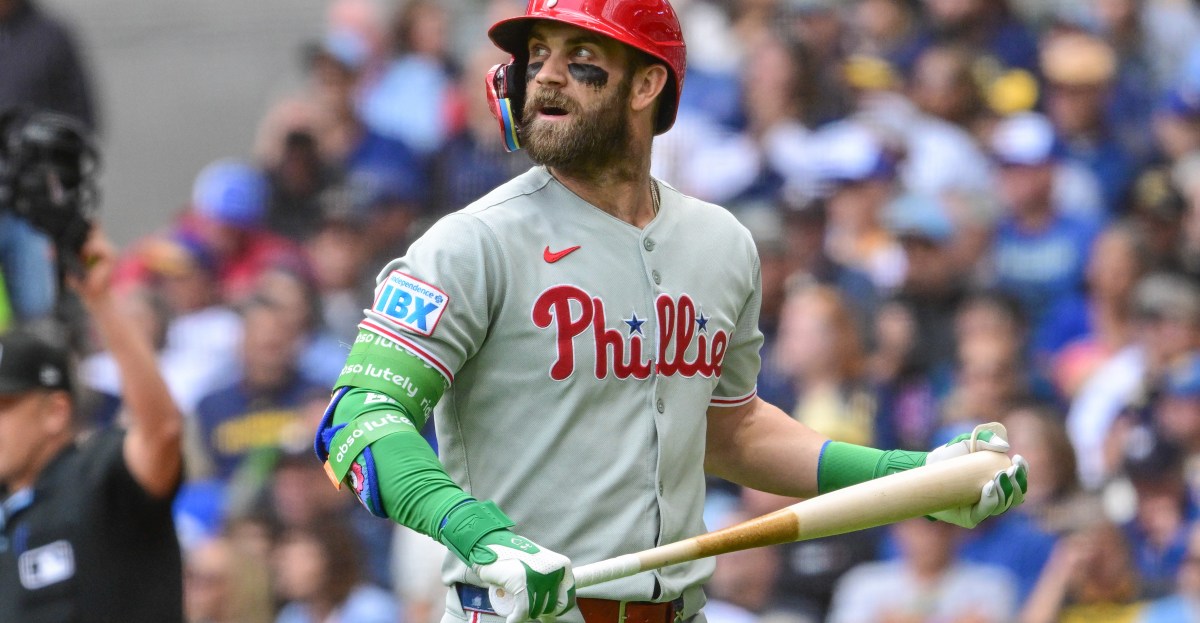
Bryce Harper strode to the plate this past Sunday with runners on the corners, two outs, the Phillies down by one to Miami, a bat in his hand and the hopes of a faithful fanbase on his back. Few, if any, active players have acquired as much good will in their cities as Harper has in his adopted home. He could, one imagines, ground out to end a sleepy early September game against a foe playing out the dregs of a lost season a dozen, two dozen times, and still not exhaust the supply of faith he stockpiled with his 2022 pennant-winning heroics. And yet, the fanbase’s opinion of Harper as he walked off the field following Sunday’s loss was decidedly sour. Harper is still beloved— one can scarcely imagine the series of unfortunate events that would have to occur in order for him to be anything less than adored in Philadelphia— but his campaign in progress has lacked the dramatic verve and superhuman defiance that we expect of our baseball heroes. A dreadful muttering can be heard in certain corners of Philadelphia: has Bryce Harper become unclutch?
Before we discuss the question of whether or not Harper has become unclutch, we have to define what we mean by clutch. The state of being clutch, like something else which I will not name on a family-friendly blog, can be identified by Supreme Court justice Potter Stewart’s famous remark: I know it when I see it. We also know when we do not see it. Harper coming to the plate on Sunday afternoon with the tying run on third only to ground into a game-ending out was certainly not clutch. Identifying clutchness or lack thereof, in an individual moment is simple. But compiling those moments into an assessment of a player’s entire season is much more difficult. Does a big eighth inning hit outweigh a ninth inning choke? How many times does a player need to come through before they erase the stain of a humiliating K against a rival’s closer? So on and so forth.
But we need not console ourselves with vague, nebulous notions of what clutch is. This is the year 2025, and our sabermetric forebears have invented statistical measures for just about everything. There is a sabermetric measure simply known as Clutch, which pairs win probability added— how much a player impacts their team’s win expectancy— with leverage index, which measures the importance of any given situation. Per David Appleman of FanGraphs, clutch is a “measurement of how much better or worse a player does in high leverage situations than he would have done in a context neutral environment”. Which is to say, how do you hit in the biggest situations versus the ordinary ones?
Clutch is simple to read: a positive number means the player performs better in high leverage situations and a negative means they perform worse. Clutch is a comparison within a player’s performances—FanGraphs notes that “a player who his .300 in high leverage situations when he’s an overall .300 hitter is not considered clutch”. In other words, to be clutch you have to do more than perform well. You have to elevate your game in the big moments.
FanGraphs regards a clutch score of 0 as average, 2 as excellent, and -2 as terrible. Here are the 2025 Phillies (qualified batters only), by Clutch.
PhillieClutch, 2025Bryson Stott0.77Alec Bohm0.28J.T. Realmuto-0.14Bryce Harper-0.23Trea Turner-0.76Kyle Schwarber-0.99Nick Castellanos-2.17
Harper’s Clutch SCORE for 2025 is -0.24. Which is to say, he hasn’t been clutch. But he hasn’t been terribly unclutch, either. He’s only been a tad worse than average in clutchness (clutchitude? clutchality? I feel like the dictionary hasn’t caught up here). Contrast with Nick Castellanos, who has been exceptionally unclutch this year.
And yet, we talk about them very differently. With Harper, fans gripe about his perceived lack of clutch. With Castellanos, they complain about his overall performance, but rarely seem to call him unclutch. His broader struggles subsume his particular struggles in the high-leverage moments this season. Perhaps another way to put it would be that complaints about clutchness are an honor, of a sort: only players who give us hope can dash our hopes for them. We react to Harper’s lack of clutch this season precisely because he has done so much to instill hope in us in the past, providing electric moment after electric moment.
This season, the electric moments have mostly come from Trea Turner and Kyle Schwarber. And it’s odd that the two of them, both of whom ought to get some downballot MVP votes this season, turn out to be unclutch by this measure. Odd, too, that they haven’t received the heat that Harper has, given this. There have been some complaints about Schwarber due to his recent swoon (though last night’s #50 ought to quiet that), but for the most part both of them have dodged complaints about clutchness this season. That is, I suspect, because of their overall strong performances. They may not be contributing more than usual in the biggest moments, but their contributions overall are so sizable that their value to the team’ s success is self-evident.
Perhaps, then, the complaints about Harper’s lack of clutch aren’t really about his lack of clutch. Perhaps the disappointment is really just about the fact that Harper, while still very good, has seemed a little more earthbound than usual. His batting average of .261 is on pace to be his lowest since 2019. His on-base percentage of .351 would be the lowest he’s posted in Phillies pinstripes. His slugging percentage of .491 is 11th best in the Senior Circuit, but still represents a sizable decline from his .525 mark from last year. These numbers aren’t terrible by any measure. Harper has, by Win Probability Added, done more to help the Phillies achieve victory than all of the other Phillies batters save Turner and Schwarber. But we expect herculean heroics from Harper. We expect bedlam in every big at bat. And should he not deliver, we feel a bit bereft, not because we expected him to fail, but because we expected him not to. This is so not just for Harper, but for baseball’s stars broadly. Casey’s mighty whiff wouldn’t have brought so much pain to Mudville if they hadn’t expected him to come through.