
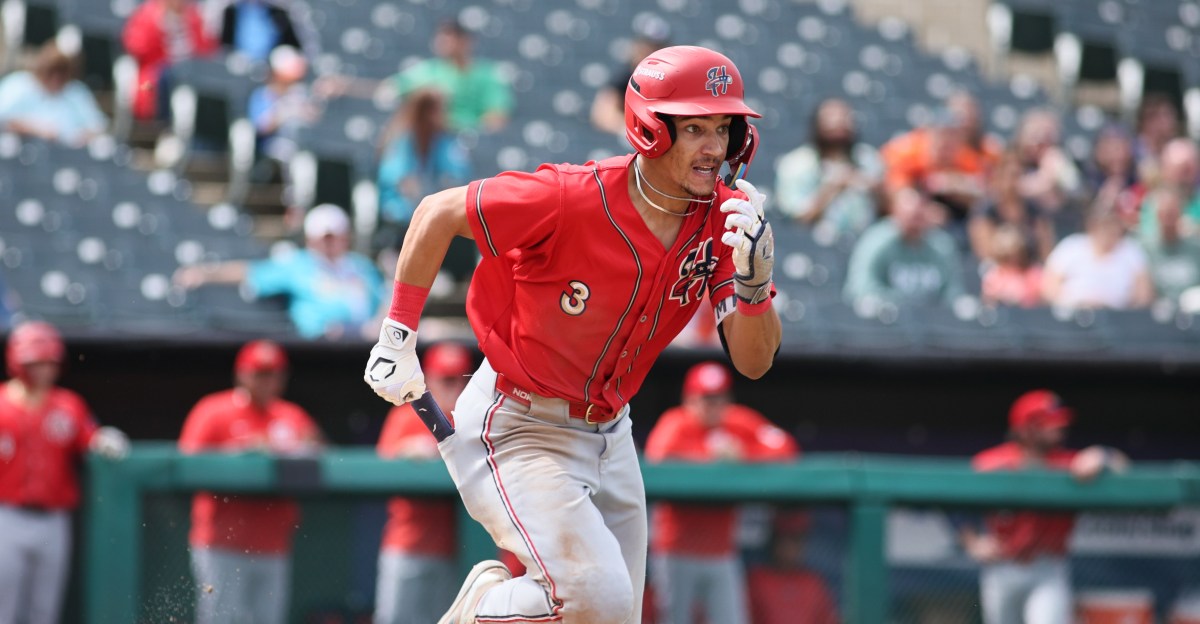
The Harrisburg Senators finished their season yesterday afternoon with a 5-4 victory over the Akron RubberDucks, marking the end of many Nationals prospects’ seasons, including 2024 first-round pick Seaver King. King’s first pro season brought with it many conversations, from his cold start in April to his speedy Double-A promotion in June to the constant promotions to the players drafted immediately after him. While the “what-if” discussion about if the Nationals had gone a different direction on draft day is certainly valid, for today, I want to remove those lofty comparisons and just have a retrospection of Seaver King’s first full pro season, looking at the highs and lows and what is next for him in his journey to the big leagues.
Seaver King’s first April as a professional baseball player did not go as he would’ve liked, as in his first 19 games at the High A level, he hit .283, posted a 0.22 BB/K, and had just 4 extra base hits, with 3 of them coming in the final 4 games of the month. Some of the flaws that would become a recurring theme were starting to show, such as a lack of power and a weak plate approach. At the same time, his tools outside the batter’s box showed why he could be such a good prospect if he worked out as a hitter, as he stole 6 bases, not being caught once, and played stellar defense at shortstop.
King’s offensive struggles continued into the first half of May, as he hit .213 with 4 extra base hits in the first 12 games of the month, but it’s in the second half where he really hit his stride, as he hit .357 with 4 extra base hits in the final 13 games, drastically improving his K% from where it was before and swiping 5 bags as well. Part of the reason for the hot streak was balls finding holes in the defense that weren’t before, but 5 strikeouts in 13 games was a marked improvement from 9 in 12 games to start the month and a 33% strikeout rate in April.
A Head-Scratching Promotion
Just as it seemed that maybe King had flipped a switch as a hitter at the High A level, he was promoted to Double A, joining the Harrisburg Senators on June 3rd. While it’s always exciting to see a Nationals prospect moving up the ranks, it certainly seemed a little early for a promotion, as King hadn’t exactly “proved” himself at High A yet, posting a 104 wRC+ and .307 OBP in 45 games at the level. Perhaps the front office believed he could somehow, someway carry the momentum he had going into success at Double A, but that wasn’t the case in June, as he hit .224 with a 0.26 BB/K ratio and 5 extra base hits over 24 games. Considering the serious on-base issues he was having at the High A level, it didn’t make much sense to me at the time to be moving King up a level, and it makes just as little sense now.
July and August held much of the same in store for King, as in 46 games across the 2 months, he hit .214, posted a 0.34 BB/K, and hit just 1 home run. He continued to excel in other aspects of the game, stealing 11 bags and playing great defense at short over this time, but his offensive issues were still plaguing him, as he wasn’t getting on-base at a strong clip, and wasn’t slugging enough to make up the difference. King would have 2 weeks in September to end the year on a high note and give himself and the fans some confidence entering 2026.
Sprint Through The Finish
And end on a high note he did, as in the 11 games he played in September, King hit .341, had 3 extra base hits, and stole 5 bags. This hot streak was very similar to his one in May, a time when more balls were getting through holes than usual, but he showed how dangerous he can be when that happens, recording his 5th triple of the year and stolen bases 26 through 30.
Seaver King’s Final 2025 Statline: 125 Games, .244 AVG, 19 2Bs, 5 3Bs, 6 HRs, 30 SBs, 87 wRC+, .294 OBP, .337 SLG, 0.28 BB/K
King’s season had some high highs, as he stole 30 bases and played excellent defense at one of the most important spots on the diamond, and some low lows, as he got on-base at a clip under .300 and was homering around every 21 games or so. His elite traits showed why he feels like a safe bet to make the big leagues one day, but his faults also showed why his ceiling is one of a utility/defensive specialist until the bat improves (aka Nasim Nunez). The good news for King is that many of his offensive struggles, at least on the power side, are fixable issues that hopefully a new coaching staff from the new regime can fix, such as his GB/FB ratio of nearly 2 and Oppo% over 40%, both seriously limiting his power potential. The plate approach is also a fixable issue, but it is certainly much harder to fix a player’s eyes than it is to fix their swing. Overall, King’s 2025 did not go how he or Nats fans hoped it would, but there are also bright spots in his profile that should have fans at least cautiously optimistic entering 2026.