
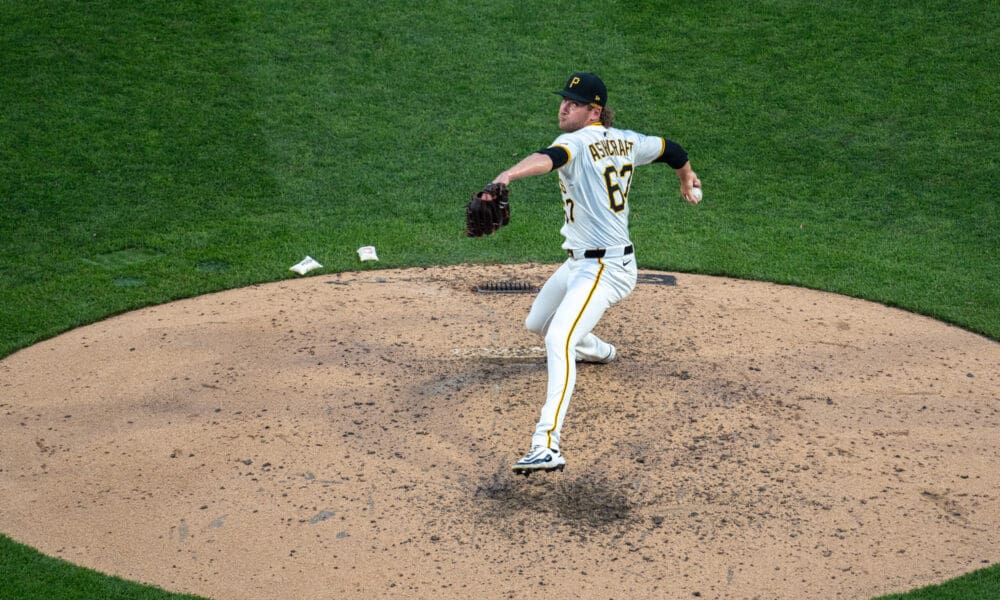
PITTSBURGH – Braxton Ashcraft has done a little bit of everything in his first season with the Pittsburgh Pirates.
The rookie right-hander began his big-league career in May pitching out of the bullpen. He made a spot start earlier in the year before heading back to a relief role, but six of his last seven appearances have come as a starting pitcher, a role in which Ashcraft had been for the overwhelming majority of his pro career.
The results as a starter with the Pirates have been good. Entering Monday’s game against the Chicago Cubs at PNC Park, Ashcraft owned a 1.08 ERA in six career starts.
However, Ashcraft, who has far surpassed his career-high in innings as a professional, has started to leak fluid of late.
Things hit a low point against the Cubs, when he allowed three runs in four innings in the Pirates’ 4-0 loss. Ashcraft pitched two-scoreless frames to begin his outing but struggled the second time through the lineup.
“It just seemed like the command wasn’t there, falling behind and it wasn’t as good as it usually is,” manager Don Kelly said of Ashcraft’s struggles in the third and fourth innings.
After striking out three of the first four batters he faced and keeping the Cubs off the board through the first two innings, he issued a leadoff walk to Matt Shaw, who was erased on a caught stealing.
But Michael Busch followed by hitting a solo home run, and the Cubs added a second run in the third inning on an Ashcraft wild pitch.
Chicago extended its lead to 3-0 in the bottom of the fourth when Pete Crow-Armstrong and Dansby Swanson hit back-to-back doubles.
“Just two-strike pitches,” Ashcraft said of his struggles the second time through the Cubs lineup. “Got to a lot of two-strike counts. Busch put a good swing on a good pitch. Wanted to go higher with it but didn’t get it quite there. Dansby put a good swing on a pitch I wanted to get out of the zone.”
Having done both in his brief career, Ashcraft knows that the very thing that plagued him in his latest start could be what determines what his eventual role will end up being.
“At the end of the day, those two-strike pitches are what creates a starter or reliever and separates good pitchers that throw for a long time and guys that end up pitching back out of the bullpen,” he explained. “I think that overall and overwhelmingly the two-strike pitches got to be better.”
Ashcraft’s pitch mix includes a power four-seam fastball and sinker, a slider, curveball and occasional changeup. His deep arsenal allows him to keep hitters off-balance in two-strike counts, but the 25-year-old understands that whatever he throws in those situations has to end up in his desired location.
“Just execution. I’ve said it time and time again, hitting is really hard. You can see that in today’s game,” he explained. “Ultimately, if we execute our pitches we’re gonna see a lot more success than we do failure. For me, it’s just getting those pitches down and out of the zone or off the plate. That’s the way forward here.”
Ashcraft has shown that he’s capable of being effective in either a relief role or when pitching out of the rotation. But if you ask any young pitcher, the goal is to end up a starter.
So far, Ashcraft looks like he could end up as a full-time starting pitcher, and he’s done it throughout his minor-league career.
Two-strike counts might be what’s been the cause of some recent hiccups, but he also has the stuff to take advantage of those situations.
Every rookie goes through growing pains – unless you’re Paul Skenes that is. Ashcraft experienced some on Monday night, but maybe that’s to be expected given this stage of the season, and when you take into consideration that Ashcraft is now at 110.2 innings between Triple-A Indianapolis and the Pirates this season. Entering the year, Ashcraft’s career-high in innings was 73 last season.
Despite his concerns about his two-strike effectiveness, Ashcraft will be squarely in the mix for a spot in the Pirates’ rotation as his workload soars to new heights.