
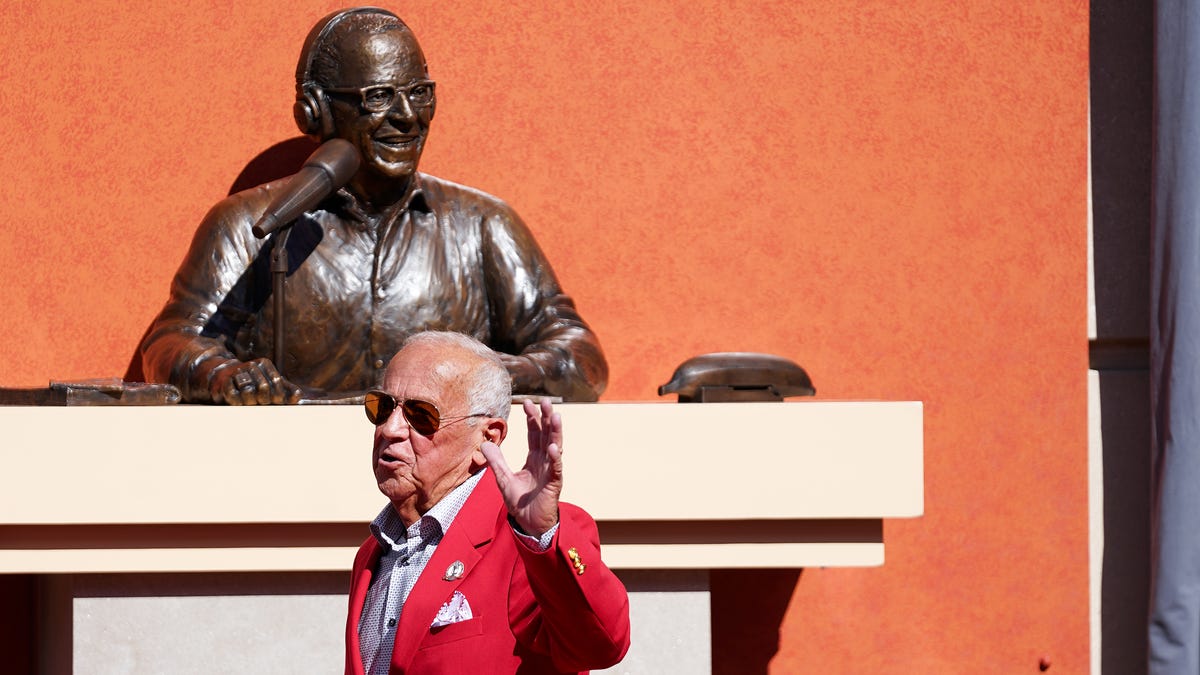


Marty Brennaman talks about his latest honor: a bronze statue at GABP
Hall of Fame broadcaster Marty Brennaman talks about his most recent honor: a bronze stature in front of Great American Ball Park.
Even the clouds knew it was a special day in Cincinnati.
Right on cue, they parted above the riverfront, and sunlight flooded into the crowd gathered to witness the unveiling of the newest statue at Great American Ball Park. The man of the hour, Franchester Martin Brennaman, ascended the stage aptly wearing his trademark aviators.
“There will never be a broadcaster quite like Marty Brennaman. Not in Cincinnati. Probably not anywhere,” wrote John Fay, The Enquirer’s Reds beat writer, in 2019 when Brennaman retired after a 46-year run as the Reds play-by-play announcer. That sentiment was echoed often during the festivities surrounding the dedication of Brennaman’s bronze likeness on Sept. 6. And it’s not hyperbole. While the statue – depicting a late-career Marty behind his microphone – is a lasting tribute to Brennaman, it’s also a monument to a bygone era when radio announcers were as much a part of baseball as the players themselves.
Transistors and traditions
In this age of streaming baseball games on your phone, it’s easy to forget that, for nearly the entirety of Brennaman’s career, not every Reds game was televised. In 1990, the year the Reds last won the World Series, the Cincinnati Post reported that a new, three-year contract with WLWT would offer television viewers 47 games – 42 on the road and five at home. It wouldn’t be until 2018, Brennaman’s penultimate season in the booth, that all 162 regular-season games were televised.
Back then, if you weren’t at the ballpark, you followed the Reds on the radio. It was all you had. That’s why Brennaman – and contemporaries such as Vin Scully, Harry Caray and Bob Uecker – became larger than life in the eyes of baseball fans listening on hand-held transistor sets or car radios. Jim Day confessed he was one of those kids listening to Marty and Joe past his bedtime during west-coast swings, hoping his parents didn’t hear the crackle of the AM signal.
I was one of those kids, too.
A dying art
Call me a baseball retro grouch, but I’m weary of broadcasters who call a midseason, solo home run like it’s Game 7 of the World Series. Brennaman could amp it up with the best of them when warranted. (Pete Rose’s hit to break Ty Cobb’s record comes to mind.) He was also a master of the one-liner (He couldn’t have hit that with an ironing board!) and other pithy observations. But he was, first and foremost, a storyteller, transforming our mind’s eye into a high-definition display.
Sports broadcasts today are laden with wonkish stats, slick graphics and manufactured hype. It’s entertaining, but make no mistake: the ability to describe the action on the field vividly and succinctly is a dying art. To appreciate what Brenneman did as good as anyone who has ever called a major league game, let’s revisit his call of Homer Bailey’s no-hitter in 2013:
And now the crescendo of noise really picks up. Doesn’t appear to be a person sitting at the moment. The righthander kicks and throws. And here’s a ground ball to Todd Frazier. He’s up, he’s throwing, and Bailey has a no-hitter! Homer Bailey has no-hit the San Francisco Giants! The sixteenth no-hitter in Cincinnati Reds History. They are crowding around. They are bouncing up and down. Everybody out of the dugout. The relief pitchers are racing from the bullpen. Caps are being thrown. Gloves are being thrown. … 3-0 the final, and this one belongs to the Reds!
I remember exactly where I was when I heard this call, nowhere near a TV but feeling like I saw it with my own eyes.
One final comment
Brennaman has said the statue is by far the greatest honor he has received, even bigger than his induction into the Reds Hall of Fame and receiving the Ford C. Frick Award from the National Baseball Hall of Fame. Even so, he was able to keep the moment in perspective, in true Marty fashion.
“One final comment,” he said after expressing his gratitude to the fans and his love for the city. “There is not a group more thrilled about us getting ready to unveil this bronze statue over here than the bird population. They’ve got another target to shoot at.”
•••
The text of the Bailey no-hitter call came from the book “@titanicstruggle: The Best of Marty Brennaman.” Written by Randy Freking and Mike Zilliox, the book is built on Brennaman quips captured on Zilliox’s Twitter account. I highly recommend it. Pick it up at the Reds Hall of Fame and Museum or on Amazon.
Enquirer Executive Editor Beryl Love writes a biweekly column that takes you behind the scenes at The Enquirer. Occasionally, he shares his thoughts on local issues, particularly as they pertain to a free press and open government. Email him at blove@enquirer.com. He can’t respond personally to every email, but he reads them all.