
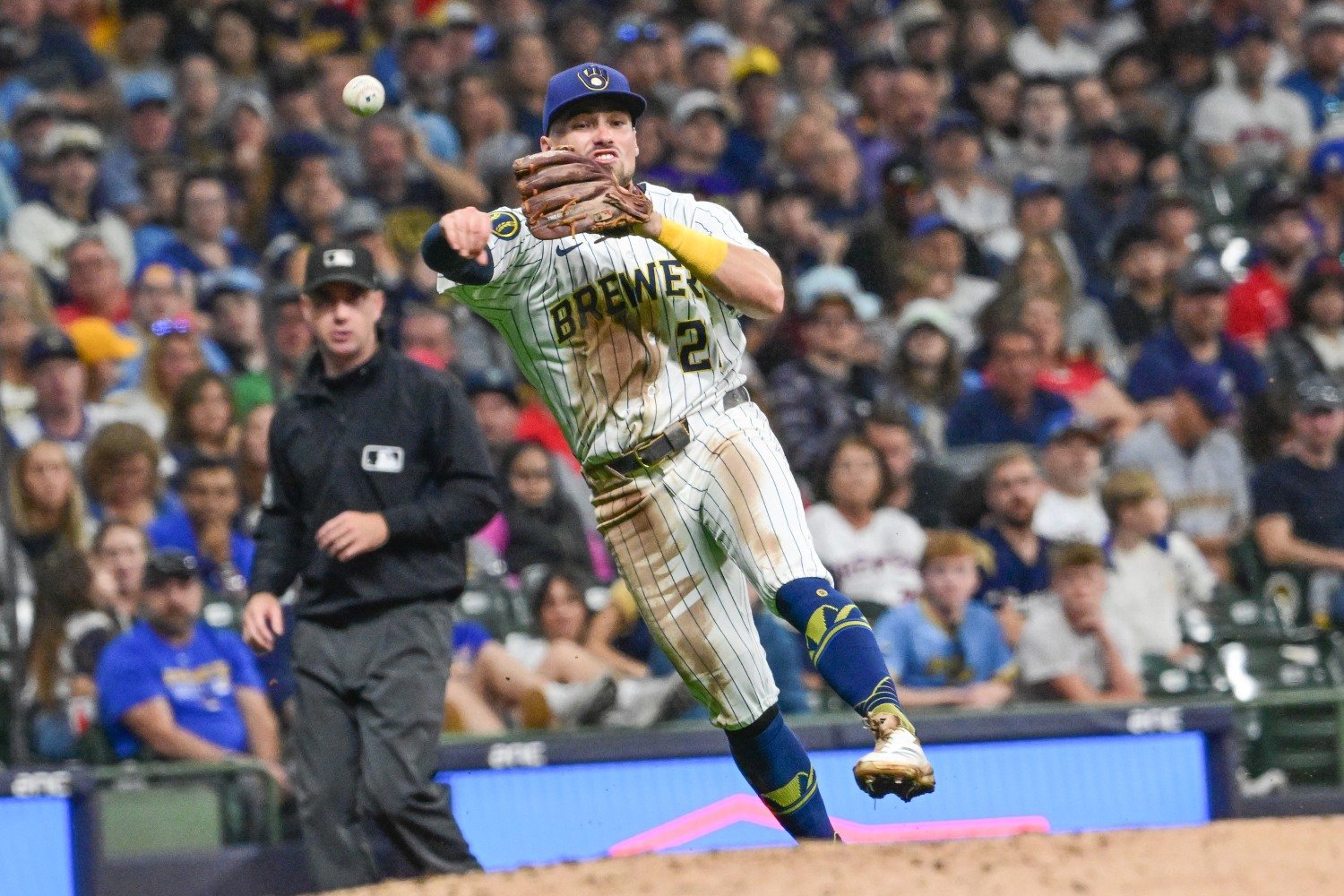
All season long, Brewers personnel have been quick to praise Joey Ortiz‘s defense. While some in the front office still think highly of his offensive potential, it’s his glove that has earned him a long leash as the starting shortstop, despite a 69 wRC+ that ranks second-to-last among qualified hitters.
Public defensive metrics have been more divided in their evaluation. Through July, Statcast’s Fielding Run Value graded Ortiz as +6 runs above average on the season, which ranked sixth among qualified shortstops. Defensive Runs Saved, meanwhile, had him bottoming out at -7 runs, and Baseball Prospectus had him at -1.9 Defensive Runs Prevented.
Since the start of August, though, Ortiz has been undeniably fantastic in the field. All three metrics agree that he’s been one of baseball’s better defensive shortstops over the last six weeks. He quickly worked his way back to an effectively neutral -1 DRS and 0 DRP and is up to an FRV of +10 runs.
Brewers infield coach Matt Erickson said some metrics dinged Ortiz early in the year because he was not completing more challenging plays. The club’s internal model classifies plays by out probability based on the lateral range required of an infielder to complete them. Those with an out probability between 30% and 70% are considered “50/50 plays,” and Ortiz rarely recorded outs on the most difficult opportunities.
“Like 12 of those 15 [plays] were from 30 to 40 percent, where he was diving, making plays, getting up, dropping the exchange, ruled a hit,” Erickson said. “Diving one way, making a throw, guy just beats it. So of the 50/50 plays that he was getting, they were on the extreme, tougher end, but he wasn’t converting many of those. Now, over the course of the second half, he’s gotten more opportunities, and he’s made a bunch more 50/50 plays, which has brought that number back up.”
Erickson did not cite specific plays, but there are plenty from the first half that fit the description. Here’s an attempt on May 3 where Ortiz dove to knock down a grounder in the hole, but the transfer was neither clean nor quick enough for his throw to beat Chicago Cubs catcher Carson Kelly.
Two weeks later, Ortiz laid out the other way for an impressive stop up the middle, but he couldn’t collect the ball to make a throw.
Of the public defensive tools, Baseball Prospectus’s models best illustrate Ortiz’s in-season evolution as a defender. They separately track how many batted balls above or below average an infielder reaches (Attempt Range) and how well he executes that range to record outs (Range Outs Made).
Split
Attempt Range
Range Outs Made
March-July
1.0
-2.6
28
Aug-Sept
9.7
2.6
3
Off the bat, the two metrics, plus the number of batters who reached base on ground balls he fielded, support the notion that Ortiz was getting to enough balls in the first half, but not recording the out. They also reveal that he turned things around not just by completing more of those plays, but mostly by significantly improving his range.
Ortiz moves gracefully and naturally on the dirt, with exceptional coordination. His movements aren’t very quick or explosive, though. On many plays in the first half, including in the clips above, he looked smooth but slow. The Brewers’ model says his initial burst toward ground balls off the bat is among the worst in their infield, so improving in that area became a focus to help him make more rangy plays.
“Over the course of the year, he’s done things like worked on his lateral range,” Erickson said. “He’s changed his prep stuff a few different times. He’s tried to be more efficient with that. That’s a number that is as slow as anybody on our team in the infield, but it’s improving over time, so I think that’s helped him make more plays and get to more balls.”
He has also seen Ortiz’s anticipation improve over time, in his first season as a big-league shortstop. The best infielders use experience and the information surrounding them to deduce where and how a ball will be hit, giving themselves a head start on properly approaching it and saving precious milliseconds on difficult bang-bang plays.
“You can see his engagement getting better,” Erickson said. “His physical skills are what they are, but his mental engagement—using the PitchCom, anticipating what pitch is being thrown, knowing his pitchers a little bit more now with experience, and knowing where balls come off the bat, whether they’re right-handed or left-handed [hitters]—anticipating some of that, I think, is what he’s really improved on, which is helping him make more plays.”
Ortiz’s glove was his calling card as a prospect, and he flashed the ingredients of an elite defensive shortstop as soon as he debuted with the Brewers, but his fielding value did not match his reputation early in the year. It does now. As Milwaukee sets its eyes on a deep postseason run, Ortiz will remain pivotal to keeping runs off the board.
“When you look at him play shortstop, there’s absolute trust from the coaching staff and his teammates that he’s a quality shortstop and he’s going to make plays,” Erickson said.