
Image courtesy of © Kiyoshi Mio-Imagn Images
There have been several theories advanced to explain the unhappy denouement of Taj Bradley‘s tenure with the Rays. A promising prospect, Bradley did establish himself in the majors with Tampa, but he never got over the hump and made it even as a mid-rotation starter. After stalling out so profoundly that he was optioned to Triple A in July, he was dealt to the Twins in the Griffin Jax deal. For Minnesota, it made sense to roll the dice on Bradley, and Jax wanted out anyway, but it wasn’t exactly an exciting time to get into the Taj Bradley business.
So far, results have been mixed, but Bradley has shown some irrefutably intriguing things during his first handful of appearances with the Twins. As hideous as his ERA is, it’s important to notice that his strikeout rate is slightly up; his walk rate is down; and he’s allowing less hard contact. With better defensive support, he’d be looking like a perfectly viable starter.
Besides, the under-the-hood stuff is much more encouraging. Bradley’s fastball velocity is significantly higher since joining Minnesota. His 96.9-mph average on the heater in September is the highest he’s posted in any month in his major-league career. Opponents are whiffing on 26.1% of swings against his four-seamer this month, the highest rate he’s ever induced.
To get from where he was to where he is now, the Twins had to clean up a delivery that had gotten downright hideous. Here’s a fastball he threw on the mound at Target Field, but as a visitor, back in early July.
ZzY4a1dfWGw0TUFRPT1fQmdkWlVWMENVbGNBREFaUlV3QUhCQVpUQUZoWFdsWUFBbEFGQkZaUlZRRUVCZ3BY.mp4
Obviously, this pitch is a mess on multiple levels. It’s poorly located, in a way that doesn’t even tempt Matt Wallner. It’s also only 94.8 miles per hour, slower than his average even for that month. But a lot of his pitches looked like this during the last few months of his time with Tampa. Now, compare the above to a pitch he threw against another Twins familiar, but this time for the home side after the trade.
ZzY4dmJfVjBZQUhRPT1fQmdKUVZGQUZWQVlBQ1FFQ0FBQUhWUWNIQUZnRlVBUUFDbDBBQVZFRkIxQUFWbE5S.mp4
This baby hums in at a robust 98.4 miles per hour, and it has some serious carry. It earns a whiff from a guy whose whole thing is not whiffing. Bradley has made some important strides. Let’s talk about how.
Some of his added carry comes from throwing from a slightly higher arm angle. The Twins have him getting down the mound slightly better and throwing with more extension, but his arm slot is higher even though his release point (relative to the ground or the batter’s eye level) hasn’t changed. That’s a small help.
.jpeg.e3ad9d007a07082e1becdad3cb326c93.jpeg)
There’s a more important change to spot, though, because it informs that angle but also drives the uptick in velocity—and gives him a better chance to command the ball, to boot. Take a look at where he is when his left foot lands in the clip from July. This is what pitching people refer to as ‘foot strike’, and it’s a crucial moment in the delivery. To understand what’s going on with a pitcher mechanically, you have to know where they are and what they’re doing at foot strike.
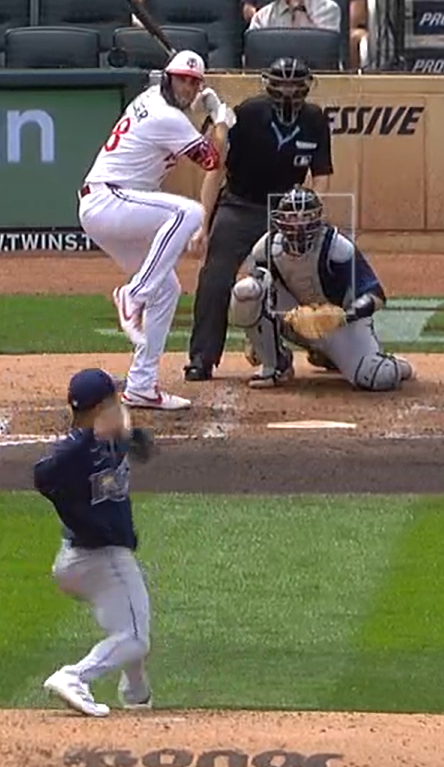
Bradley had something really strange (and bad) going on in the back side of his delivery, back in July. After reaching back with the ball upon breaking his hands, he was bending his elbow to bring the ball back toward his head and start moving forward quite early, and quite flat. There’s a movement the pitcher’s arm has to go through to wind the ball up behind their head, to build tension and torque through the shoulders and upper arm muscles. In this clip, though, Bradley isn’t getting the ball up high enough, early enough. Nor is he creating flexion in his spine, to store energy that gets released when he launches into spine extension by getting over that landing leg.
Compare that image to where he was at foot strike on the pitch to Arraez.
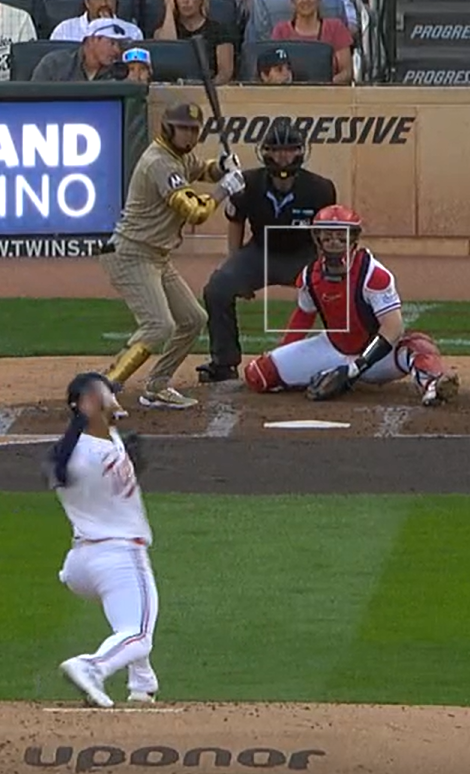
He’s driven off the back leg better. That creates initial force. The ball is up higher, and will be on time, so less of that initial force will be wasted. And his spine is flexed, which will create more snap into extension in the next moment. This is the difference between 94.8 and 98.4, in a nutshell. Obviously, if you take any two given heaters, the differences won’t always show up as this extreme, but there’s a meaningful difference almost every time he fires.
Bradley’s stuff gets intense in a hurry, working with this improved mechanical profile. He can give hitters trouble in a lot more ways, even without an elite out pitch. His cutter, curveball and splitter probably need further refinement, but he’s already killing spin better on the latter and throwing them all harder, too.
.jpeg.91b0ebac93a73a90b3ca086cfb89a9ce.jpeg)
Again, he’s far from an ace, but the upside is apparent again. Bradley’s heat plays very differently at 97 than it does at 95, and so does the rest of his arsenal when those extra ticks are there. As he takes the ball a couple more times to close out 2025, the Twins remain in evaluation mode, but Bradley increasingly looks like a good investment. They bought low, and the stock is already rising.