
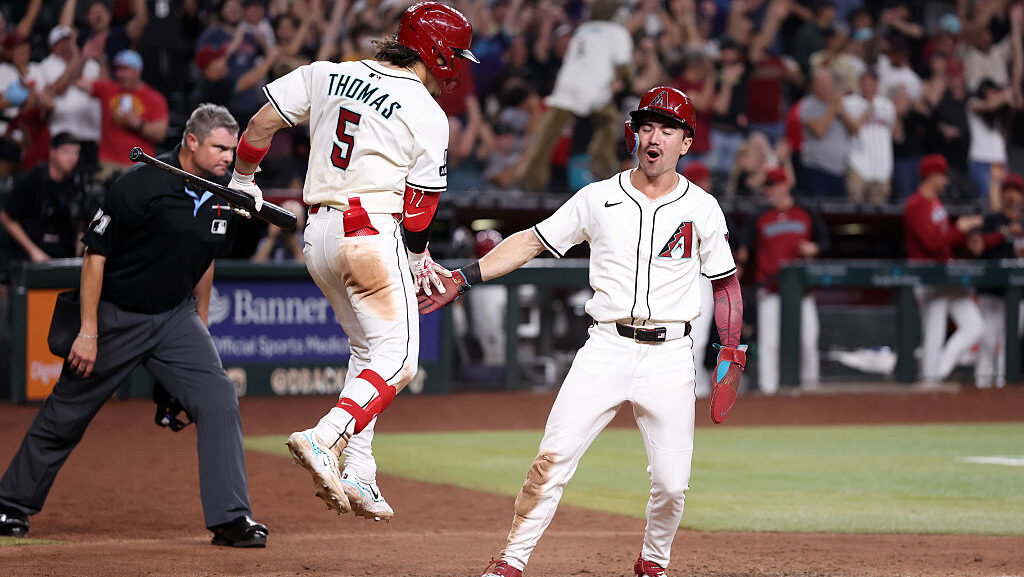
PHOENIX — Arizona Diamondbacks general manager Mike Hazen made it clear to his players and the media alike that rolling over was not his expectation for the club despite a sell-off at the MLB trade deadline.
Hazen explained Wednesday on Arizona Sports’ Wolf & Luke, “Bouncing back once the culture of losing sets in is a very hard thing to get out of young players’ heads.” He brought up 2021 as an example of what could not happen.
Arizona’s roster still had a talented core and was about to face an influx of youth waiting in the wings for an opportunity.
The Diamondbacks have exceeded expectations to stay alive in the pennant race with a 26-18 record. They are 1.5 games behind a playoff spot with nine games left, bolstered by significant turnarounds from the rotation and defense.
The lineup, meanwhile, has actually averaged more runs per game after the deadline (5.2) than before it (4.8), despite trading All-Star third baseman Eugenio Suarez, first baseman Josh Naylor and outfielder Randal Grichuk.
“I feel like that version of this team is playing a better brand of baseball, maybe one that’s more suited to our skillset,” Hazen said. “There’s a mountain in front of us that is yet to be climbed if even possible.
“But I do believe that this team has the capabilities of going out every night and playing a clean game defensively, on the bases and having good at-bats. I think that’s a recipe for winning games. … While (the lineup has) lost considerable power — we took a 50-home run hitter out of it among others — what it’s been replaced with is contact and speed.”
Diamondbacks continue to score
Wednesday was a frustrating day for the offense, but it had scored at least five runs in six consecutive contests leading up to it.
Some of the D-backs’ power numbers have surprisingly not dropped off too significantly despite the lineup not being as deep in proven talent. Speed had played a greater factor, as it had previously.
– Arizona stole 0.65 bags per game prior to the trade deadline (18th in MLB), and that has increased to 1.02 (5th), which is at 2023 levels.
– The home runs decreased marginally from 1.37 per game to 1.27, while their slugging percentage (.436) and hard hit rate (33%) have remained comparable despite less isolated power.
– Strikeouts are actually up from 20.6% to 22.4%, as younger players have worked to find a footing.
– With runners in scoring position, the difference is significant. Arizona is hitting .289 with runners in scoring position since the deadline, even after an 0-for-8 showing on Wednesday against San Francisco. Pre deadline, that figure was .240.
“I think when you’re pressing contact and speed, I think that adds a different element and gives defenders more things to have to worry about,” Hazen said. “I think that’s what this offense does. We know that we like this brand of baseball. I think we’re better suited to play this brand of baseball than wait for the three-run home run.”
Tuesday was an extreme case of willing to go small ball with a franchise-record four sacrifice bunts.
It was an example of finding alternative ways of scoring other than relying on the long ball, which was the case for stretches of the first half.
“You have (Suarez) hitting a homer every other night, you don’t really ask him to bunt,” Corbin Carroll joked on Tuesday. “It’s a different team than we had earlier in the year. I think we’ve got a very selfless group. Everyone does what’s asked of them.”
It helps to have Geraldo Perdomo vying for MVP votes, Gabriel Moreno back from the injured list and the Ketel Marte-Carroll tandem to lean on — as well as a breakout second half from Blaze Alexander.
Why has the defense improved so much?
Pitching and defense were supposed to be calling cards for this team going into the season.
The rotation going from a below-average 4.38 ERA to a top-10 ERA of 3.79 since the deadline speaks volumes about Zac Gallen’s turnaround, the consistency of Ryne Nelson and emergence of Nabil Crismatt.
Why the defense went from mistake prone with a fielding run value of 4.9 (middle of the pack) to much cleaner with a top six FRV (6.3) has been tougher to explain for manager Torey Lovullo.
Replacing Suarez with Alexander at third base is a clear defensive upgrade, but that’s not enough to change the entire equation.
“ I think things started to click, the concepts started to play out,” Lovullo said. “ I think we’re excited to go make plays right now and we realize how important it is. Why doesn’t that happen in April or May, because that’s all I talk about in spring training? … I can’t explain it.
“ I think the outfield defense has improved. The pitching has been efficient in throwing the ball where it’s supposed to be thrown and the defense is following the game plan there. I don’t know. I think things just clicked at the right time.”
The group going into the trade deadline was talented and faced consistent adversity from injuries to big leads disappearing. Play the season over again with the Opening Day roster and it may look a lot differently.
But there is something to be said about having a clear identity, and the team over the past six weeks has shown how beneficial it is to know who you are.
“ I think the brand of baseball is what’s changed. I think what we have expected of them has changed,” Hazen said. “Once some level of belief starts setting in, I think that’s also a very powerful thing.”
