

The Republic analyzes the Diamondbacks’ second half turnaround
The Arizona Republic’s Dana Scott and Greg Moore break down the Diamondbacks’ sudden surge, and review the 2025 season ahead of the MLB playoffs.
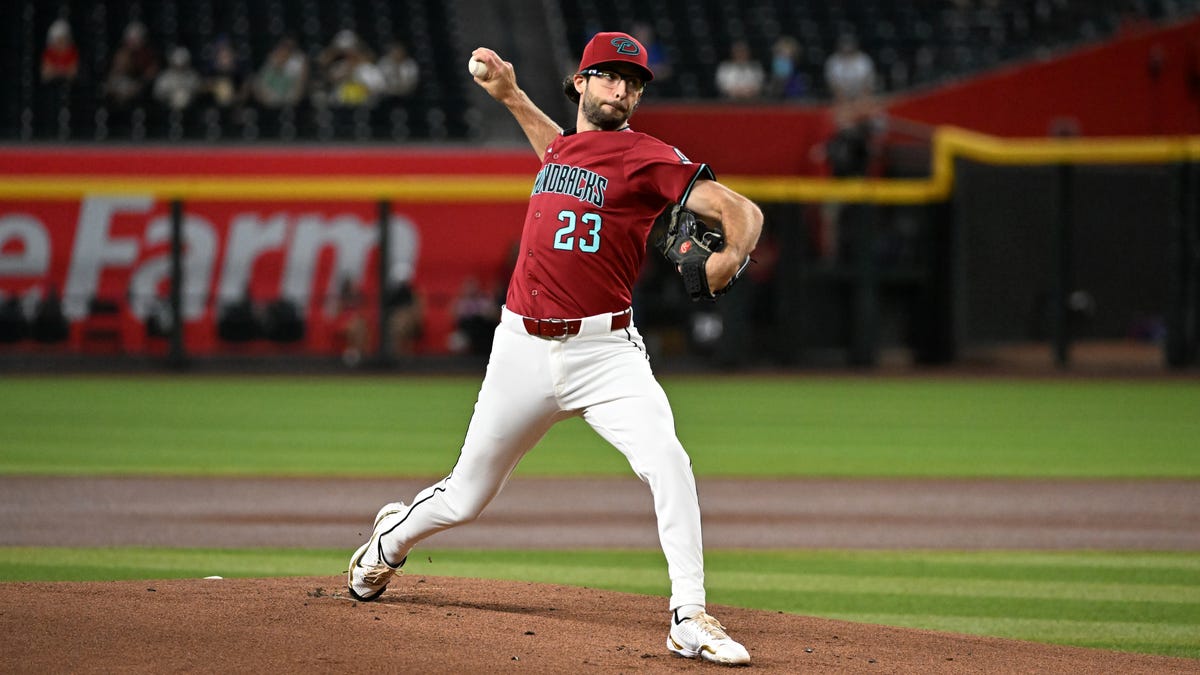
The Diamondbacks’ decision not to trade pitcher Zac Gallen at the deadline has proved beneficial.Gallen overcame a poor first half to become a key player in the team’s recent surge.
The Diamondbacks’ best trade deadline move might have been a deal they didn’t make.
Of course, the club’s decision to keep right-hander Zac Gallen rather than trade him — like they did with most of their other impending free agents — was mostly a byproduct of how he was pitching. Gallen had a rough first half, ranking among the worst pitchers in the National League at the end of July.
But he has righted the ship over the past six weeks, and he has played an outsized role in helping the Diamondbacks surge back into the playoff race. They entered the off day on Thursday, Sept. 18, just 1 1/2 games back of the New York Mets for the final wild-card spot in the NL.
Gallen is scheduled to start the Sept. 20 game at Chase Field against the Phillies.
After giving the Diamondbacks six innings of one-run ball in a crucial win over the Giants earlier this week, Gallen admitted that his first-half struggles weighed on him. He said the thought crossed his mind that had he not pitched so poorly the club likely would not have been sellers at the deadline.
“I took it pretty personally,” Gallen said. “I felt like I was one of the opposites of a bright spot in the first half and kind of hung us out to dry from that standpoint. I had a lot of games where I went out there and didn’t give us a chance to win.”
Diamondbacks’ Gallen a second-half beast
Since the deadline, Gallen has notched a 2.68 ERA in 53 2/3 innings, averaging nearly six innings per outing while significantly cutting back his walk rate.
In a way, his second-half turnaround is hardly a surprise. He ranked among the better starters in baseball over the past three seasons; he twice finished in the top five of Cy Young voting and two years ago started the All-Star Game for the National League. He wasn’t hurt, and his pure stuff was still intact.
But it also made sense why he did not change teams. When contenders are looking to add rotation help at the deadline, they don’t tend to want to gamble on someone who is struggling. They also often want an arm they would feel comfortable slotting into a playoff rotation.
Given the Diamondbacks’ asking price — they wanted value at least comparable to a draft pick, which they would get if they make Gallen a qualifying offer — it was understandable no team was eager to meet it.
“Were there teams that wanted him? Yes,” Diamondbacks general manager Mike Hazen said. “Did I come close to trading him? No. I didn’t get close to trading him.”
Hazen said he “totally” understood rival teams’ hesitancy to make strong offers.
“He hadn’t pitched that great up until that point,” Hazen said. “There’s definitely momentum that comes into it.”
Hazen referenced a player he did end up trading at the deadline: third baseman Eugenio Suarez. Despite his gaudy numbers at the deadline, Suarez also had gone cold at the plate in the week before he was traded to the Seattle Mariners.
“Does that go into the back of somebody’s mind that we stopped scoring runs and he wasn’t hitting a ton at that point, either?” Hazen wondered. “You step back and think, ‘That won’t have an impact on it,’ but I said during that week that if Geno had hit four more home runs that week, would the calls have come in even more urgently? My gut tells me yes because we’re all human.
“To that point on Zac, from a momentum standpoint, I totally understand.”
Trade deadline: Diamondbacks didn’t have ‘much of a choice’
As for the deals Hazen did make — he traded away starter Merrill Kelly, Suarez and first baseman Josh Naylor, among others — he admitted to some regret about not having those players anymore, though not about having actually made the trades.
“At the time of the deadline, I didn’t feel like we had much of a choice,” Hazen said. “Just the way we were playing, the direction we were going, the position we were in relative to where we were in the league.
“I wish we still had some of those players, obviously, because we would be a better team from a talent standpoint, on paper, in some regards. (But) I do wonder if that was, from a mental or psychological standpoint, a wakeup call, in some ways.”
Hazen stressed that he did not intend for the deadline sell-off to serve as such. He thought the second half would have value whether the Diamondbacks were in the race or not, the most realistic hope being that a strong finish could have the same carryover effect next year that the club saw going from 2022 to 2023.
Odds are, however, Gallen’s strong second half means he won’t be a part of next year’s team. Assuming nothing goes terribly wrong in his final two starts, Gallen seems assured of receiving — and rejecting — a qualifying offer once he reaches free agency.
At that point, he will hit the market riding tailwinds — not just his solid track record of previous years, but a strong finish to 2025 on top of that. With the Diamondbacks expected to lower their payroll next year, it is likely that Gallen will sign elsewhere, though owner Ken Kendrick has surprised before with his willingness to spend.
Short hop
The Diamondbacks selected the contract of left-hander Philip Abner from Triple-A Reno and optioned lefty Kyle Backhus to Reno. Abner, a sixth-round pick in 2023 out of Florida, has been on a dominant run pitching in relief at Double-A and Triple-A over the past six weeks. Since Aug. 1, he has given up just two runs (one earned) in 19 2/3 innings, walking four and striking out 20.