
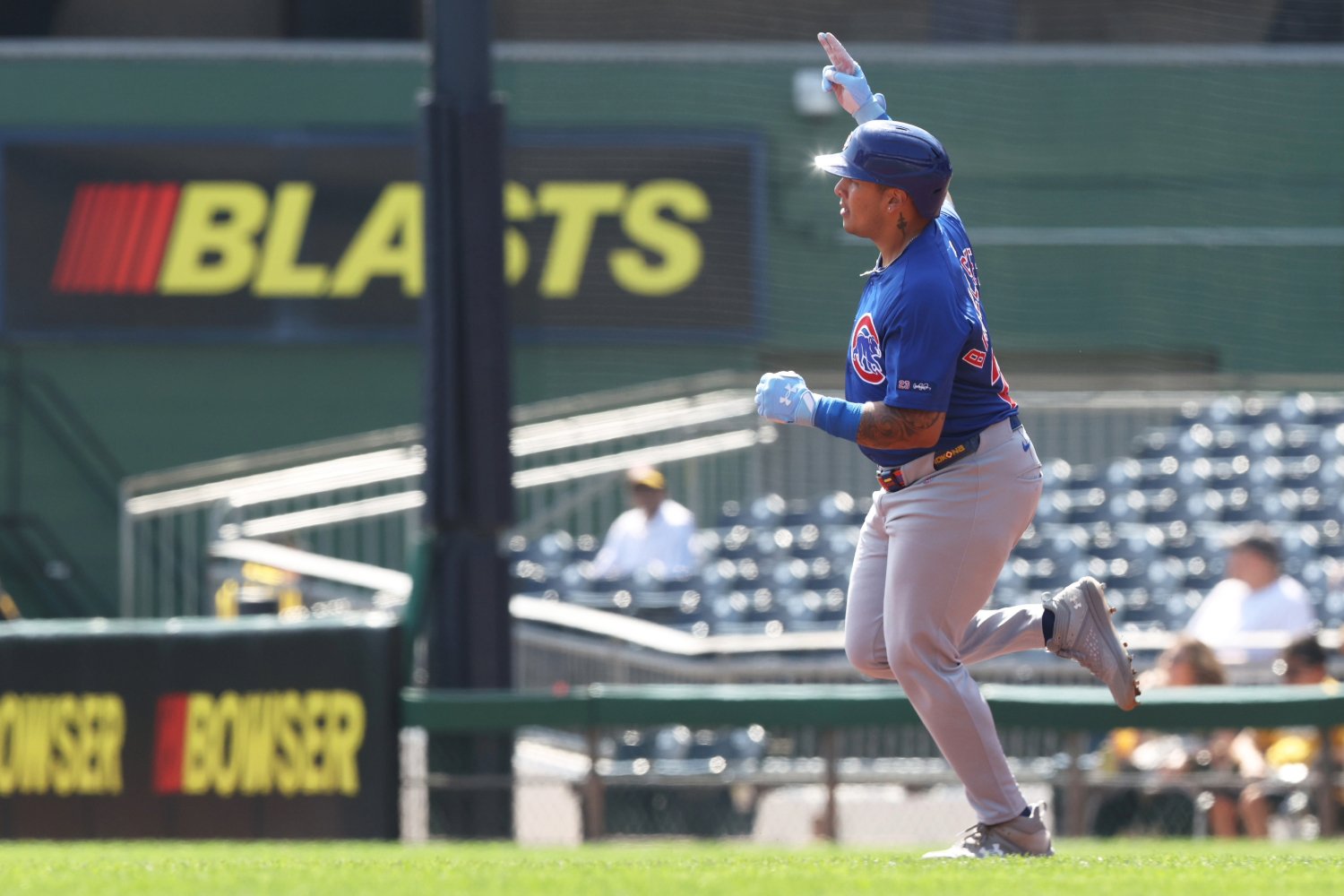
Moises Ballesteros was always expected to hit. Young catchers rarely, if ever, show any level of advanced feel with the bat in their hands, but Ballesteros was an exception from the moment the Cubs signed him as a teenager.
In 2022, his first full season of pro ball, an 18-year-old Ballesteros posted a .743 OPS after getting a late-season call-up to Single-A Myrtle Beach. In 2023, he climbed all the way to Double-A Tennessee, slashing .285/.374/.449 across three levels despite being years younger than the average age at each stop. He hit 19 homers in 2024, making it all the way to Triple-A Iowa as a 20-year-old backstop. There were question marks on defense, to be sure, but the bat was not to be doubted.
We thus arrive to the current 2025 season, where Ballesteros only continues to improve. He’s hammered Triple-A pitching to the tune of a .316/.385/.473 batting line over roughly 500 plate appearances, earning his call-up to the big leagues for his MLB debut. He’s been up and down a bunch this season as the Cubs have shuffled their roster to make room for injured players and outside additions, but in his first taste of uninterrupted MLB action, Ballesteros is proving he belongs.
Since getting the call back to the bigs on Sept. 12, Ballesteros has played in every game for the Cubs (save for Friday night’s affair against the Reds) as the starting designated hitter, batting cleanup. In those 27 plate appearances, he’s batting .333/.407/.667 to go with two home runs and a triple. In conjunction with his impressive 11.1% walk rate, Ballesteros’ 189 wRC+ in that span is the best on the team.
He’s doing the things you’d expect a quality big league hitter to do during this hot streak; his hard-hit rate (38.9%) is up, he’s deploying a solid all-fields approach, and luck has been on his side (.375 BABIP). Sure, his ground-ball rate is an alarming 61.1%, but when you’ve got the bat control and power of Ballesteros, it’s easy to punch those ground balls through the infield.
Of course, the big part of the conversation with “Mo Baller” is his defensive home. He hasn’t been allowed to play anywhere in the field in the big leagues, and there have been endless questions about his ability to handle catching on a full-time basis. For what it’s worth, he did catch in more than half of the games he appeared in with Iowa this season, but standing at a stout 5’8″ and nearly 200 pounds, he’s certainly not the best glove the Cubs can deploy behind the plate.
If this sounds familiar, it’s exactly the conundrum the Cubs had with Kyle Schwarber one decade ago. Another sturdily built left-handed slugger, Schwarber tried his hardest to make things work as a backstop, though his defensive shortcoming and huge offensive potential were too much to overlook. The team elected to stash him in left field — even after his infamous torn ACL to open the 2016 season — rarely letting him DH, if ever. Now, Schwarber is in his mid-30s as a full-time DH and hitting better than ever.
There’s a lesson to be learned from that saga. Ian Happ is currently patrolling left and Michael Busch is entrenched at first base; Ballesteros will never be better defenders than they are. His bat is already among the best on the team—why ask him to handle a physically demanding position he isn’t good at (catcher) or one he barely knows (left field, first base) and risk letting his bat falter? It might seem counterintuitive to relegate a 21-year-old to the DH spot on a permanent basis, but the Astros have done it with Yordan Alvarez for years, and it’s safe to say they don’t have any regrets. When you have someone who makes hitting look as easy as Ballesteros does, there’s no reason to be greedy.
As long as he’s not getting drilled by line drives off the bat of Pete Crow-Armstrong, Ballesteros should be a fixture in the Cubs’ lineup for the remainder of the season as the regular designated hitter. Bat-first rookies don’t always live up to the hype right away, but most rookies aren’t Ballesteros.