
Much will be made about the Miami Marlins’ experiment of calling pitches from the dugout.
Early in the 2025 season, the Marlins’ minor league teams began doing it. Their coaches would relay signs to the catcher, who would then transmit the call to the pitcher.
Marlins manager Clayton McCullough said prior to Friday’s game in Arlington that they made the decision to bring this process to the major league level, with assistant pitching coach Alon Leichman relaying the signs to catcher Liam Hicks. There is video evidence that strongly suggests Hicks received several pitch calls from Leichman during his previous catching appearance on Wednesday—Hicks has spent the entire season in the majors, so that allowed him to accumulate some in-game experience before the new pitch-calling procedure was fully implemented.
Friday was a great first data point—at least for the vast majority of the night. Starting pitcher Janson Junk was in top form, allowing one run over seven innings in a 6-4 win against the Texas Rangers.
Junk allowed just three hits, struck out five, and walked zero. From the end of the second inning to the sixth, the 29-year-old right-hander retired 12 straight hitters.
As far as pitch selection goes, it was largely similar to what we usually see from Junk. He relied mostly on his four-seamer and slider, those two accounting for 75% of his 91 pitches, compared to his season average of 64% on that combination. He still offered a dozen sweepers—all to righties—and then a handful of changeups and curveballs to lefties, which is all consistent with his scouting report.
Pitchers can still shake off what the coach calls, but with the pitch clock, it can be hard to send a new call in time. Whether Junk agreed to most of the calls or not, he was not hit with a pitch-clock violation during his outing Friday.
Lake Bachar and Cade Gibson delivered the game to extras with two scoreless innings, clinging to a 1-1 tie. While Gibson was facing Jake Burger with two out and nobody on in the ninth, there was a breakdown in communication. As he was waiting for the call on a 2-1 count, Hicks kept spinning his finger towards the dugout to urge Leichman to get the call in as the pitch clock ticked down to five seconds. Burger wound up calling timeout anyway, making it a moot issue.
The Marlins took a 3-1 lead in the 10th on an Otto Lopez RBI double to center field. Lopez would score two batters later on an Xavier Edwards single. However, a two-out, two-run home run by Rowdy Tellez off of Michael Petersen‘s 2-0 cutter gave Texas renewed life. Each of the previous pitches Petersen threw to Tellez were also cutters. It was the 11th pitch of the inning, and the ninth time he threw the cutter.
Petersen seemed to be the only Marlins pitcher Friday whose pitch selection was significantly different. Twelve of his 21 pitches over two innings were cutters, and only nine were four-seamers. It’s usually the inverse for him, using his fastball 57% of the time and the cutter 39.7%. Even when he used his fastball Friday, eight of them were thrown to righties, even though he’s slightly more liable to use it against lefties this year.
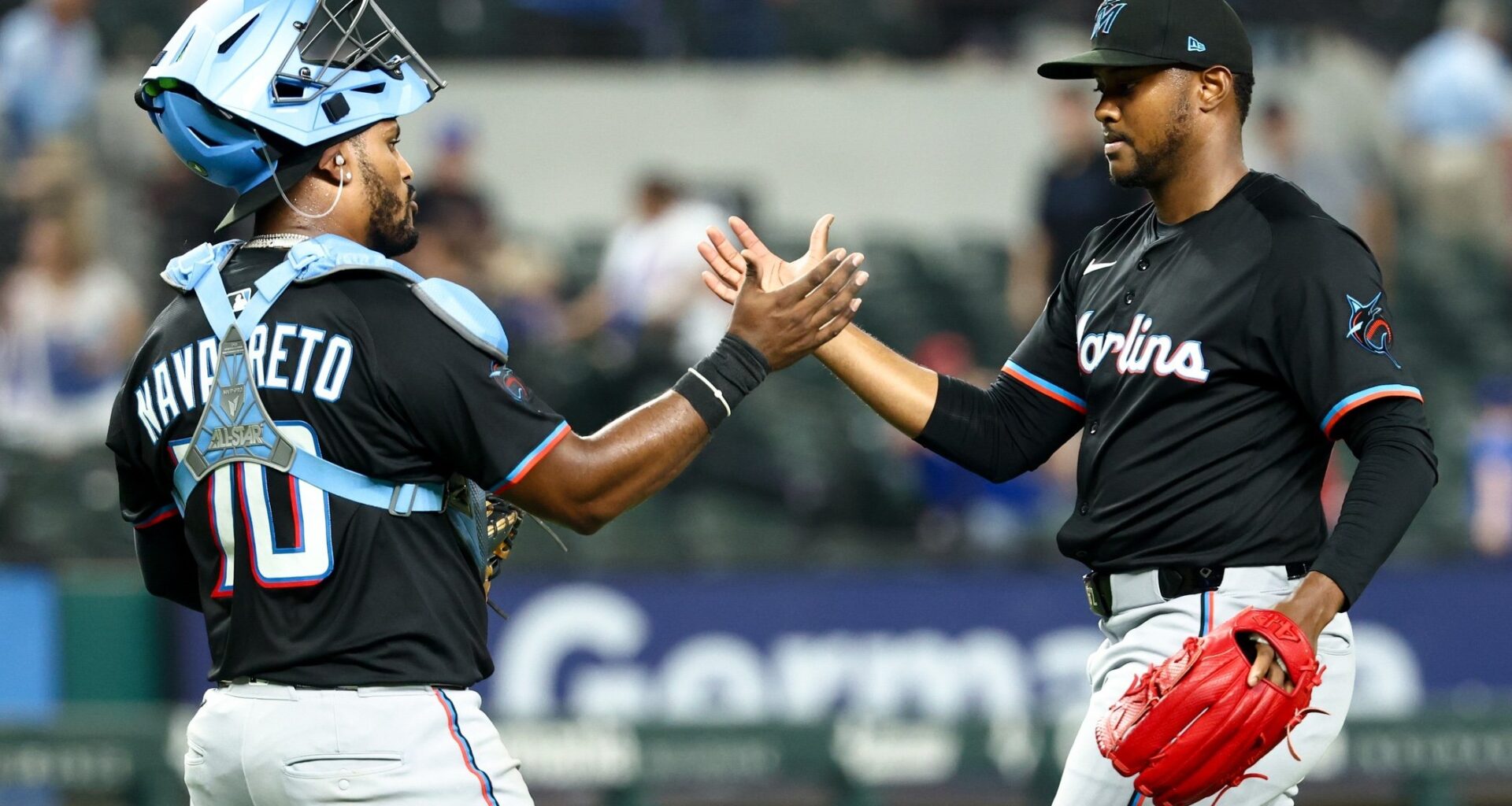
The Marlins retook the lead in the 12th on a Jakob Marsee double to right field. Brian Navarreto, replacing Hicks defensively in the 10th, tacked on another run with a double of his own.
George Soriano pitched a perfect final two innings to earn the win, only allowing the placed runner to score in the 12th on two consecutive flyouts.
The Marlins now have eight wins in their last nine games, which matches their best nine-game stretch of the entire season.