
Twenty-one months ago, Bryan Carmel and Paul Freedman began the Oakland Ballers project with two goals at the top of their list.
Spurred by the anger over the Athletics’ departure, the owners of the newest team in the indie Pioneer League wanted to redefine the relationship between ballclub and community.
“Our whole idea is to tear down all walls that exist between fans and teams,” Carmel said.
The other goal was more obvious: bring a ring to a city that hasn’t seen a championship baseball team in over 35 years.
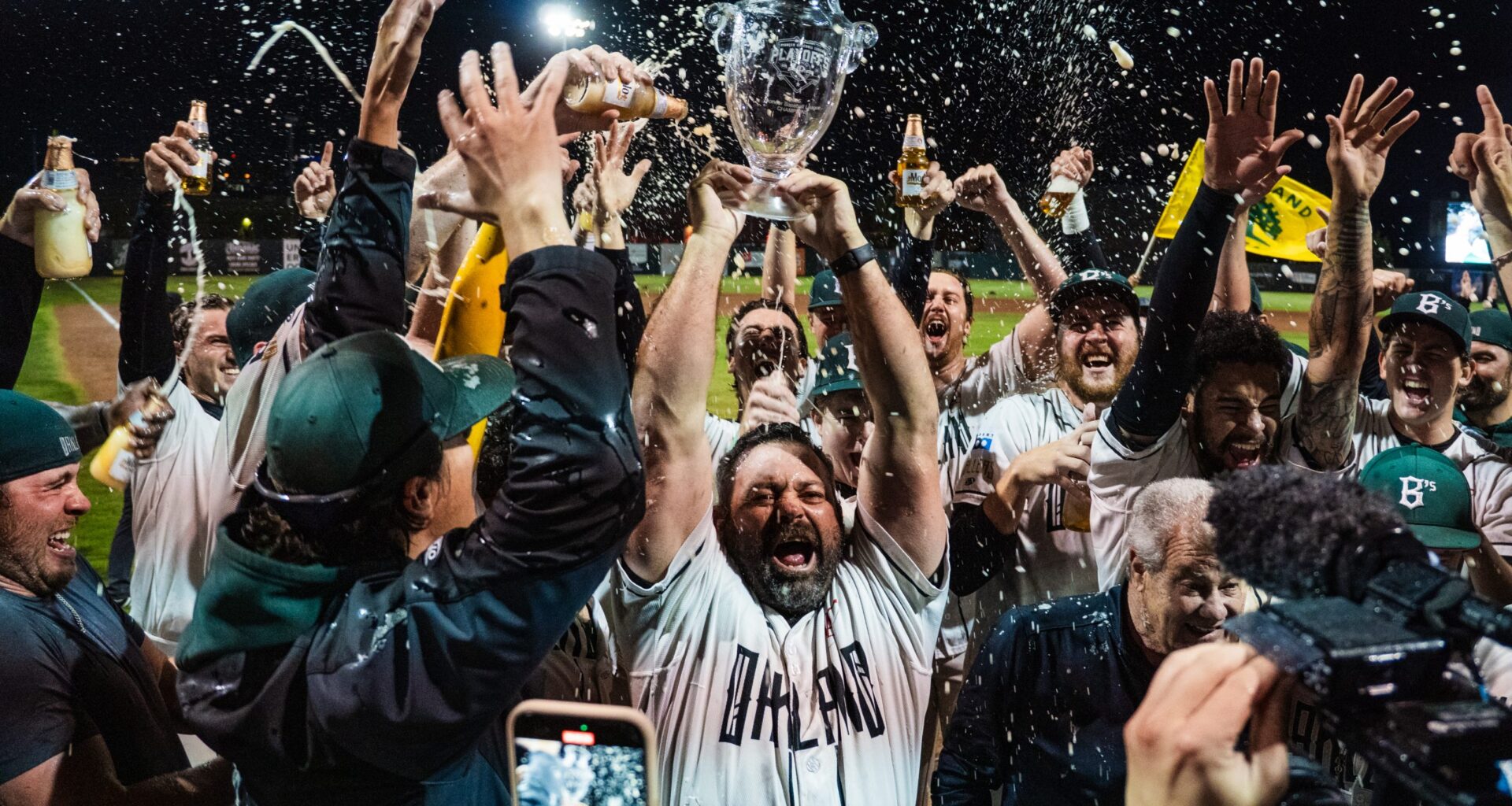
On Sunday, in the finale of the best-of-five Pioneer League championship, both goals coalesced in a magical moment. The Ballers won their third straight elimination game at Raimondi Park against the Idaho Falls Chukars, giving the thousands of Oakland baseball fans in attendance a long-sought title.
Ballers players poured out onto the field to celebrate, cracking open beers and dumping them on ecstatic teammates. Some fans broke out into tears; some climbed the railing; one was bold enough to hop onto the field. Even a truck from the Fire Department got in on the action, spraying players with its hose from just beyond the center-field wall.
“I think that the whole point of sports teams is to bring the community together for a shared purpose and a shared joy, and we’ve brought together a lot of people, and it’s been beautiful,” Carmel said.
The people inside the ballpark played as significant a role in the success of the Ballers as anyone who threw a pitch or recorded a hit. In Idaho Falls, playing in a half-empty stadium after a 14-hour travel day, the Ballers came out flat, losing the opener 5-3 and then getting knocked around in Game 2, 15-10.
The team with the best record in Pioneer League history (73-23) was one loss away from ending the season on a demoralizing low.
Coming home made all the difference.
While the Pioneer League might be the lowest rung of the professional baseball ladder, the Ballers and their fans strove to create a big-league atmosphere at their little park in West Oakland.
Before each home game of the championship series, the national anthem was accompanied by a flyover. Fans waved yellow rally towels during the game, and the constant drumbeats and the “Let’s go, Oakland!” chants might as well have been piped in from an old playoff game at the Coliseum.
“The energy is amazing, and I know that this is what we’re capable of,” said Jorge Leon, president of the Oakland 68’s fan group, which helped organize protests against the A’s before the team left town and which now takes up noisy residence at Ballers games in the right-field bleachers.
Leon himself played a significant role in the team’s adoption of a unique fan-ownership model, and he was elected to the club’s board of directors as the fans’ representative.
“If you put a winning product in the field,” he went on, “this is what Oakland does.”
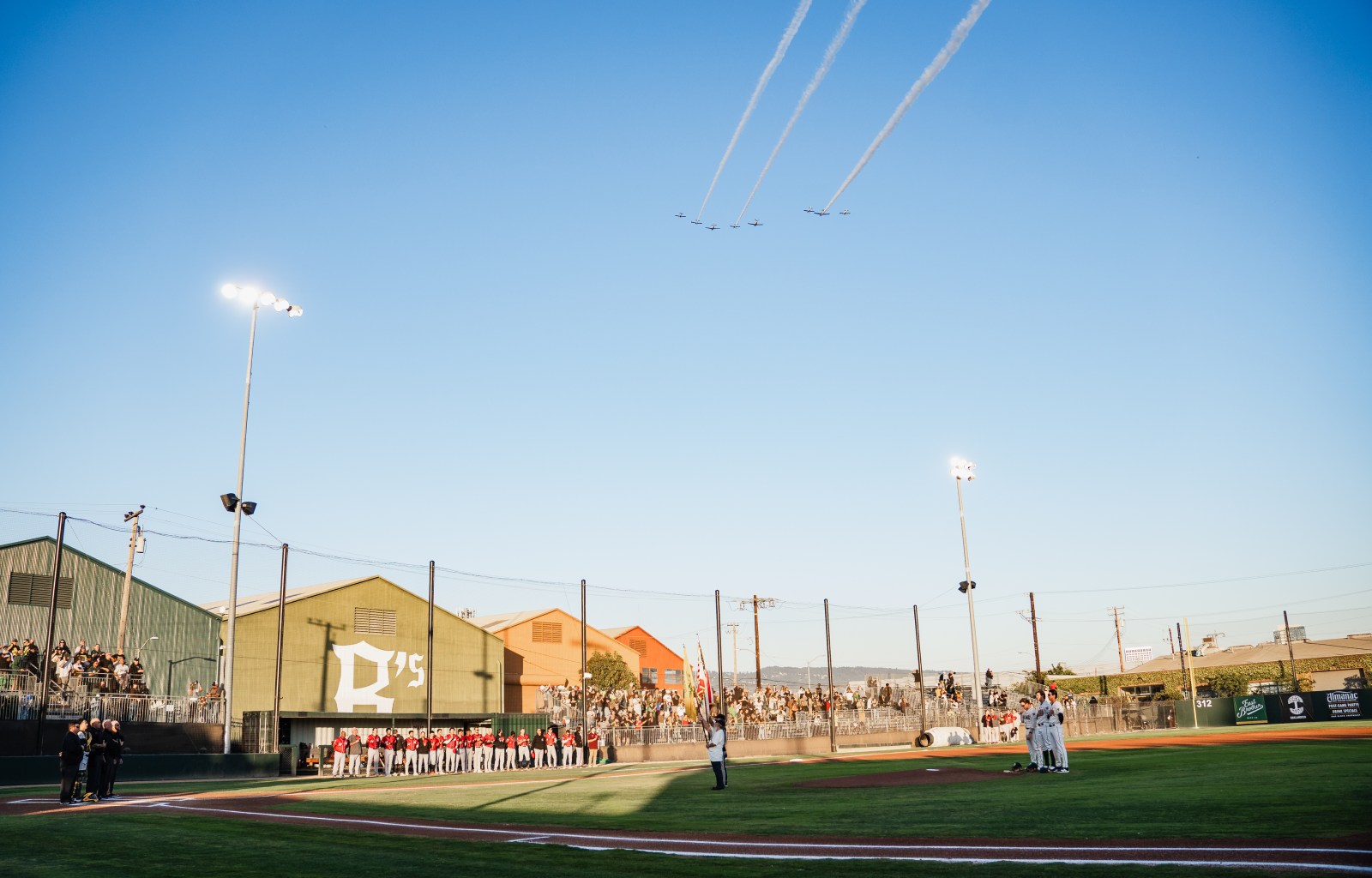 A flyover before Game 5 gave the atmosphere a little touch of the majors. Credit: Sammy Nute for The Oaklandside
Buoyed by the lively home atmosphere, the Ballers on Friday reestablished themselves as the best pitching club in the league, riding a masterful start from former Cal ace Luke Short, who went five innings and allowed just one earned run. First baseman Christian Almanza slugged his third homer of the series on the way to a 10-2 Ballers victory.
In Game 4, the Ballers went down 2-0 in the second inning and struggled to generate offense in the early going. But infielder Treymane Cobb Jr. tied the game with a two-run bomb in the fifth, and designated hitter Cam Bufford put the game away with a three-run shot in the bottom of the eighth, giving the Ballers an 8-3 victory and tying up the series.
Over the final three games of the series, the Ballers held the Pioneer League’s best offensive team to just six runs in all.
“The biggest wins for me were Game 3 and Game 4,” Ballers assistant general manager Tyler Petersen said, “Once we got to Game 5, I knew we were gonna win it.”
The championship is a tribute not just to the sterling play of the Ballers but to the philosophy on which the team was built. The owners’ emphasis on breaking down walls between fans and team can be seen at the very doorstep of Raimondi Park. With no clubhouse attached to the home dugout, the players are forced to enter through the same gate as all the fans.
In the big leagues, the players are the product, above the fans, and are to be protected at all costs. At Raimondi, they are just another part of the community, distinguishable from other Oaklanders only by the uniform and cleats.
On the way in, they get stopped for photos and autographs, fans and players mingling in a way that goes to the heart of what the Ballers are trying to achieve.
“They know who they’re playing for, and they have a responsibility to those people to play well,” Petersen said. “Face-to-face contact is so important because at that point, you’re not just playing for a city. You’re also playing for people you know personally.”
Even an owner can disappear into the crowd at Raimondi. In the middle of Game 5, Carmel shunned the stereotypical role of a baseball boss at a playoff game. Instead of sitting in any designated owners’ seats, he made his way down the right-field line to talk to all different types of fans. He was easy to miss.
“I get a lot of steps in during games,” Carmel said. “Part of that is just nervous energy, but I also like to experience the ballpark from different vantage points and see what the experience is like out in the right-field bleachers, in the bowl, and everywhere else. For me, they are little pockets of community.”
Soon after Carmel made his way to the next pocket, Cam Bufford crushed the team’s second three-run homer of the night, and his second in as many games, sending the ball into the Ballers’ bullpen and through the heart of the Chukars, who now trailed 8-0 in the seventh inning.
Two innings later, the game was over, 8-1 the final score, and the mission was complete. The players dogpiled on the field, and a stadium packed to the brim with 4,100 people erupted with the sound of a ballpark 10 times bigger.
As the players made their way down the right-field line to celebrate with their fellow Oaklanders, a sign greeted them before any fan. “Never Quit,” it read in big bold letters, perhaps less an instruction to the players than a statement of a principle for a community of fans whose ballclub quit on them 22 months ago.
And today, Oakland is a city of champions once again.
“This is a community where the world has said, ‘You don’t get professional baseball. You’re not worthy,’” Carmel said. He was standing on the infield, drenched in beer with a rally towel adorning his head.
“That was a narrative that we refused to accept about ourselves. That’s really what this team is about: showing that Oakland never quits, showing that we can do something for ourselves. There’s no limit to how far we can take that.”
“*” indicates required fields