
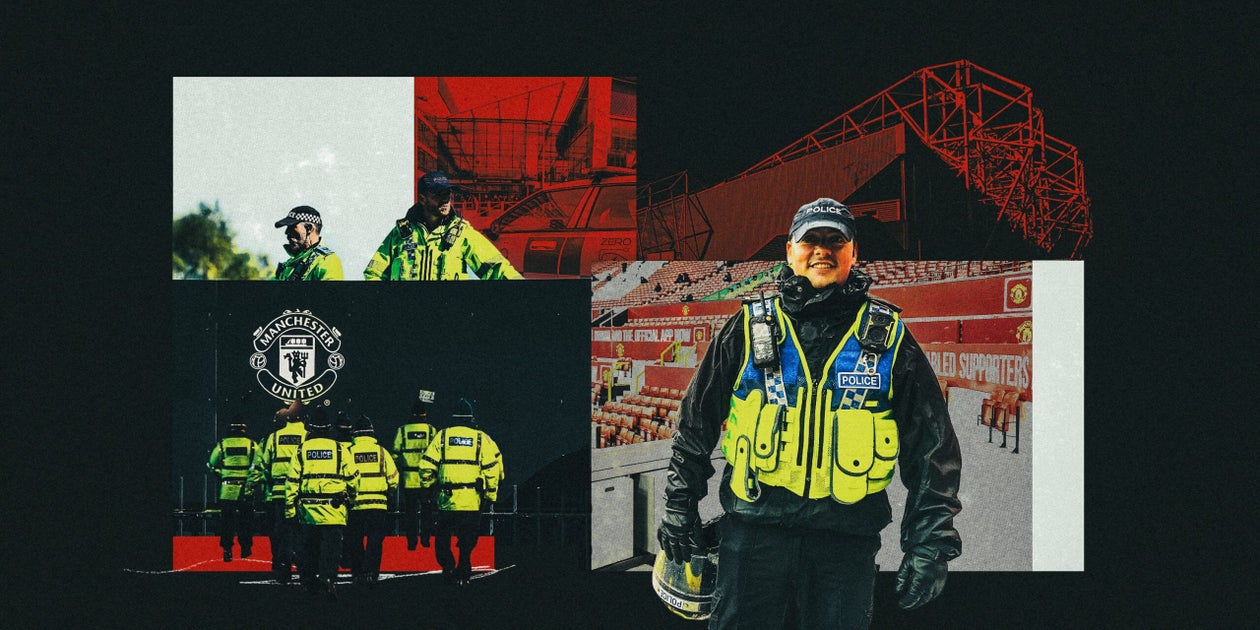
Colleagues tell PC Oliver Mayall he has the best job in Greater Manchester Police (GMP), but on Saturday afternoon it didn’t necessarily look like it.
It is several hours before Manchester United’s home game with Chelsea and the heavens have well and truly opened over and around Old Trafford. Even by Manchester’s standards, it is some deluge.
For Mayall, there is a positive to cling to, though. “If we see ‘PC Rain’ come out, we think we’re usually going to be OK,” says Mayall, feeling the brunt of the weather as he stands at the foot of Sir Matt Busby Way, the road that leads to United’s home stadium.
Mayall is the dedicated football officer (DFO) for United and, as such, travels to every competitive home and away game they play. PC Matt Hero has the same responsibilities for Chelsea and has come north on Saturday on behalf of London’s Metropolitan Police, two days after returning from a Champions League tie at Germany’s Bayern Munich.
“It’s that conduit between the club and the police but also between police and the fans,” Mayall says, explaining the duties of a DFO. “They’ve got someone they can liaise with. It’s having that familiar face.”
There has often been an uneasy relationship between football fans and the UK police, born from the hooliganism which blighted the English game in the 1970s and ’80s and the scandal of the latter’s Hillsborough Disaster. But Mayall and Hero, two of the 120 officers on duty for Chelsea’s visit to United, are part of an effort to help restore relations.
On Saturday, police were satisfied with their day’s work. The match attracted the biggest crowd of any sporting event held in the UK on Saturday, with over 74,000 in attendance, yet significant police action was minimal.
Three United fans caught chanting the homophobic “Chelsea rent boys” outside Old Trafford had their tickets cancelled and will face further police action this week, but only two arrests were made, both of them Chelsea supporters found to be in possession of cocaine.
“I would say 99.9 per cent of that 74,000 that are coming to the game are decent people who just want to come and see Man United play Chelsea and enjoy a really good football fixture,” says chief inspector Jamie Collins, who oversaw the game from GMP headquarters, six miles from Old Trafford. “The challenges at the moment are just around that small minority of people.”
The Athletic was given access to GMP’s operations around the game to discover how the Premier League’s largest stadium is policed, the ways strategies for doing so have evolved and the challenges officers still face.
Stretford Police station, on the opposite side of Talbot Road to the Old Trafford cricket ground, around half a mile from the footballing version, has long been the starting point for GMP’s involvement in United home games. It is where the 100 or so officers on duty have their final briefing — on Saturday, for what was a 5.30pm kick-off, this happened at 3pm — and the point where the scale of the pre-match planning involved becomes clear.
Chelsea’s annual visit is traditionally one of the Premier League’s biggest fixtures but was categorised as a medium-risk fixture by GMP this time. The classification is derived from details of the match — forecast numbers of home and away fans, the kick-off time, any history of unrest at prior meetings — being entered into a matrix developed by the UK Football Policing Unit.
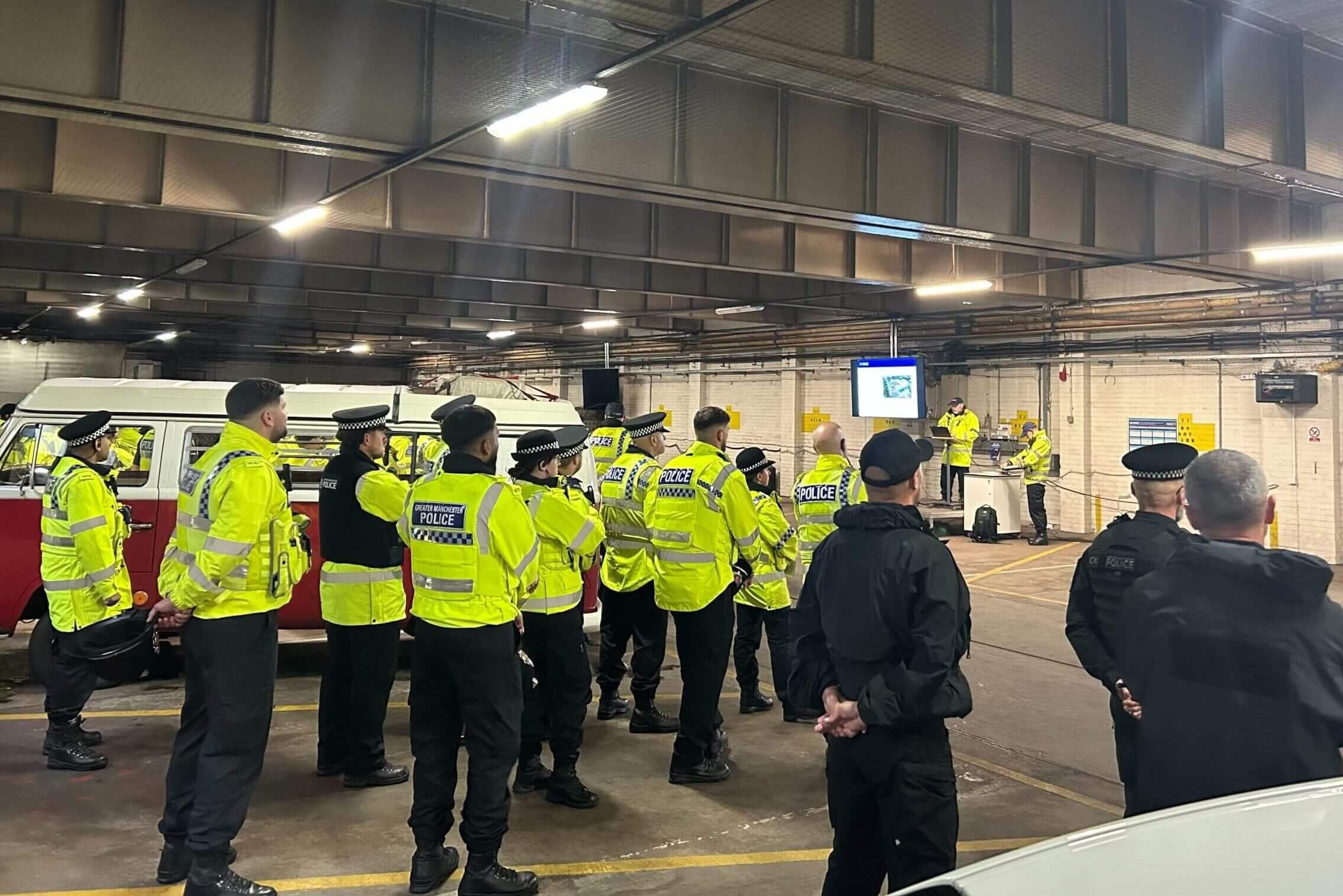
Police gather for a pre-match briefing (Phil Buckingham/The Athletic)
The match in third-tier League One between Bolton Wanderers and Wigan Athletic had a third of the crowd expected at Old Trafford later in the day yet was deemed GMP’s only high-risk fixture of the weekend, owing to large-scale disorder when those teams, from neighbouring towns on Manchester’s northern outskirts, met in 2023. GMP’s mounted unit, typically present at Old Trafford, and their horses instead spent the day at Bolton’s Toughsheet Community Stadium.
The visits of Liverpool, Leeds United and Manchester City to Old Trafford this season will inevitably be high-risk fixtures but pre-match assessments found no reason to commit the same level of resources to Chelsea and their 3,000 fans. That classification also gave the green light to a Saturday evening kick-off at 5.30pm — a live-TV slot which would ordinarily not be allocated to a high-risk game.
A bus workers’ strike across Greater Manchester over the weekend was highlighted as a potential challenge, as was the likelihood of Chelsea fans congregating at a city-centre pub and travelling in large numbers on the local tram network. Officers were told of damage caused by the west London club’s supporters at the corresponding fixture last season.
An issue unique to Chelsea’s visit, though, was the chanting now considered by the CPS (Crown Prosecution Service, the body in the UK responsible for deciding which criminal cases to prosecute) to be a hate crime. The “rent boy” chant that has historically been aimed at their fans is now considered “offensive and inappropriate” and meets the threshold to be considered a hate crime.
Eleven United fans were arrested for that offence in the 2024-25 season and the club, led by safety and security manager Dean Howard, adopted a strategy on Saturday that would see any supporter caught using the chant outside Old Trafford denied entry, with their match ticket cancelled. A three-year ban would also follow, as would a police interview and a likely charge. United made this clear with a club statement two days before the game but three supporters failed to heed the warning.
“It’s a challenge to police it,” says Collins. “You could have 200 or 300 fans chanting that at once, and (in that situation) you can’t arrest everybody. We’ve had some really clear advice from the CPS around it and it’s really important we take positive action. The club has been proactive as well. They can get ticket details and straight away cancel that and give out a three-year ban. We haven’t seen as much this season.”
Officers are purposefully dotted around Old Trafford for visibility in the hours building up to kick-off, with the highest number concentrated around the away turnstiles, where Chelsea have also sent their own stewarding teams to assist the travelling fans. Sniffer dogs are also present, trained to detect drugs and pyrotechnics.
Both United and neighbours City request special police services around each of their home games, which sees them pay for officers operating on the private geographical footprint of the club. Those stationed further away from the stadiums, in surrounding streets and Manchester city centre, remain funded by the UK taxpayer, but there is an ongoing intent to change perceptions. Even dress codes, with officers wearing baseball caps rather than their standard-issue helmets, are designed to project a less intimidating image of police at matches than English fans routinely encounter in other countries.

Police try to present a friendlier face to fans, including wearing baseball caps not helmets (Nick Potts/PA Images via Getty Images)
“A lot of cops historically, you’ll have seen them in their yellow jackets standing there with their arms folded,” says Collins. “That’s not helping anyone with engagement. I want cops to go out and have that communication with supporters, try and nip things in the bud before they happen. It can be a friendly, ‘That’s enough of that’, and intervening before things escalate.
“We’re much better at engagement now with football fans and listening to them. We do a lot of work with fan groups, trying to understand their needs. We try to be really transparent and open around the police operation.”
Saturday’s atrocious weather across north-west England is undeniably helpful. There is little desire among fans to gather on the plazas around Old Trafford in the heavy rain but leaving their entry to the stadium late sees several thousand of them stuck outside its turnstiles at kick-off.
“People will just have a mission in their heads just to get to the stadium or the pub,” says Mayall, a United supporter himself. “Nothing can be ruled out in the police but I’m hoping today goes well. That goes for the performance (from United) as well.”

Wet weather like Saturday’s in Manchester usually deters troublemakers (Nick Potts/PA Images via Getty Images)
The Old Trafford control room, situated above the away end, is the on-site focal point for officers but operations at the ground are directed from GMP headquarters, where experienced, senior officers monitor a wall of CCTV screens.
As part of changes to football policing in the aftermath of Hillsborough — where 97 fans were unlawfully killed at a FA Cup semi-final between Liverpool and Nottingham Forest at that Sheffield stadium in April 1989, and South Yorkshire Police was heavily criticised for its role in wrongly blaming supporters for causing the fatal crushes — it was concluded that an off-site team leading in-ground operatives would have greater benefits.
GMP has access to every camera inside and outside of Old Trafford, as well as local authority ones in the area and those positioned at tram stops. A drone also flies around the stadium, helping officers monitor crowd movement.
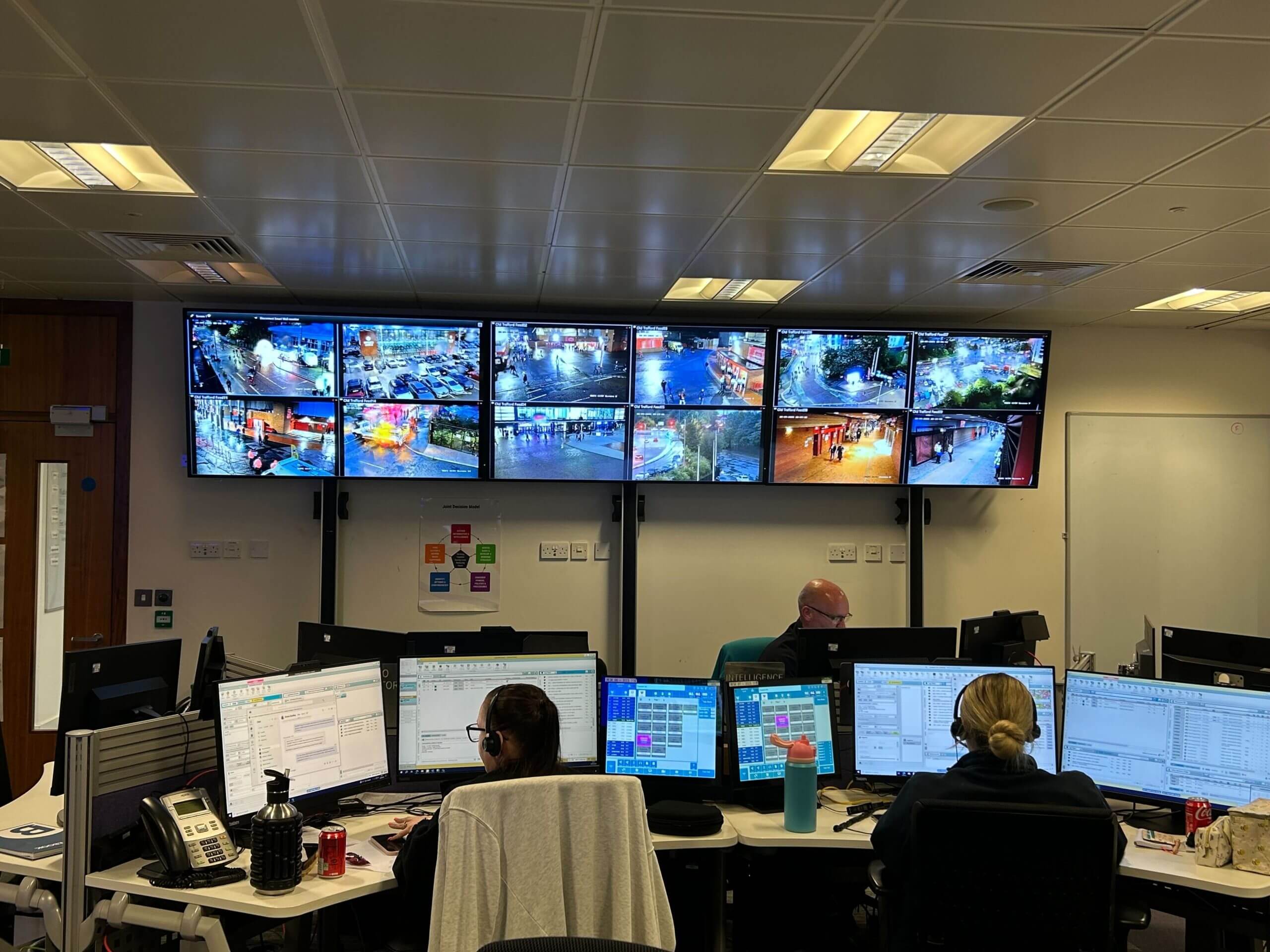
Control-room staff at GMP headquarters monitor events in and around Old Trafford (Phil Buckingham/The Athletic)
A spike in disorderly behaviour at football matches after the Covid-19 pandemic has flattened in the past two seasons and bigger flashpoints now tend to occur in the lower leagues, as with that violence between Bolton and Wigan two years ago.
That is not to say Old Trafford is trouble-free these days. Last season’s Europa League tie at home to leading Scottish side Rangers saw 39 people arrested and United, admittedly with a greater matchgoing fanbase than other English clubs, topped the arrest chart in 2024-25 with 121, according to figures published by the UK’s Home Office.
Manchester City were next on 94 but this is not an era when hooliganism can take hold in the way it once did. The number of football-related arrests across England and Wales fell by 11 per cent to 1,932 last season. As well as having DFOs serving each of the 92 clubs across the Premier League and three divisions of the EFL, there are operational football officers, formerly known as “spotters”, tasked with identifying high-risk supporters before they have entered stadiums.
“We’re a lot better now than we’ve ever been,” insists Collins, who has been with GMP for 27 years. “These last five years, we’ve really been intelligence-led. The DFOs are really good at understanding the (high) risk supporters, where they’re going to go, who they associate with and the risks they bring.
“It’s much more professional now in how we police games. The planning processes that go into every fixture, there’s a lot of work that goes into it that just wasn’t in place when I first joined the job.”
Two briefings are held ahead of every home game, involving local authorities, emergency services, with policing numbers ultimately shaped by the risk attached to the game. City’s Champions League tie with Italian side Napoli, for example, two days earlier at their Etihad Stadium across town, saw almost 100 more officers on duty than Chelsea’s visit to Old Trafford.
That outlook is justified.
A pre-match briefing hears that the conduct of Chelsea fans in the city centre is “all good-natured”, while two found in the home sections of Old Trafford are ejected without major incident. There is passing concern for the state of the pitch under the torrential rainfall — an abandonment, as happened earlier on Saturday at nearby second-tier side Blackburn Rovers, would have brought obvious logistical headaches — but United’s eventual 2-1 win ensures the majority in attendance head home happy. There is even no apparent goading of away fans as the ground empties in the unrelenting deluge.
“I go and watch football with my grandson, and you don’t want to get caught up in something,” says Collins, whose night concludes with a post-match briefing at 8.15pm. “We’ve seen in the last couple of years that we’re starting to reduce our resourcing because we’ve taken that risk away. The vast majority of people are decent.”
(Top photos: Getty Images, Phil Buckingham; design: Eamonn Dalton)