
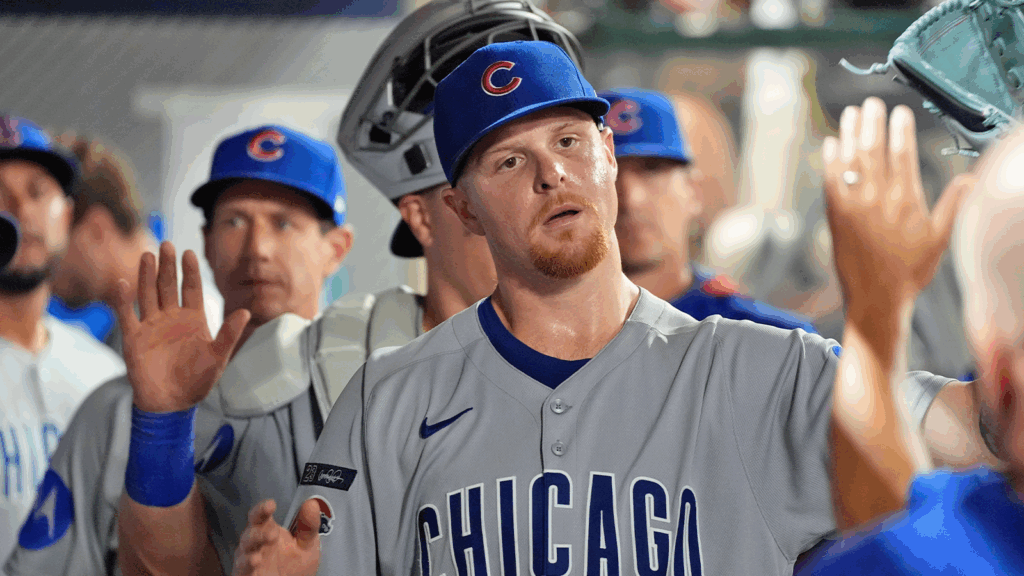
The Chicago Cubs sealed their place in the 2025 MLB postseason after two straight years of 83 wins and falling just short of the playoff tournament. How did the Cubs put it all together and get over the hump? Here are six key areas that led to the return of October baseball on the North Side.
When Cade Horton made his major-league debut in May against the New York Mets, the Chicago Cubs sought to protect him a bit by using an opener – Brad Keller – in front of him.
How do you create as much of a soft landing for a top prospect in their first big-league game? Avoiding Francisco Lindor, Juan Soto and Pete Alonso helps accomplish that.
But when Horton takes the mound against the Mets this week, there will be no opener, no need for protection for a top prospect who has quickly blossomed into the Cubs’ most reliable starter. In the second half, Horton has posted a 0.93 ERA and a 0.79 WHIP in 11 starts across 58.1 innings.
“Cade’s had a brilliant second half,” Cubs manager Craig Counsell said after his last start on Sept. 16 at Pittsburgh. “There’s no question about it. It’s been a brilliant second half. There’s nothing you can’t like about it.
“He’s been as good as anybody in the game.”
That’s a welcome boost for a Cubs team that likely didn’t expect that kind of production from their 2022 first-round pick. When Horton was called up, it was as much out of necessity as it was his readiness.
In early May, Justin Steele was already sidelined with season-ending elbow surgery. Shota Imanaga was on the injured list with a hamstring injury. Javier Assad hadn’t pitched in the big leagues as he battled an oblique injury.
The Cubs – who had October aspirations – were quickly depleted in their rotation and the season was little more than a month old.
Horton was solid in his first eight outings, posting a 3.73 ERA in 41 innings and keeping his team in games. The Cubs were 6-2 in those starts and, again, that alone was a boost to the starting group.
But things spiraled out of control in his ninth big-league start at Daikin Park in Houston. In the series opener of a three-game set that saw the return of Kyle Tucker and Ryan Pressly to the Space City, Horton let emotions get the best of him. He surrendered seven runs on eight hits with four walks in four innings as the Cubs lost 7-4.
“I got my a– kicked today,” Horton said after the outing.
He didn’t mince words and vowed to get better.
“From that moment forward, I wanted to make sure that never really happened again,” Horton said in Pittsburgh. “No matter what the result is, I didn’t want my emotions to play a part in what I do. That was kind of what I was feeling.”
The results will confirm that it hasn’t happened. He’s allowed more than two runs in a start just twice in 13 games since that appearance.
“Honestly, I’m not surprised at all, because you see him day in and day out,” Imanaga said through interpreter Edwin Stanberry. “The preparation he does, when he’s not starting, he takes everything seriously. It’s just now all that is showing up on the field.”
Horton has been so strong and so dependable for the Cubs rotation that he’s helped them navigate the early-season injury woes and become a key cog in a rotation that has a 3.84 ERA, the seventh-best mark in baseball.
He’s done that with a stubbornness and a belief in his stuff that is hard to hit and has led to results. That’s helped the Cubs turn into a postseason team.
“He’s one of the most aggressive pitchers I’ve ever seen pitch,” right-handed reliever Brad Keller said. “And it’s a lot of fun watching. He’s got unbelievable stuff. He’s the ultimate ‘here it is, hit it’ kind of pitcher, you know? And it’s really fun to watch.
“We sit back and enjoy the show and pick up where you left off.”